Best e-Commerce API Integrations for Modern Online Stores

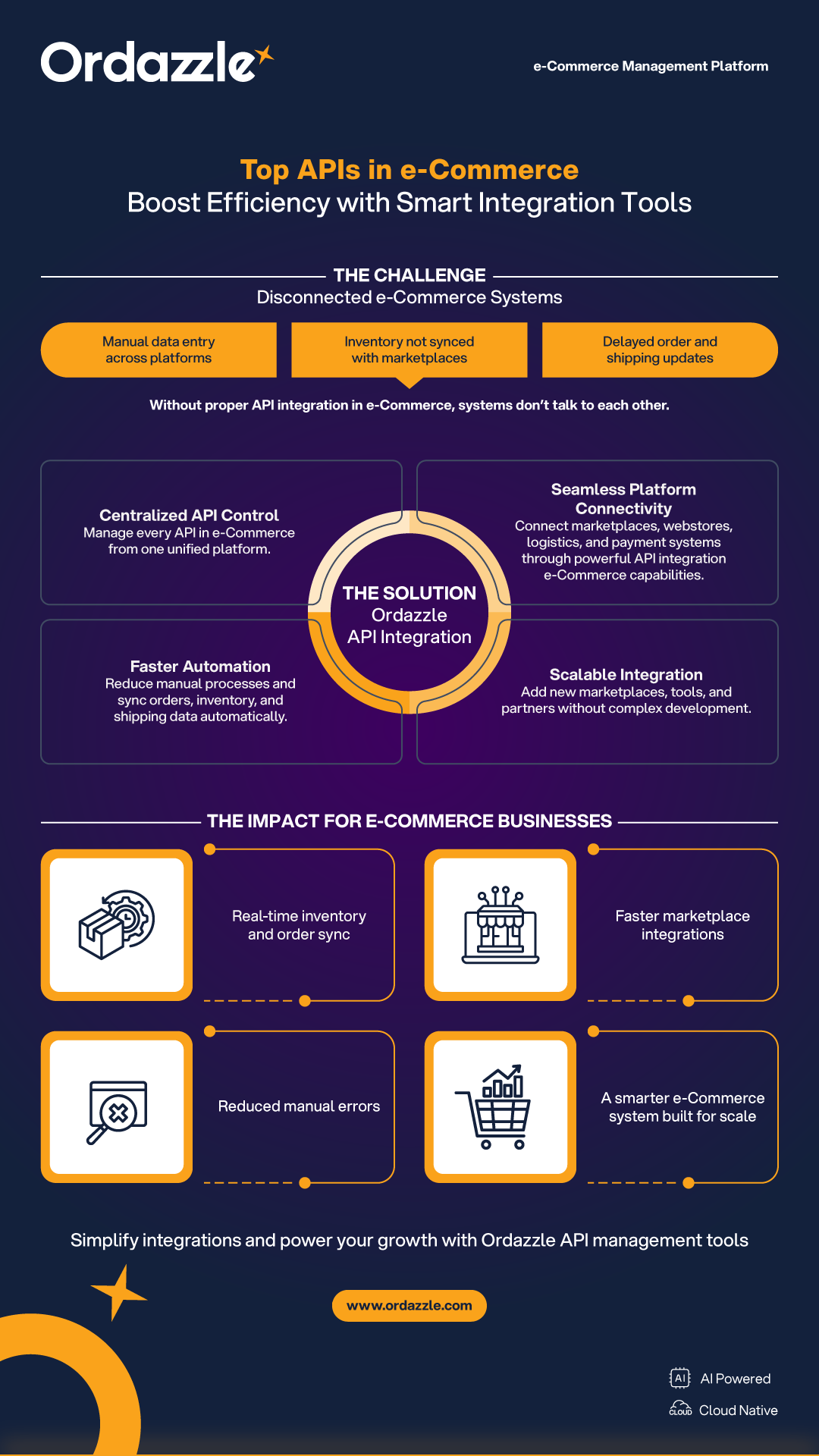
e-Commerce brands today often struggle with fragmented systems spread across marketplaces, warehouses, and payment platforms. This lack of integration leads to inventory mismatches, fulfilment delays, and inconsistent customer experiences. Modern API integration e-Commerce frameworks address these challenges by connecting systems in real time, giving brands better control, visibility, and efficiency across their operations.
What is an API in e-Commerce?
An API in e-Commerce is a set of protocols that allows different software systems, such as marketplaces, payment gateways, warehouse systems, and storefronts, to communicate with each other in real time.
In simple terms, APIs act as connectors that ensure your Shopify store, Amazon listings, warehouse, and logistics partners stay in sync without manual intervention.
Without strong e-Commerce API integration, brands rely on manual processes, spreadsheets, and disconnected tools, which break as order volumes grow.
Why Do Fast-Growing e-Commerce Brands Struggle With API Integration?
Fast-growing e-Commerce brands struggle because they adopt multiple tools quickly without a unified integration strategy. As brands expand across Amazon, Flipkart, Myntra, Shopify, and D2C channels, each system operates in isolation. This creates operational blind spots and inefficiencies.
“e-Commerce brands that rely on disconnected operational systems often struggle with inventory accuracy, fulfilment delays, and limited operational visibility.”
Common challenges include:
- Orders flowing from multiple dashboards
- Inventory not updating across channels in real time
- Delayed or failed API syncs
- Manual reconciliation between systems
- Lack of centralized API management
What Makes API Integration Critical for Modern e-Commerce Operations?
API integration is critical because it directly impacts order accuracy, delivery timelines, and customer satisfaction. In high-volume environments, even small delays in API sync can result in overselling, stockouts, or delayed shipments.
According to a report by McKinsey, companies that leverage advanced digital integrations can improve operational efficiency by up to 30%.
For e-Commerce brands, this translates into:
- Faster order processing
- Accurate inventory visibility
- Seamless marketplace operations
- Better customer experience
What Are the Core Components of an API Management Platform?
An API management platform ensures that integrations are stable, secure, and scalable.
Key components include:
- API gateway to manage traffic and requests
- Authentication and security layers
- Monitoring and analytics
- Rate limiting and throttling
- Developer tools and documentation
Strong API management solutions are essential when dealing with multiple integrations across marketplaces, payment systems, and logistics partners.
Why Do Inventory Mismatches Happen Across Marketplaces?
Inventory mismatches occur when systems are not updated in real time due to weak or delayed API connections. When a product sells on one platform, but inventory is not updated across others instantly, it results in overselling or stock inconsistencies.
Root causes include:
- Batch-based API updates instead of real-time sync
- Multiple inventory sources
- Lack of centralized inventory orchestration
- Poor API reliability
Operational Scenario
Scenario: A D2C Brand Managing Orders Across Three Marketplaces
The brand sells on Amazon, Shopify, and Flipkart. Orders come in from different dashboards. Inventory is tracked manually. Warehouse teams rely on delayed updates.
As order volume increases:
- Orders are missed
- Inventory becomes inaccurate
- Fulfilment delays increase
With a unified e-Commerce API integration layer:
- Orders are consolidated in one system
- Inventory updates in real time
- Fulfilment decisions become faster and more accurate
The 4 Pillars of Scalable e-Commerce API Integration
To scale efficiently, brands need a structured approach to API integration.
1. Unified Order Management
All orders across marketplaces and D2C channels should flow into a single system.
2. Real-Time Inventory Visibility
Inventory must update instantly across all platforms to prevent overselling.
3. Fulfilment Orchestration
Orders should be automatically routed to the right warehouse or fulfilment center.
4. Intelligent Monitoring and Anomaly Detection
Systems should detect failures, delays, or suspicious activities automatically.
Your e-Commerce Operations Are Becoming Unmanageable
- Orders are processed across multiple dashboards
- Inventory mismatches across marketplaces
- Frequent stockouts or overselling
- Manual reconciliation between systems
- Delayed fulfilment and customer complaints
- Lack of visibility into operations
If you relate to more than two of these, your API integration e-Commerce setup likely needs improvement.
How Do Modern e-Commerce API Management Tools Solve These Problems?
Modern API management tools centralize integrations and provide real-time visibility into operations. They help brands:
- Monitor API performance
- Prevent integration failures
- Automate workflows
- Ensure data consistency across systems
Instead of managing multiple point-to-point integrations, brands move toward a unified integration layer.
Where Does Ordazzle Fit Into This Ecosystem?
Modern e-Commerce operations platforms such as Ordazzle act as an intelligent orchestration layer rather than just another tool. Instead of just connecting systems, they enable operational control across the entire commerce lifecycle. With capabilities like:
- Order Management System
- Warehouse Management
- Product Information Management
- Marketplace integrations
- Inventory orchestration
- Fulfilment automation
- AI anomaly detection
- Fraud monitoring
Ordazzle transforms API in e-Commerce from a technical necessity into a strategic advantage.
How Can AI Improve API Integration and Fraud Detection?
AI improves API-driven systems by identifying anomalies and predicting issues before they impact operations. For example:
- Detecting unusual order patterns that may indicate fraud
- Identifying failed API syncs in real time
- Predicting inventory shortages
This is especially valuable in high-growth e-Commerce environments.
How Do You Choose the Best e-Commerce API Integration Solution?
Choosing the best e-Commerce API solution requires evaluating operational needs, not just technical features.
Key criteria:
- Scalability across multiple marketplaces
- Real-time data synchronization
- Strong API management capabilities
- Built-in monitoring and analytics
- Ease of integration with existing systems
- Support for fulfilment and inventory orchestration
- Avoid solutions that only solve one part of the problem. Look for platforms that unify operations.
Key Takeaways
- Strong API integration e-Commerce is essential for scaling modern online stores
- Disconnected systems lead to inventory issues, fulfilment delays, and poor customer experience
- API management platforms ensure stability, security, and performance
- Real-time integration is critical for multi-channel operations
- Platforms like Ordazzle go beyond integration and enable full operational orchestration
Conclusion
In today’s competitive landscape, API in e-Commerce is no longer just a backend technical layer. It is the foundation of scalable, efficient, and intelligent operations.
Brands that invest in strong e-Commerce API integration and API management are better equipped to handle growth, reduce operational chaos, and deliver consistent customer experiences.
Ready to Simplify Your e-Commerce Operations?
See how Ordazzle helps e-Commerce brands unify API integrations, streamline fulfilment, and gain real-time operational visibility.
Book a demo with our experts and take control of your growth.
Common Questions e-Commerce Leaders Ask
What are the common components of an API management platform?
API gateways, security layers, monitoring tools, analytics dashboards, and developer interfaces are core components. These ensure APIs remain stable, secure, and scalable.
Is API management useful for small or startup e-Commerce apps?
Yes. Even early-stage brands benefit from structured API management solutions as they prevent future scaling issues and reduce operational complexity.
How do I choose the right API management solution?
Focus on scalability, real-time capabilities, reliability, and integration depth rather than just pricing or features.
What makes your API solution different?
Unlike traditional tools, platforms like Ordazzle combine API orchestration with operational intelligence, enabling end-to-end visibility and control.