How an e-Commerce API Platform Helps Secure and Scale Third-Party Integrations
An e-Commerce business rarely operates through a single software application. Its technology ecosystem may include an online store, marketplaces, an ERP system, payment gateways, warehouse management software, logistics providers and customer management tools. Each application handles a different part of the business, but they need to exchange information to keep operations running smoothly.
APIs make these connections possible. They allow applications to communicate and exchange data, helping businesses synchronise orders, inventory, product information and other operational details.
However, as the number of integrations grows, managing them individually becomes increasingly difficult. Businesses need visibility into their API connections, control over how information is exchanged and a way to identify issues before they disrupt operations.
An e-Commerce API platform helps address these challenges by providing a centralised environment to publish, manage, monitor and control APIs. It gives businesses a more structured approach to connecting third-party applications while supporting the flexibility needed to expand their technology ecosystem.
Why Third-Party Integrations Become Difficult to Manage
Adding a new application may solve an immediate business requirement, but every additional connection introduces another integration to maintain.
For example, an e-Commerce business may connect its webstore to a payment gateway, its order management system to a logistics provider and its ERP system to inventory management software. Each connection has its own data requirements, dependencies and operational considerations.
Without centralised management, several challenges can emerge.
1. Disconnected Systems Create Data Silos
When applications do not exchange information reliably, teams may end up working with different versions of the same data.
An order may be updated in one system but not reflected in another. Inventory quantities may differ between the warehouse and online store, or product information may need to be updated separately across multiple applications.
These gaps create additional manual work and make it harder for teams to maintain accurate operational information.
2. Limited Visibility Makes Integration Issues Harder to Identify
When integrations are managed separately, identifying the source of a problem can take time.
For instance, an order synchronisation issue could originate from the source application, the API connection or the receiving system. Without a centralised view of integrated services and their performance, IT teams may need to investigate each component independently.
This can delay issue identification and affect business operations.
3. Manual Integration Management Does Not Scale Easily
As businesses expand, they often add new marketplaces, logistics providers, payment services and business applications.
Managing every API connection through separate configurations and processes increases the workload for technology teams. Changes to one integration may also require additional coordination with other applications.
A more structured approach helps businesses manage existing connections while making it easier to introduce new ones.
4. Uncontrolled Data Access Creates Security Concerns
APIs exchange information between applications, which makes access management an important part of integration governance.
Businesses need to understand which applications can connect, what information they can access and how data is exchanged.
Without appropriate access controls and validation practices, integrations may expose information to unintended applications or introduce inaccurate data into business systems.
How an e-Commerce API Platform Improves Integration Management
An e-Commerce integration platform provides a centralised way to manage connections between different applications. Rather than treating every integration as an isolated technical task, businesses can manage APIs through a more coordinated environment.
Here are the capabilities that make this possible.
1. Centralise API Management and Visibility
A centralised API dashboard gives technology teams a consolidated view of their APIs and integrated services.
Instead of navigating different systems to understand the integration landscape, teams can access API information from one place.
This helps them:
- View and manage APIs centrally.
- Access details about individual integrated services.
- Review API configurations and publishing requirements.
- Maintain better visibility into the wider integration environment.
For businesses managing multiple third-party applications, centralisation makes it easier to understand and oversee their API ecosystem.
2. Control API Publishing and Access
Not every API needs to be available to every application. Businesses need a structured approach to deciding which APIs are published and which external applications are permitted to consume them.
API management tools help provide this control through API publishing and access management.
For example, a business may connect its order management system with an external logistics provider. The integration should support the required exchange of shipment information without giving the external application unnecessary access to unrelated business data.
Appropriate access permissions and secure publishing practices help businesses manage these interactions more responsibly.
3. Validate Data Before It Moves Between Systems
An integration is only useful when the information being exchanged is accurate and usable by the receiving application.
Different systems may use different data formats, field structures or validation requirements. If these differences are not addressed, data may be rejected, incorrectly interpreted or recorded inconsistently.
Data validation helps businesses check information as it moves between connected applications.
Consider an order being transferred from an online store to an order management system. If essential order details are missing or incorrectly formatted, the receiving system may not be able to process it as expected.
A structured validation approach helps reduce these data-exchange issues and supports more reliable integration workflows.
4. Monitor API Performance and Identify Bottlenecks
Integrations need ongoing monitoring after they are deployed.
An API connection that worked during implementation may experience issues as transaction volumes change, applications are updated or new services are introduced.
API monitoring helps technology teams review service performance, identify potential bottlenecks and understand whether data is flowing as expected.
A consolidated service dashboard makes this information easier to access and supports faster investigation when integration issues arise.
5. Support Native and Custom APIs
Businesses rarely have identical integration requirements. Some may need standard connections to common applications, while others require custom integrations to support specific operational workflows.
An e-Commerce API platform should provide the flexibility to work with native APIs as well as develop and manage custom ones.
Native APIs can support established integration requirements, while custom APIs provide greater flexibility when businesses need to connect specialised applications or adapt existing workflows.
This combination helps businesses extend their technology ecosystem without relying entirely on one fixed set of integrations.
Which e-Commerce Systems Can Businesses Connect Through APIs?
The applications connected through APIs depend on the business's technology architecture and operational requirements. Common examples include:
| System | What the Integration Supports |
|---|---|
| ERP Systems | Exchange business, product, inventory and order information |
| Marketplaces | Connect marketplace operations with product, inventory and order systems |
| Payment Gateways | Support payment-related data exchange between connected applications |
| Order Management Systems | Synchronise order information and coordinate fulfilment workflows |
| Logistics Providers | Exchange shipping and delivery information |
| Warehouse Management Systems | Connect warehouse operations with wider e-Commerce processes |
| Analytics Tools | Share relevant business data for reporting and analysis |
| Product Management Systems | Exchange product information with other applications |
The objective is not to connect every available application. It is to establish the integrations that support business operations and ensure they can be managed reliably as requirements evolve.
What Should Businesses Look for in API Management Tools?
Choosing an API management solution involves more than checking whether it can connect two applications. Businesses should evaluate how well the platform supports ongoing integration governance and operational visibility.
Some important capabilities to consider include:
Centralised API Dashboard: A consolidated view of APIs and integrated services helps teams manage connections without relying on disconnected interfaces.
API Publishing and Management: The ability to create, edit, publish and manage APIs according to business requirements.
Access Control: Tools to manage which applications can access and consume APIs, with permissions aligned to business requirements.
Data Validation: Capabilities that help maintain accurate information during exchanges between connected applications.
API Monitoring: Visibility into service performance, data flow and potential integration bottlenecks.
Native and Custom API Support: Flexibility to use existing APIs or develop custom integrations for specific business needs.
Scalability: An architecture that can support additional applications and integration requirements as the business expands.
Businesses should also evaluate security requirements such as authentication, encryption, rate limiting, audit logging and compliance support. These capabilities should be assessed against the organisation's technical and regulatory requirements rather than assumed to be included in every API management platform.
How Ordazzle Supports e-Commerce API Integration Management
As e-Commerce operations expand, businesses need a structured way to manage the APIs connecting their internal systems and external applications.
Ordazzle's API Management solution provides a centralised environment for managing, publishing and monitoring APIs through its cloud-native platform.
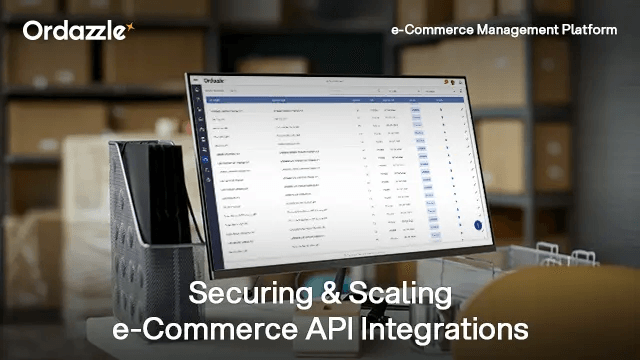
Its API Dashboard allows teams to view and manage APIs from a consolidated interface, while Service Details provides visibility into individual integrated services.
Through API Lists, businesses can edit, manage and publish APIs according to their requirements. The platform also supports Client Apps, allowing external trusted applications to connect and consume APIs.
Ordazzle supports centralised API call management, secure publishing and data validation to help coordinate communication and data exchange across connected systems.
Its API monitoring capabilities help teams review service performance, identify potential bottlenecks and maintain visibility into data flow. Businesses can also use native APIs or develop custom ones to support their integration requirements.
These capabilities help e-Commerce businesses manage their API ecosystem with greater visibility and control as their connected applications grow.
Explore Ordazzle's e-Commerce API Integration Management solution to learn more about its API management capabilities.
Common Questions e-Commerce Leaders Ask
What is an e-Commerce API platform?
An e-Commerce API platform helps businesses connect and manage the applications that support their online operations. It provides tools to publish, manage and monitor APIs, allowing different systems to exchange information and support connected workflows.
What is the difference between API integration and API management?
API integration refers to connecting applications so they can exchange data and functionality. API management covers the broader process of publishing, managing, monitoring and controlling those APIs throughout their lifecycle.
How do API management tools improve e-Commerce security?
API management tools can support security through centralised control, access permissions, secure API publishing and data validation. Businesses should also evaluate specific security controls such as authentication, encryption and audit logging when choosing a platform.
Which third-party applications can connect through an e-Commerce API?
Depending on the available APIs and integration requirements, businesses can connect applications such as ERP systems, marketplaces, payment gateways, logistics providers, warehouse management systems and analytics tools.
Why is API monitoring important for e-Commerce businesses?
API monitoring helps businesses review service performance, identify integration bottlenecks and understand whether information is flowing correctly between applications. This makes it easier for technology teams to investigate issues that could affect orders, inventory or other business processes.
What is the difference between native APIs and custom APIs?
Native APIs are provided as part of an existing platform or application and support established integration requirements. Custom APIs are developed or adapted to support specific business processes, data structures or application requirements.