How Centralized e-Commerce Inventory Management Simplifies Operations

Why Inventory Complexity Increases Faster Than e-Commerce Growth
As e-Commerce businesses scale, inventory operations become significantly harder to manage manually.
What starts as inventory tracking across one warehouse and one sales channel quickly evolves into managing stock across marketplaces, warehouses, stores, and fulfilment partners simultaneously.
Many retailers still rely on spreadsheets, disconnected ERP systems, or marketplace dashboards to track stock. This creates delays in inventory updates and increases the risk of overselling, stockouts, and fulfilment inefficiencies.
Without centralized inventory control management, operational complexity grows faster than the business itself.
What Causes Inventory Mismatches in e-Commerce Inventory Management?
Inventory mismatches occur when stock updates are delayed or inconsistent across sales channels and fulfilment systems.
This usually happens because inventory data exists in multiple disconnected platforms with no centralized synchronization.
Common causes include:
- Manual stock updates across marketplaces
- Separate inventory systems for online and offline sales
- Delayed warehouse synchronization
- Lack of real-time stock visibility
- High order volumes during promotions or festive periods
For fast-growing brands, even small inventory inaccuracies can create operational disruptions at scale.
How Does Centralized Inventory Management Improve e-Commerce Operations?
Centralized inventory management for e-Commerce creates a single source of truth for inventory visibility across all channels and fulfilment locations.
Instead of managing inventory separately across marketplaces, warehouses, and stores, businesses can monitor stock movement centrally in real time.
Key operational improvements include:
- Accurate stock visibility across channels
- Reduced overselling and stockouts
- Faster fulfilment decisions
- Better demand forecasting
- Improved warehouse coordination
This allows operations teams to make faster and more reliable inventory decisions.
What Happens When e-Commerce Inventory Management Systems Are Disconnected?
Disconnected inventory systems create operational blind spots that impact both revenue and customer experience.
Common operational challenges:
- Inventory discrepancies across marketplaces
- Delayed stock synchronization
- Cancelled orders due to overselling
- Poor visibility into warehouse inventory
- Manual reconciliation between systems
Checklist: Signs Your Inventory Operations Are Becoming Unmanageable
- Inventory is tracked across multiple spreadsheets
- Marketplace stock frequently goes out of sync
- Teams manually reconcile stock data daily
- Customer complaints about unavailable products are increasing
- Stockouts occur despite inventory being available elsewhere
“Brands operating without unified inventory visibility often spend more time correcting stock errors than optimizing fulfilment efficiency.”
Why Is Real-Time Inventory Visibility Critical for Multi-Channel Retail?
Real-time inventory visibility is essential because customers now shop across multiple channels simultaneously.
A product may be sold through:
- Amazon
- Shopify
- Flipkart
- Physical retail stores
- Social commerce channels
According to IHL Group, retailers worldwide lose billions annually due to inventory distortion caused by overstocks, out-of-stocks, and inaccurate inventory visibility.
Without centralized e-commerce inventory management, inventory availability becomes inconsistent across platforms.
Real-time synchronization ensures inventory updates happen instantly after every sale, return, or warehouse transfer.
This improves:
- Customer trust
- Marketplace compliance
- Fulfilment accuracy
- Operational responsiveness
The 4 Pillars of Scalable Inventory Control Management
1. Centralized Inventory Visibility
All inventory data should flow into one unified system across warehouses, marketplaces, and stores.
2. Real-Time Synchronization
Inventory updates must reflect instantly across all sales channels to prevent overselling.
3. Intelligent Inventory Allocation
Orders should be routed based on stock availability, warehouse proximity, and fulfilment efficiency.
4. Inventory Forecasting and Analytics
Retailers need inventory insights to improve replenishment planning and reduce dead stock.
These pillars help businesses build scalable and resilient inventory operations.
Operational Scenario: A Retail Brand Managing Inventory Across Multiple Channels
A fashion retailer initially sells through Shopify using a single warehouse. As the business grows, it expands to Amazon, Flipkart, retail stores, and regional marketplaces.
Inventory is managed separately across each channel, and warehouse updates are delayed during peak sales periods.
This creates:
- Duplicate stock allocation
- Overselling during promotions
- Delayed fulfilment decisions
- Poor visibility into available inventory
With centralized inventory management software for e-Commerce, inventory across all channels syncs in real time, allowing the operations team to manage stock centrally and reduce fulfilment disruptions.
How Does Inventory Management Software for e-Commerce Support Business Growth?
Modern e-Commerce inventory software helps businesses scale operations without increasing operational chaos.
Key benefits include:
- Automated stock synchronization
- Multi-warehouse inventory visibility
- Faster inventory reconciliation
- Better stock forecasting
- Reduced manual operations
This becomes especially important for retailers expanding across India, Southeast Asia, and APAC regions where fulfilment networks are increasingly distributed.
According to McKinsey & Company, retailers with better supply chain visibility and inventory transparency are more resilient during demand fluctuations and operational disruptions.
Where Does Ordazzle Fit Into Centralized Inventory Management?
Modern commerce operations platforms such as Ordazzle Inventory Management System help retailers centralize inventory visibility across marketplaces, warehouses, and fulfilment channels.
Instead of managing disconnected stock systems, brands can unify:
- Inventory tracking
- Warehouse visibility
- Marketplace synchronization
- Order allocation
- Stock movement monitoring
This creates a more reliable operational foundation for scaling retail and e-Commerce operations.
What Challenges Can Occur During Inventory Management System Implementation?
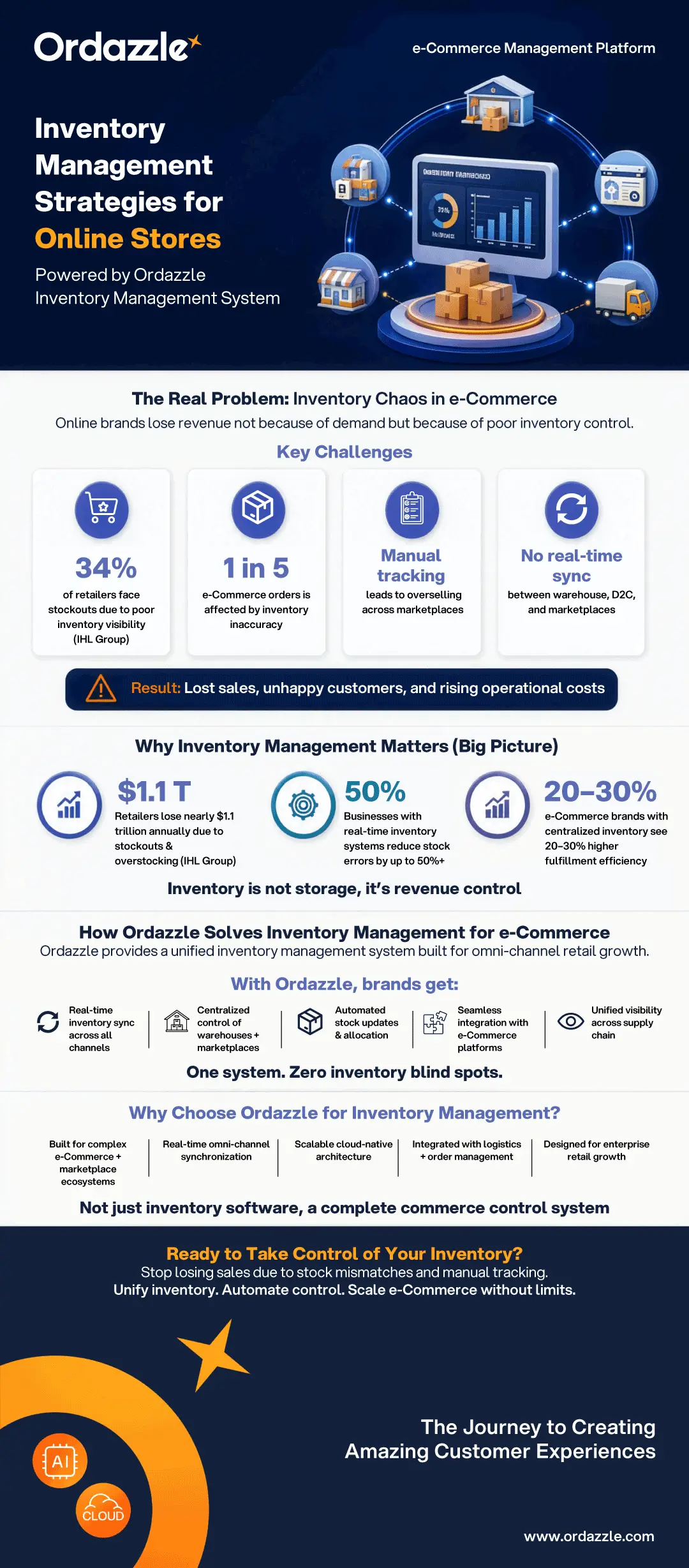
Implementing centralized inventory control management requires operational alignment across systems and teams.
Common implementation challenges:
- Inaccurate historical inventory data
- Integration complexity with ERP and marketplaces
- Lack of standardized SKU structures
- Delayed warehouse synchronization processes
- Team adaptation to new workflows
Businesses that clean and standardize inventory data before implementation often experience faster onboarding and more accurate results.
Why Unified Inventory Visibility Is Becoming a Competitive Advantage
Inventory visibility is no longer just an operational requirement. It has become a competitive advantage for modern retailers.
Brands that maintain accurate and centralized inventory management are better positioned to:
- Fulfil orders faster
- Improve customer trust
- Reduce operational inefficiencies
- Scale across multiple channels confidently
As retail ecosystems become increasingly connected, centralized inventory systems will play a critical role in operational scalability and customer experience.
See how Ordazzle Inventory Management System helps retailers simplify inventory operations, improve stock visibility, and scale efficiently across marketplaces and fulfilment networks. Let’s connect with the team!
Common Questions e-Commerce Leaders Ask
What is inventory management software used for?
Inventory management software is used to track, manage, and synchronize stock across warehouses, marketplaces, and sales channels. It helps businesses maintain accurate inventory visibility, reduce stock discrepancies, and streamline fulfilment operations.
What is the difference between inventory control and inventory management?
Inventory control focuses on maintaining accurate stock levels and preventing overstocking or stock shortages within a warehouse. Inventory management is broader and includes inventory planning, tracking, forecasting, replenishment, and multi-channel stock visibility.
What is multi-channel inventory management?
Multi-channel inventory management is the process of managing inventory across multiple sales channels, such as marketplaces, websites, retail stores, and social commerce platforms from a centralized system. It helps ensure real-time stock synchronization and consistent inventory visibility everywhere products are sold.
How does inventory management work in e-Commerce?
In e-Commerce, inventory management tracks stock movement across warehouses and sales channels while automatically updating inventory levels after every sale, return, or transfer. This helps businesses prevent overselling, improve fulfilment accuracy, and maintain real-time inventory visibility.