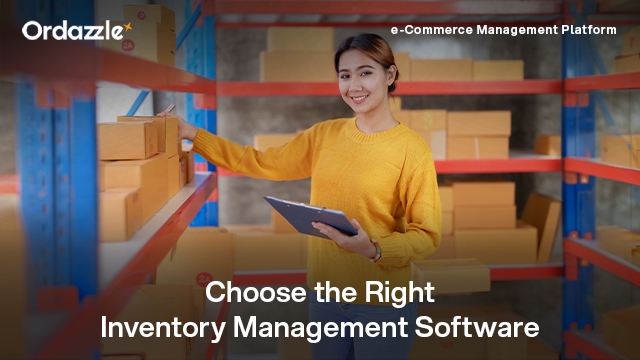
How to Choose the Right e-commerce inventory management software for Your Business
Quick Summary
- Poor inventory visibility leads to stockouts, overselling, delayed fulfilment, and lost revenue.
- As businesses expand across websites, marketplaces, and physical stores, manual inventory management becomes increasingly difficult.
- The right e-commerce inventory management software provides real-time inventory visibility, automates stock updates, and simplifies inventory control across every sales channel.
- Modern platforms like Ordazzle help retailers build scalable inventory operations that support sustainable growth.
Why Inventory Management Has Become a Growth Challenge
Inventory is one of the most valuable assets in any retail or e-Commerce business—but it's also one of the most difficult to manage.
As businesses grow across Shopify, Amazon, Flipkart, Lazada, Shopee, TikTok Shop, and physical stores, inventory data changes every second. Every sale, return, cancellation, warehouse transfer, and purchase order affects stock availability.
Without reliable e-Commerce inventory management software, businesses often rely on spreadsheets or disconnected systems that struggle to keep pace with real-time operations. The result is inventory inaccuracies, delayed fulfilment, higher operational costs, and disappointed customers.
Choosing the right inventory management software for e-Commerce is therefore not just an IT decision—it's a strategic investment that enables scalable growth.
Expert Insight: Inventory accuracy is no longer just a warehouse metric. It directly influences customer experience, operational efficiency, and profitability.
What Is e-Commerce Inventory Management Software?
e-Commerce inventory management software is a centralised platform that tracks, updates, and manages inventory across online stores, marketplaces, warehouses, and fulfilment locations in real time.
It synchronises stock levels automatically, provides visibility into inventory movement, supports replenishment planning, and helps businesses prevent stockouts and overselling.
Unlike basic stock tracking tools, a modern inventory management system for e-Commerce integrates inventory with orders, fulfilment, procurement, and analytics to create a unified operational view.
Why Is e-Commerce Inventory Management Software Important?
Inventory management software is important because it ensures businesses always know what inventory is available, where it is located, and how quickly it is moving.
Without accurate inventory visibility, retailers face operational challenges such as:
- Overselling during promotions
- Stockouts of high-demand products
- Excess inventory carrying costs
- Delayed order fulfilment
- Manual stock reconciliation
- Poor demand forecasting
According to IHL Group, inventory distortion—including stockouts and overstocks—costs retailers globally more than US$1.7 trillion annually, highlighting the financial impact of inaccurate inventory management.
What Should You Look for in e-Commerce Inventory Management Software?
Not every inventory solution is designed for growing e-Commerce businesses.
The best platforms support both current operations and future expansion.
1. Real-Time Inventory Visibility
Inventory should update instantly whenever stock is sold, returned, transferred, or received.
Real-time visibility prevents inventory discrepancies across marketplaces and improves fulfilment decisions.
2. Multi-Channel Inventory Synchronisation
As brands expand across multiple sales channels, inventory must remain synchronised everywhere.
Look for software that automatically updates stock across marketplaces, webstores, warehouses, and retail outlets.
3. Automated Inventory Allocation
Smart inventory allocation ensures the right stock is reserved for the right order while reducing manual intervention.
4. Demand Forecasting and Inventory Planning
Historical sales trends and demand forecasting help businesses maintain optimal stock levels while reducing excess inventory.
5. Integration Capabilities
Your inventory software should integrate seamlessly with:
- ERP systems
- Order management platforms
- Warehouse management systems
- Shipping providers
- Marketplaces
- Accounting software
Operational Framework: The Five Pillars of Scalable Inventory Management
Successful retailers build inventory operations around five core capabilities.
1. Centralised Inventory Visibility
One accurate inventory view across every sales channel.
2. Automated Stock Synchronisation
Instant updates that eliminate manual reconciliation.
3. Intelligent Inventory Allocation
Automatically reserve stock based on fulfilment priorities.
4. Predictive Inventory Planning
Use historical sales and demand patterns to optimise replenishment.
5. Operational Analytics
Monitor inventory turnover, ageing stock, and replenishment performance through real-time dashboards.
Operational Scenario
Scenario: A Lifestyle Brand Expanding Across APAC
A retailer sells through Shopify, Amazon, Lazada, and Shopee while fulfilling orders from two warehouses.
Initially, inventory is managed through spreadsheets. As order volumes increase, stock updates lag across channels. Products sell out on one marketplace but continue appearing as available on another, leading to overselling and cancelled orders.
After implementing a unified inventory platform like Ordazzle, inventory updates occur in real time across every connected channel. Warehouse teams work from a single inventory view, replenishment decisions become more accurate, and customer orders are fulfilled without unnecessary delays.
Checklist: Signs You've Outgrown Your Current Inventory Process
If several of these challenges sound familiar, it may be time to upgrade your inventory management software.
- Inventory is managed using spreadsheets
- Stock discrepancies occur frequently
- Overselling happens during promotions
- Multiple teams maintain separate inventory records
- Replenishment decisions rely on guesswork
- Warehouse teams spend hours reconciling stock
- Inventory reports require manual consolidation
- Stockouts are increasing despite holding excess inventory
How Ordazzle Helps Modern Retailers Manage Inventory
As businesses scale, inventory management becomes increasingly interconnected with order processing, fulfilment, and warehouse operations.
Modern unified commerce platforms such as Ordazzle help retailers centralise inventory visibility, automate stock synchronisation, and connect inventory operations across marketplaces, online stores, warehouses, and logistics partners.
Rather than operating as a standalone inventory tool, Ordazzle enables businesses to manage inventory as part of a connected operational ecosystem—improving accuracy, reducing manual effort, and supporting long-term growth.
Key Takeaways
Accurate inventory visibility is essential for scalable e-Commerce operations.
The best e-Commerce inventory management software combines inventory, orders, fulfilment, and analytics into one unified platform.
Real-time synchronisation reduces overselling and improves customer satisfaction.
Integration with marketplaces, ERP systems, and warehouses enables operational efficiency.
Choosing scalable inventory management software for e-Commerce prepares your business for future growth rather than simply solving today's inventory challenges.
Conclusion
As digital commerce grows more complex, inventory management can no longer rely on disconnected systems or manual processes. Investing in the right e-Commerce inventory management software gives retailers the visibility, automation, and control needed to maintain accurate inventory, improve fulfilment performance, and deliver better customer experiences.
For businesses planning to expand across multiple sales channels, selecting a scalable inventory management system for e-Commerce today can help avoid costly operational challenges tomorrow.
Common Questions e-Commerce Leaders Ask
What should I look for in e-Commerce inventory management software?
Look for real-time inventory visibility, multi-channel synchronisation, automation, demand forecasting, integration capabilities, analytics, and the ability to scale as your business grows.
Can e-Commerce inventory management software support multiple sales channels?
Yes. Modern inventory platforms synchronise stock across websites, marketplaces, retail stores, and warehouses, helping maintain consistent inventory availability across every channel.
Is cloud-based inventory management software better than on-premise solutions?
Cloud-based solutions typically offer faster deployment, easier scalability, automatic updates, remote accessibility, and seamless integrations, making them well suited for growing e-Commerce businesses.
How does inventory management software improve profitability?
By reducing stockouts, preventing overstocking, improving inventory turnover, minimising manual work, and enabling better purchasing decisions, inventory software helps lower operational costs and maximise revenue.