5 Common Inventory Challenges Businesses Face and How an eCommerce Management Platform Can Solve Them
By now, every eCommerce company knows that efficient inventory management can be the difference between success and failure.
However, it’s not easy to build all accounting, stock, and monitoring processes into a well-coordinated and clear mechanism.
There are a lot of moving parts in inventory management, with many challenges and variables associated with each part.
As businesses grow across multiple ecommerce platforms, ecommerce websites, e commerce sites, and online shopping platforms, managing inventory manually becomes increasingly complex.
In this blog post, we will explore the main inventory management challenges faced by warehouse managers in their daily routines and understand how an ecommerce management platform can help address these issues.
5 inventory management challenges businesses face
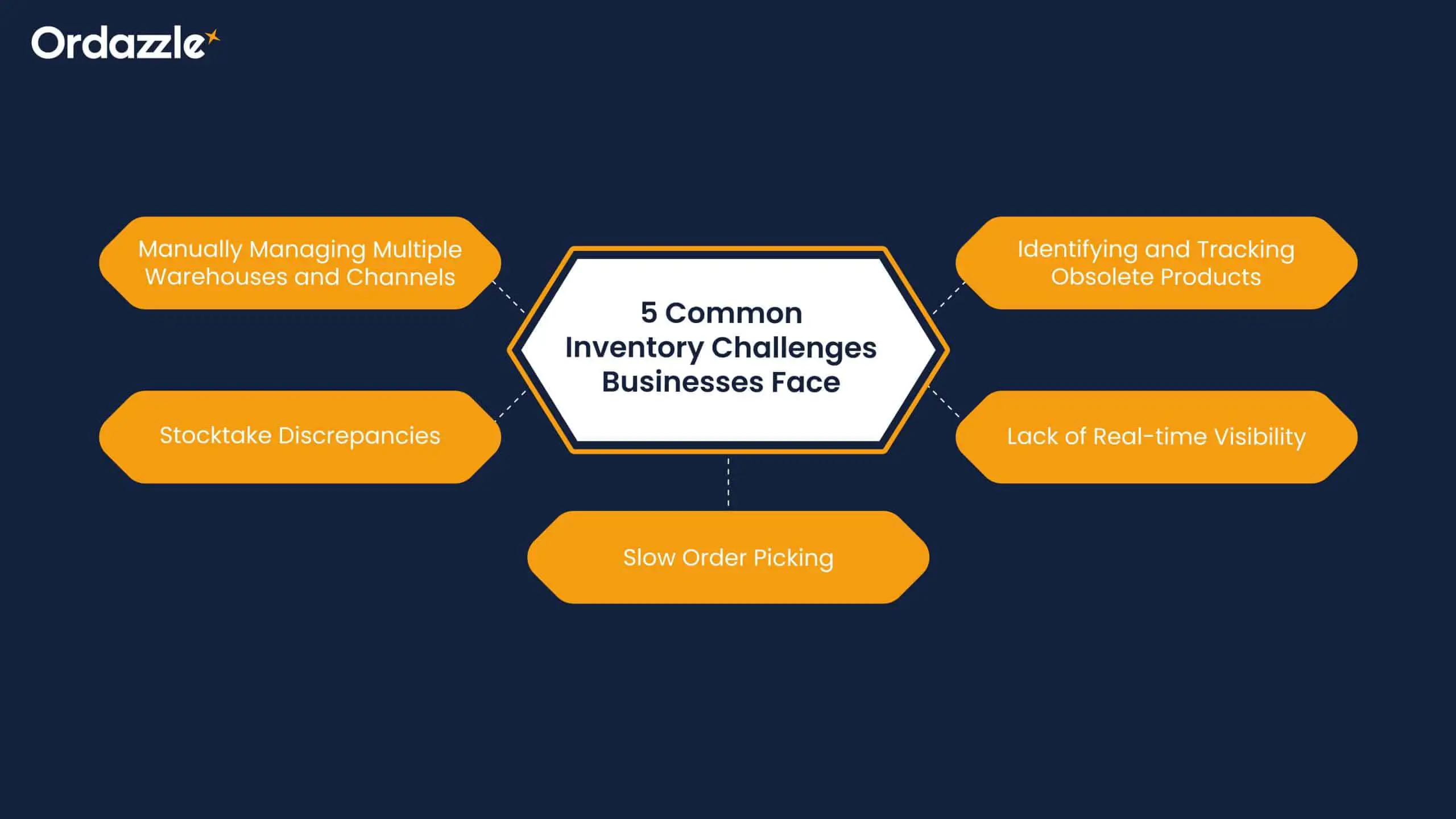
1. Manually Managing Multiple Warehouses and eCommerce Platforms
During the initial stages of your business, it’s common to have only your website and a single warehouse to store your stock. Pen-and-paper spreadsheets might suffice to keep tabs on your inventory, the movement of products, and everything else.
But as your products pick up momentum, they will also grow in demand. As time passes, demand will also arise from different geographies. As a result, you would require more warehouses to store your inventory and more channels to sell through.
As your business expands across multiple ecommerce platforms, ecommerce websites, and online shopping platforms, spreadsheets won’t be able to keep up with the increasing complexity.
In fact, any manual method to keep track of inventory will become extremely tedious, cause confusion, and lack clarity. The outcome? Supply chains go haywire, sales drop, and so does customer satisfaction.
That’s why it’s important to put your inventory tracking on autopilot as you scale. An Warehouse management platform like Ordazzle can consolidate your inventory and warehouse information into one single source of truth, allowing you to stay on top of your stock, prevent understocking and overstocking, and ensure supply and demand are always balanced.
2. Identifying and Tracking Obsolete Products
It’s possible that while some of your products sell like wildfire, some are forgotten and left abandoned on corner shelves at warehouses. This might be due to them being overshadowed by your other products and a general lack of demand.
But their need might still arise. And many times, in such cases, inventory managers may order new products, leaving the old stock unused and resulting in a loss.
Businesses operating across multiple ecommerce sites need accurate inventory information to identify slow-moving and obsolete products before they become a major cost.
With sophisticated stock control systems and ecommerce inventory management software, like Ordazzle, you can effectively identify dead inventory and use it when required. Stock rotation and expiry management methods like FIFO and FEFO ensure that older inventory is used before newer stock. This prevents the accumulation of stockpiles.
3. Stocktake Discrepancies
When goods and shipments are incorrectly placed or packed in a warehouse, that leads to a stocktake discrepancy. Due to this, goods may be mixed with other items, scattered in the wrong places, or incorrectly labeled.
The result? Errors in product accounting, problems in order shipment, and customer dissatisfaction.
To prevent this problem, you need a proper, effective, and preferably automated system of goods accounting and control.
For businesses selling through leading ecommerce platforms, maintaining accurate stock information is essential to avoid overselling, incorrect orders, and fulfilment delays.
Ordazzle allows you to track goods by barcode, optimise accounting and selection processes, and accurately receive timely information about goods availability.
All in all, having an ecommerce management platform provides an organized storage system for your goods in your warehouse. This allows your employees to find and select goods easily, reducing search time and minimising errors.
Also Read: 5 Tips For Accurate Inventory Control Management For eCommerce Businesses
4. Lack of Real-Time Inventory Visibility
As mentioned earlier, spreadsheets quickly become impractical as you scale. The reason is that as your product grows more popular, your brand recognition also increases.
Now, there’s a reputation at stake, and you can maintain and improve it only by providing the best service and customer satisfaction.
That means on-time deliveries, reliable returns, and delivery tracking. For that, you need to know where all your orders are as they move through the supply chain.
Not doing so opens you up to shipping delays, extra costs, and a mismatch in inventory balance.
An ecommerce management platform provides businesses with better visibility across inventory, orders, warehouses, and e commerce websites, helping teams identify delays or issues quickly and minimize disruptions in supply chain processes.
5. Slow Order Picking and Fulfilment
A lag in your order-picking processes essentially means delayed deliveries, missed business opportunities, and, ultimately, dissatisfied customers.
You need to optimise your order-picking operations to address these issues.
For businesses operating an ecommerce platform or multiple online shopping channels, faster order picking and fulfilment can improve customer satisfaction and support business growth.
Ordazzle’s eCommerce order management capabilities make it possible to implement batch-picking and zone-picking strategies, thereby expediting order picking. Leveraging Ordazzle’s modern, automated processes further simplifies other processes associated with order management.
The right inventory management starts with Ordazzle’s e-Commerce management system
By addressing the key challenges associated with inventory management and accounting through automated systems, e-Commerce order management, and improved inventory and visibility, businesses can overcome the obstacles and achieve reproducible efficiency in inventory management.
Improve profitability and customer satisfaction with a streamlined inventory mechanism, made possible by Ordazzle’s next-gen capabilities, which are designed with efficiency, interoperability, and convenience in mind.
Get yourself the competitive edge today. Connect us to take charge of your inventory management with our cutting-edge e-Commerce management systems.
Common Questions Businesses Ask About Inventory Management
How can businesses prevent inventory discrepancies across multiple warehouses and sales channels?
Businesses can prevent inventory discrepancies by using centralized inventory management that synchronizes stock levels across warehouses, marketplaces, ecommerce websites, and other sales channels in real time. This reduces manual updates, overselling, and stock inaccuracies.
How does inventory management software help reduce dead stock and overstocking?
Inventory management software helps businesses monitor stock movement, identify slow-moving products, and use inventory rotation methods such as FIFO and FEFO. This helps reduce dead stock, avoid unnecessary purchases, and maintain healthier inventory levels.
How can businesses improve order picking and fulfilment efficiency?
Businesses can improve order picking and fulfilment by automating warehouse processes and using strategies such as batch picking and zone picking. These approaches reduce picking time, minimize errors, and help businesses process and ship orders faster.