Minimum Order Quantity (MOQ): Formula, Calculation & e-Commerce Management Platform Guide

The right inventory strategy is essential for running a successful e-Commerce business. Businesses need to maintain enough stock to fulfil customer demand while avoiding excess inventory that can increase storage costs and tie up working capital.
When purchasing products from suppliers, one important factor businesses need to consider is Minimum Order Quantity (MOQ). Suppliers often set an MOQ to define the minimum quantity or order value a buyer must purchase in a single transaction.
Understanding MOQ helps e-Commerce businesses make better purchasing decisions, manage inventory levels, and avoid unnecessary stock accumulation. Businesses can also use enterprise e-commerce management software to improve visibility into customer orders, inventory levels, and purchasing requirements, making it easier to plan replenishment.
But what exactly is MOQ, how is it calculated, and why do suppliers set minimum order requirements? Understanding can help businesses determine suitable order quantities while balancing customer demand, inventory costs, and supplier requirements.
In this guide, we will explain the meaning of Minimum Order Quantity, explore walk through an example of MOQ calculation, and discuss the key factors businesses should consider when setting or managing MOQ.
What Is Minimum Order Quantity (MOQ)?
Minimum Order Quantity (MOQ) refers to the minimum number of units or minimum monetary value that a supplier requires a buyer to purchase in a single order.
For example, a supplier may set an MOQ of 5,000 units for a particular product. This means the buyer must purchase at least 5,000 units in one order to meet the supplier's minimum purchasing requirement.
Some suppliers may instead define MOQ based on order value. For example, a supplier could require every purchase order to have a minimum value of ₹1 lakh.
Suppliers typically establish MOQ requirements to ensure that production, procurement, packaging, and distribution costs are commercially viable. The minimum quantity allows suppliers to cover their operating costs while maintaining profitable production and fulfilment processes.
Examples of Minimum Order Quantity
Consider a manufacturer that sets an MOQ of 5,000 units for a particular product. An e-Commerce business purchasing that product would need to order at least 5,000 units at a time.
Similarly, a wholesale supplier may require retailers to purchase a minimum of 1,000 units or place an order worth at least $1,000.
For e-Commerce businesses, understanding these requirements is important because ordering below the supplier's MOQ may not be possible, while ordering significantly more than the required quantity can increase storage costs and the risk of excess or unsold inventory.
Businesses can use to gain better visibility into order volumes, inventory availability, and fulfilment requirements. This information can support more informed purchasing decisions when working with suppliers that have MOQ requirements.
Understanding MOQ is only the first step. The next important question is how businesses can determine the appropriate minimum quantity for an order.
How to Calculate Minimum Order Quantity
MOQ calculation helps businesses understand the minimum quantity they need to purchase while considering supplier requirements and their own inventory needs.
A simple way to determine the required purchase quantity is:
Minimum Order Quantity = Minimum Number of Units Required by the Supplier
For example, if a supplier specifies an MOQ of 5,000 units, the buyer must purchase at least 5,000 units in a single order.
However, businesses should also consider factors such as product demand, inventory holding costs, available storage space, supplier pricing, and the risk of excess inventory before placing an order.
MOQ Calculation Example
Suppose an e-Commerce business sells a product that has an average monthly demand of 2,000 units. Its supplier requires a minimum order of 5,000 units.
In this case:
Supplier MOQ = 5,000 units
The business must therefore purchase at least 5,000 units per order, even though its expected monthly demand is only 2,000 units.
This means the business needs to evaluate whether it has sufficient storage capacity and whether the expected sales justify purchasing the required quantity.
Using an centralized e-commerce management platform businesses can monitor customer demand, inventory levels, and order activity to make better-informed purchasing and replenishment decisions.
Also Read: 4 ways to streamline your e-Commerce operations with a logistics management software
How to calculate MOQ: minimum order quantity formula
The process of calculating MOQ varies in complexity based on the industry and the product. It will not be static.
As raw materials and parts change prices down the supply chain, manufacturers or suppliers may need to alter the MOQs and prices to stay competitive, particularly if they are operating on low margins.
e-Commerce platforms like inventory or order management software can help you keep track of the dynamic nature of MOQs and ensure precise calculations.
Software that is directly integrated with an ERP (enterprise resource planning) platform can also be useful, as it brings together data from various functions of your business into one single platform e-commerce operations management software
For instance, e-Commerce solutions like supply chain management software can be integrated with finance management software so that suppliers have accurate, up-to-date information on component parts and raw materials to calculate accurate MOQs.
As for the minimum order quantity formula, there’s no set formula. But here are some standard considerations to keep in mind when making MOQ calculations.
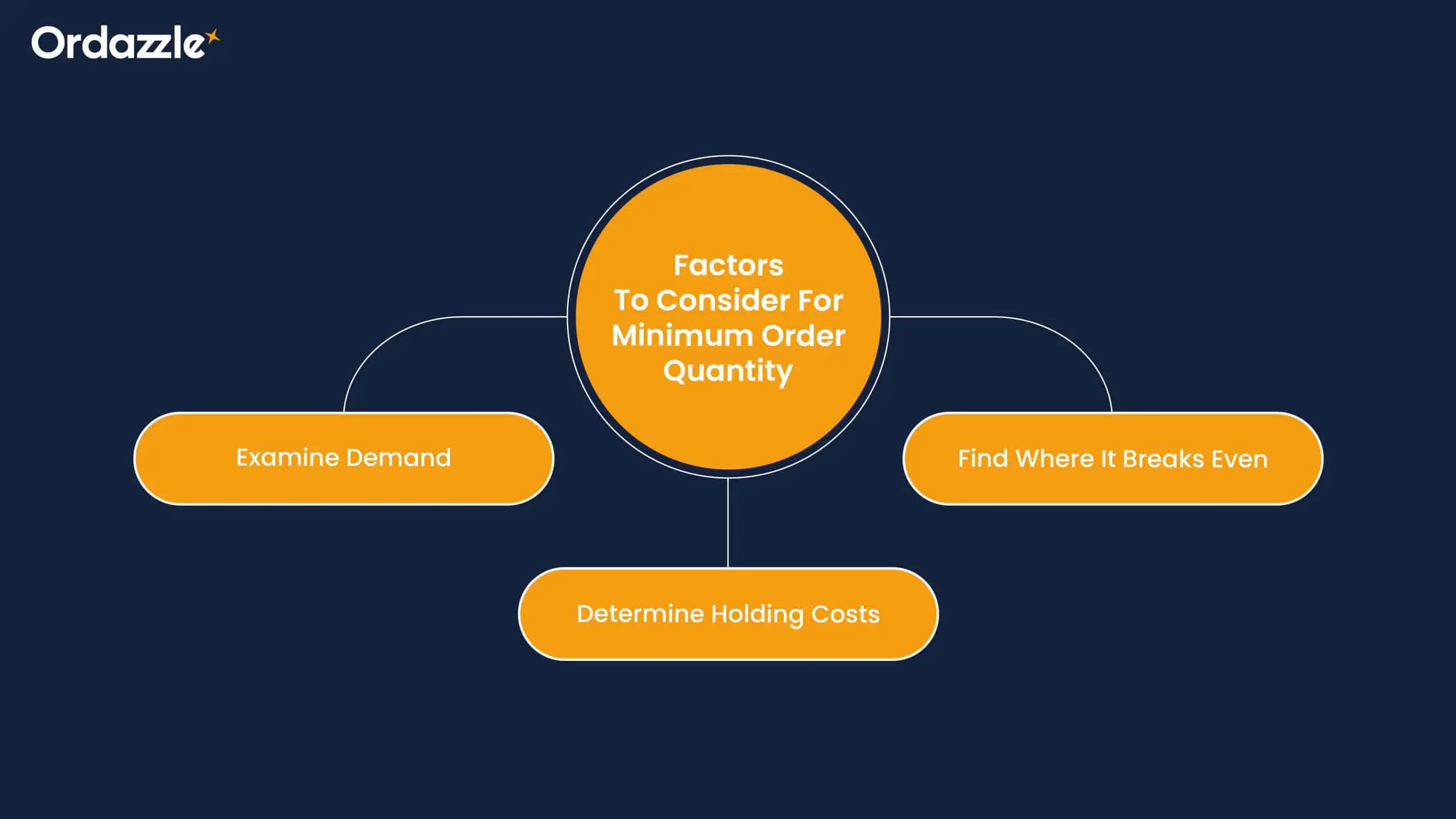
1. Examine Demand
Consider the historical data and based on it, forecast demand. If you are receiving orders of around 500 units and you make the MOQ 2000, it might not be feasible. Other considerations include seasonality and lead times (how long it takes to produce an order).
2. Determine Holding Costs
How much cost is the supplier bearing to store products? This varies from item to item. For instance, some products may have odd shapes or need to be stored in a cool or hot environment. This makes inventory management difficult. Also, holding such inventory for long is never ideal. And these costs need to be accounted for in your MOQs.
3. Find Where It Breaks Even
If a supplier wants to sell 100 units at a fair market price, would they turn a profit? How about 1000? Overhead costs like setup charges, labour, and other delivery-related costs need to be accounted for. Eventually, they will find the break-even point, which is essential to calculating MOQ.
Why is minimum order quantity important?
MOQ is essential for both the supplier and the buyer who purchases inventory from the supplier. Suppliers set MOQs after considering not only the cost of the products but also the expenses incurred while sourcing them. Setting an MOQ helps suppliers improve their profits and also ensures that their inventory sells off quickly.
On the other hand, MOQs allow the buyers to get the best price possible for each unit, because products are purchased in bulk. Doing so lowers the per-unit cost, allowing the retailer to maximise their profits, too.
Final words
Buyers may be tempted to lower the MOQs, while suppliers may look to increase them. On one hand, low MOQs may force suppliers to produce low-quality products so that they can continue to turn in profits.
High MOQs, on the other hand, reduce the profit-making ability of the buyer and also cause inventory-related issues like overstocking and dead stocks.
If you’re facing issues related to the minimum order quantity, Ordazzle’s inventory and order management software can help you optimise your inventory and warehousing efforts effortlessly.
Along with MOQs, our e-Commerce solution also helps you figure out the inventory turnover rate to ensure optimum levels of inventory and no wastage of money, space, or any associated resources.
Get in touch today and take charge of your inventory effectively.