Best Order Management Software for e-Commerce
As e-Commerce grows more complex, one thing is clear: order management is no longer a back-office function. It sits at the center of customer experience, delivery speed, and revenue. Brands today sell across marketplaces, D2C websites, social commerce, B2B portals, and even physical stores. Managing this volume and variety of orders with basic tools simply doesn’t work anymore.
This is where a modern e-Commerce order management system becomes critical.
The best order management software for e-Commerce doesn’t just track orders. It orchestrates how every order is received, processed, fulfilled, and returned across channels. When done right, it becomes a growth engine rather than an operational bottleneck.
Why E-Commerce Order Management (OMS) is a Business Growth Engine
From a customer’s point of view, the experience is simple. Place an order. Get updates. Receive it on time. Maybe return it if needed.
Behind the scenes, none of this is simple.
Each order touches inventory, pricing, promotions, fulfillment locations, logistics partners, and customer support. Without a strong e-Commerce order management foundation, these touchpoints quickly fall out of sync.
This is why leading brands treat order management e-Commerce capabilities as strategic, not operational.
A powerful e-Commerce order management software enables brands to:
- Maintain real-time inventory accuracy across channels
- Route orders intelligently based on availability and location
- Handle split shipments and partial fulfillment without manual work
- Keep customers informed with accurate order status updates
Without this control layer, teams end up firefighting. Orders get delayed. Inventory oversells. Support tickets pile up. Growth slows.
A centralized e-Commerce order management system solves this by acting as a single source of truth. Every order flows through one platform, making fulfillment predictable and decisions data-driven.
Managing Marketplace Orders Without Operational Chaos
Marketplaces are essential for scale, but they introduce complexity fast. Each marketplace has its own rules around SLAs, cancellations, pricing, and fulfillment timelines. Managing this manually or through disconnected plugins increases error rates and hurts seller ratings.
This is where strong order management for e-Commerce becomes critical.
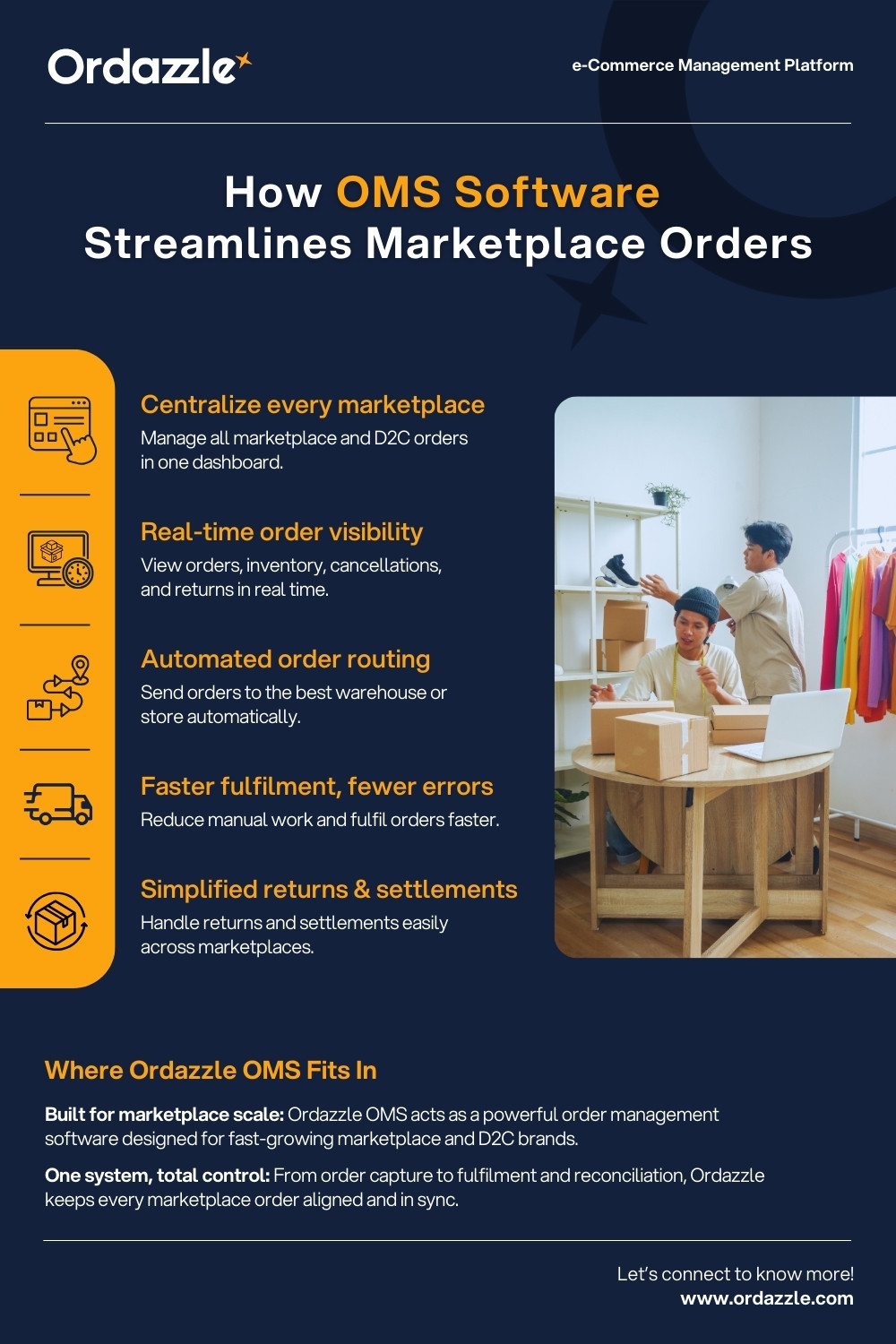
Instead of treating each marketplace as a separate workflow, the right order management software brings all marketplace orders into a unified dashboard. From there, brands can:
- View and process orders from multiple marketplaces in one place
- Apply channel-specific fulfillment and routing logic
- Sync inventory availability in real time to avoid overselling
- Reduce late shipments and unnecessary cancellations
When marketplace orders are handled through a centralized order management e-Commerce platform, operations become calmer and more predictable. Marketplaces stop feeling like a daily risk and start contributing clean, profitable volume.
Unified Order Management for e-Commerce, B2B, and D2C
Most growing brands today don’t operate in just one model. Alongside D2C orders, they manage wholesale, distributor, and corporate orders. Each comes with different expectations.
B2B orders often involve bulk quantities, negotiated pricing, partial deliveries, and credit terms. D2C orders demand speed, flexibility, and real-time updates.
Running separate systems for each creates silos. Teams lose visibility. Inventory data conflicts. Reporting becomes unreliable.
A unified e-Commerce order management system brings all of this together.
Platforms like Ordazzle allow brands to manage B2C, B2B, and marketplace orders through a single order management software layer. This unified approach ensures:
- One view of all orders, regardless of source
- Consistent inventory logic across channels
- Faster coordination between sales, warehouse, and support teams
- Better decision-making based on accurate, real-time data
When everything runs through one e-Commerce order management software, complexity reduces even as order volumes grow.
e-Commerce Order Fulfillment System That Optimizes Every Order
Order fulfillment is where promises are either kept or broken.
A basic setup assigns orders to a default warehouse and hopes for the best. That approach doesn’t scale. Inventory may be closer elsewhere. Shipping costs may be higher than necessary. Delivery timelines may slip.
An intelligent e-Commerce order fulfillment system looks at each order individually.
It evaluates factors such as:
- Inventory availability across locations
- Customer delivery address
- Shipping costs and delivery timelines
- Business rules like priority customers or premium delivery
Based on this, the system decides how and where each order should be fulfilled.
This dynamic approach helps brands reduce logistics costs while improving delivery speed. It also enables advanced omnichannel models like ship-from-store, click-and-collect, and endless aisle, all managed through one order management e-Commerce platform.
For customers, the experience feels effortless. For operations teams, fulfillment becomes controlled and scalable.
Returns and Post-Order Experience Matter More Than Ever
Order management doesn’t stop at shipping.
Returns, exchanges, cancellations, and refunds are now a standard part of the e-Commerce journey. A weak post-order process creates friction for customers and manual work for teams.
A modern e-Commerce order management system brings returns and reverse logistics into the same workflow as forward orders. This ensures:
- Faster approvals and processing of returns
- Accurate inventory updates when items are received
- Better visibility for customer support teams
- Cleaner financial reconciliation
Strong post-order capabilities are a key reason brands invest in advanced order management software rather than relying on marketplace tools alone.
API-First e-Commerce Order Management Software
As brands scale, their tech stack expands. ERPs, WMS platforms, payment gateways, CRMs, and marketing tools all need to stay in sync with orders.
Legacy systems struggle here. Custom integrations become fragile and expensive to maintain.
A modern e-Commerce order management software must be API-first.
This approach allows brands to:
- Integrate new sales channels faster
- Connect third-party logistics partners easily
- Customize workflows without heavy development
- Adapt to change without disrupting operations
Ordazzle’s API-driven architecture gives teams flexibility without compromising stability. As the business evolves, the e-Commerce order management system evolves with it.
Choosing the Best Order Management Software for e-Commerce
Not all platforms are built for high-volume, multi-channel operations. When evaluating the best order management software for e-Commerce, look beyond basic order capture.
Key capabilities to consider include:
- Native support for marketplaces and omnichannel fulfillment
- Centralized inventory and order visibility
- Configurable routing and fulfillment logic
- Strong APIs and integration capabilities
- Proven performance at scale
The best e-Commerce order management system doesn’t just solve today’s problems. It supports where your business is headed next.
Scaling Operations: The Strategic Value of an E-Commerce OMS
Order management sits at the intersection of operations, customer experience, and revenue. When it works well, everything feels smooth. Orders flow. Customers stay informed. Teams stay in control.
When it doesn’t, problems surface everywhere.
Investing in the right e-Commerce order management system is no longer optional for growing brands. It’s a competitive advantage.
Platforms like Ordazzle help brands simplify complexity, scale confidently, and deliver consistent experiences across every channel. That clarity is what separates fast-growing e-Commerce businesses from the rest.
See how Ordazzle simplifies and scales order management Book A Demo!
Frequently Asked Questions
Which order management system is best?
The best order management system is one that offers real-time visibility, marketplace support, and flexible fulfillment, making platforms like Ordazzle ideal for growing e-Commerce brands.
What is the difference between order management and order fulfillment?
Order management controls how orders are captured, routed, and tracked, while order fulfillment focuses on picking, packing, and shipping those orders to customers.
What is OMS in e-Commerce?
OMS in e-Commerce refers to an e-Commerce order management system that centralizes orders, inventory, and fulfillment across all sales channels.
What is e-Commerce order fulfillment?
e-Commerce order fulfillment is the process of processing, packing, and delivering online orders using an optimized e-Commerce order fulfillment system.