How Integrated Logistics Management Software Streamlines Modern Supply Chains
Managing logistics today involves more than just moving goods from point A to point B. The rise of e-Commerce, multi-channel retail, and global supply chains has made logistics quite complex. Businesses handle numerous warehouses, delivery partners, and marketplaces, all while customers expect faster and more dependable delivery. A disconnected system results in errors, delays, and lost revenue. Integrated logistics management offers a solution that brings all logistics processes together within one smart platform. Ordazzle’s Logistics Management System aims to provide clarity, control, and efficiency for modern businesses.
What is an Integrated Logistics Management System?
An integrated logistics management system combines warehouse management, transportation, inventory tracking, and delivery coordination into one unified platform. Unlike traditional methods, where different teams use separate tools, this system centralizes data and workflows. This ensures that every movement in the supply chain stays coordinated.
For instance, Ordazzle’s system connects various marketplaces, carriers, and warehouses through a single dashboard. Orders from any channel are automatically processed, assigned to the right warehouse, and shipped along the most efficient route. Businesses receive real-time tracking, automated updates, and actionable insights to prevent delays and errors.
In summary, an integrated logistics management system is more than just software; it’s a strategic tool that brings together all players in the supply chain.
Why Businesses Need a Logistics Information System
A logistics information system serves as the backbone of modern supply chain operations. It captures data from every point in the logistics chain, including inventory levels, warehouse tasks, shipments, carrier performance, and delivery times. This comprehensive view helps businesses make informed choices.
Without such a system, teams work in isolation. Warehouse staff might not know which orders are urgent, delivery partners may struggle with route planning, and managers lack visibility into issues. A logistics information system resolves these problems:
- Predictive insights: Use historical data to forecast demand and prevent stockouts.
- Operational efficiency: Streamline tasks like picking, packing, and shipping.
- Carrier management: Compare performance and costs across different shipping providers.
Ordazzle’s solution enhances these capabilities by supporting integrations with over 60 carriers and multiple marketplaces, enabling businesses to grow without losing control.
How Logistics Management Software Improves Efficiency
Logistics management software automates tedious tasks, reduces manual errors, and ensures consistent service levels. Imagine a multi-channel retailer with five warehouses and shipments going out through ten carriers. Coordinating every order manually would be nearly impossible.
With logistics management software, businesses can:
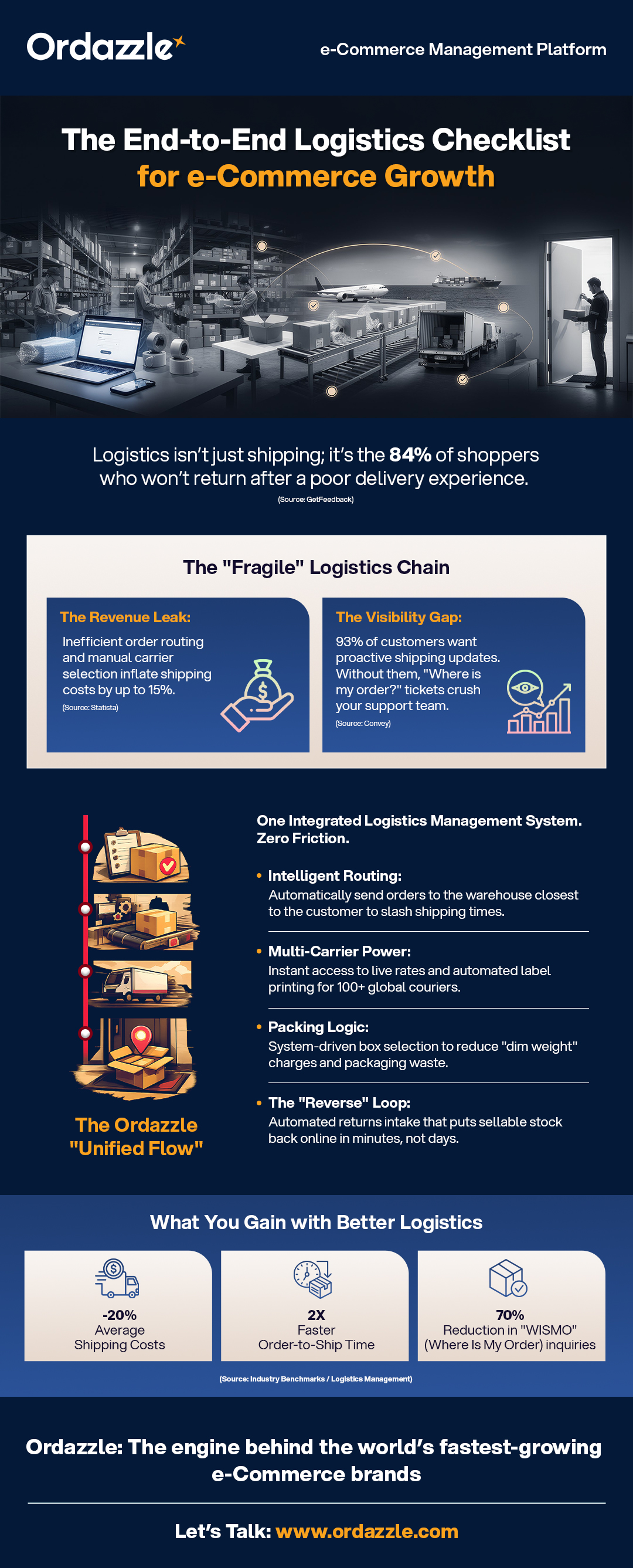
- Automatically assign orders to the nearest warehouse.
- Generate shipping labels and manifests in bulk.
- Track shipments in real time and notify customers automatically.
- Monitor KPIs like delivery times, fulfillment rates, and cost per shipment.
Ordazzle’s software does more than just automate tasks. It allows businesses to set up custom workflows for different order types, service level agreements, or delivery priorities. This flexibility is essential for fast-growing e-Commerce businesses that need to meet various customer expectations.
Benefits of Using an Integrated Logistics Management System
Implementing a strong integrated logistics management system offers clear benefits:
- Greater Visibility Across the Supply Chain: Managers can track inventory, shipments, and carrier performance from one dashboard. This reduces uncertainty and helps with proactive problem-solving.
- Faster Fulfillment and Delivery: Automation in routing and warehouse assignment cuts down delays, ensuring customers get their orders promptly.
- Lower Operational Costs: Optimizing warehouse usage and carrier choices helps businesses save on shipping and storage expenses.
- Better Accuracy and Customer Satisfaction: Automated checks replace error-prone manual processes, lessening the chance of incorrect shipments.
- Scalability for Growth: As businesses expand into new markets or regions, a single logistics management system adjusts without needing separate tools for each location.
These benefits are particularly crucial for e-Commerce businesses, where speed, accuracy, and customer experience significantly affect revenue.
Challenges Small Businesses Face Without WMS and Integrated Logistics
Small businesses often manage logistics with spreadsheets, different software tools, or manual methods. This may work at first, but the approach soon becomes unmanageable as order volumes increase. Common issues include:
- Inventory Discrepancies: Manual updates can create stock differences across warehouses and channels.
- Delayed Shipments: The lack of automation and coordination slows order fulfillment.
- Limited Visibility: Management finds it hard to track orders and spot issues.
- Rising Operational Costs: Inefficiencies and mistakes drive up labor and shipping costs.
By adopting a unified integrated logistics management system, small businesses can tackle these challenges and scale effectively while maintaining control.
Key Features of Ordazzle’s Integrated Logistics Management System
Ordazzle’s platform addresses real-world logistics challenges with several key features:
- Multi-Channel Order Management: Integrate orders from e-Commerce marketplaces, web stores, and offline channels.
- Warehouse Automation: Streamline picking, packing, and shipping processes for better efficiency.
- Carrier Integrations: Connect with over 60 delivery partners for real-time tracking and automated shipping labels.
- Analytics and Reporting: Track fulfillment KPIs, delivery times, and operational costs to make informed decisions.
- Customizable Workflows: Adjust the system to fit your business rules, service level agreements, and shipping priorities.
These features make Ordazzle’s logistics software solutions more than just tools; they form a strategic platform that supports business growth and operational excellence.
How to Choose the Right Logistics Management Solutions
Choosing the best logistics management solutions starts with understanding your business needs:
- Integration Capabilities: Can it connect with your e-Commerce platforms, ERP, and carriers?
- Scalability: Will it support growth across multiple warehouses and marketplaces?
- Automation and Customization: Can you automate processes and tailor them to your rules?
- Analytics: Does it provide useful insights to optimize costs and efficiency?
Ordazzle’s Integrated Logistics Management System excels in these areas, offering a complete solution that grows with your business.
Future Trends in Logistics Management
The logistics field continues to change with technology. Some trends include:
- AI and Predictive Analytics: Forecast demand, optimize routes, and avoid stockouts.
- IoT and Real-Time Tracking: Monitor shipments, temperature-sensitive items, and vehicle conditions.
- Sustainable Logistics: Improve routes and warehouse tasks to cut carbon emissions.
- Omnichannel Fulfillment: Seamless coordination between online and offline sales channels.
Businesses that implement an integrated logistics management system now will be better positioned to take advantage of these trends, improve efficiency, and provide outstanding customer experiences.
Conclusion
In a world where speed, accuracy, and visibility matter, disconnected logistics systems are no longer enough. Investing in a solid integrated logistics management system and logistics management software can transform operations, reduce costs, and boost customer satisfaction. Ordazzle’s platform brings together warehouses, carriers, and marketplaces into one smart system, giving businesses the control and insights they need to grow confidently.
Take control of your logistics today. Explore Ordazzle’s Integrated Logistics Management System to see how your business can achieve operational excellence and faster, more reliable deliveries.
Discover how Ordazzle’s Integrated Logistics Management System can streamline your operations, explore the solution now. Let’s connect: https://ordazzle.com/book-a-demo
FAQs
1. How do logistics management solutions help e-Commerce businesses?
They streamline order processing, warehouse operations, and deliveries, ensuring faster, error-free fulfillment. Modern logistics management solutions also give real-time visibility across warehouses and carriers.
2. Which logistics software solutions are best for modern supply chains?
The best logistics software solutions integrate warehouses, carriers, and marketplaces, automate workflows, and provide analytics to optimize costs and efficiency.
3. How does logistics scheduling software facilitate efficient management?
Logistics scheduling software automates dispatch planning, routes shipments optimally, and ensures timely deliveries while reducing manual errors.
4. What is an integrated logistics management system, and why does e-Commerce need it?
An integrated logistics management system unifies warehouse, inventory, and shipping operations into a single platform, helping e-Commerce businesses scale efficiently while maintaining accuracy and visibility.