The Role of Anomaly Detection for an e-Commerce Pricing System in Global e-Commerce Solutions

Pricing, order, and inventory errors are common in complex e-Commerce systems operating across multiple marketplaces. Even small anomalies, incorrect product prices, suspicious orders, and inventory mismatches can lead to revenue loss, fraud, and fulfilment disruptions.
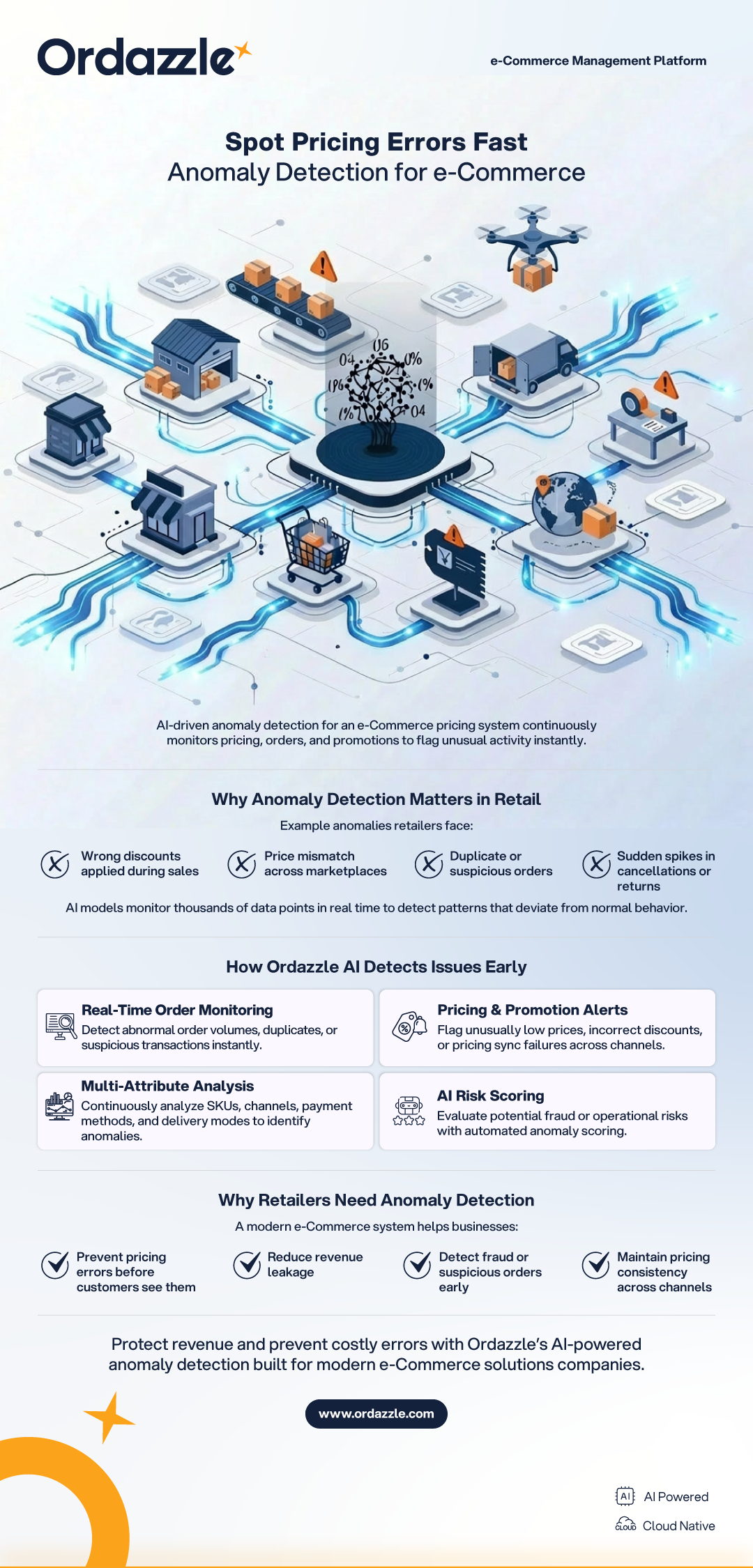
Modern global e-Commerce solutions now use AI-powered anomaly detection to identify irregular activity in real time. Platforms that combine order management, inventory orchestration, and anomaly detection enable fast-growing brands to scale operations without operational chaos.
What Is Anomaly Detection in an e-Commerce System?
Anomaly detection for an e-Commerce pricing system refers to the process of identifying unusual patterns, unexpected behaviour, or irregular data within an e-Commerce system.
In digital retail operations, anomalies typically occur in areas such as:
- Product pricing errors
- Unusual order volumes
- Suspicious transaction patterns
- Inventory discrepancies
- Fulfilment delays
AI-powered detection systems continuously analyse operational data across orders, inventory, marketplaces, and fulfilment systems to flag activities that deviate from normal behaviour.
“e-Commerce operations generate thousands of data signals daily. Without intelligent monitoring, operational anomalies can quickly escalate into revenue-impacting issues.”
Why Do Fast-Growing e-Commerce Solutions Companies Struggle With Operational Anomalies?
Fast-growing brands often operate across multiple marketplaces, warehouses, and fulfilment providers. This creates fragmented data environments where anomalies are difficult to detect manually.
Common causes include:
- Orders flowing from multiple marketplaces
- Separate inventory systems across warehouses
- Pricing changes across different channels
- Limited visibility into fulfilment operations
- Manual reconciliation between systems
When these systems are disconnected, identifying unusual behaviour becomes almost impossible. For brands in India and Southeast Asia, where marketplace selling is dominant, operational complexity increases even faster.
What Types of Anomalies Occur in e-Commerce Pricing and Orders?
- Anomalies in digital retail usually appear in predictable operational patterns.
- Pricing Anomalies
- Incorrect pricing caused by system sync failures or manual errors.
Examples:
- A product priced at ₹4,999 appearing as ₹499
- Incorrect discounts applied across marketplaces
- Duplicate promotions stacking unintentionally
- Order Behaviour Anomalies
- Unusual spikes or irregular purchasing behaviour.
Examples:
- Hundreds of orders from the same IP address
- Abnormal purchase volumes for specific SKUs
- Rapid order cancellations
- Inventory Anomalies
- Mismatch between marketplace listings and warehouse stock.
Examples:
- Inventory showing available, but actually out of stock
- Overselling due to delayed syncs
- Phantom inventory across warehouses
- Fulfilment Anomalies
- Unexpected fulfilment delays or operational inefficiencies.
Examples:
- Orders stuck in processing
- Routing errors between warehouses
- Delayed shipping confirmation
- Without automated monitoring, these issues are typically discovered after customers are already affected.
How Does AI Anomaly Detection Improve Pricing Accuracy?
AI detection systems analyse historical operational data to understand what “normal behaviour” looks like within an e-Commerce management environment.
Once patterns are established, AI models detect deviations instantly.
For example, the system may identify:
- Sudden price drops beyond normal thresholds
- Discount combinations that exceed configured rules
- Rapid bulk purchases of discounted products
- Instead of discovering errors hours or days later,
- operations teams receive immediate alerts.
This prevents:
- Revenue leakage from pricing mistakes
- Marketplace penalties for incorrect listings
- Brand reputation damage from incorrect promotions
- For large catalogues common in fashion, electronics, and lifestyle categories, AI monitoring becomes essential.
Operational Scenario
Scenario: A D2C Brand Managing Pricing Across Multiple Marketplaces
A fashion brand sells across Shopify, Amazon, and regional marketplaces. Product pricing is updated weekly, with multiple promotional campaigns running simultaneously. During a flash sale, a system sync error incorrectly applies a 90% discount to several SKUs. Within minutes, hundreds of orders are placed at the incorrect price. Without anomaly detection, the brand discovers the issue hours later, resulting in:
- Massive revenue loss
- Order cancellations
- Negative customer experience
- With an AI anomaly detection system, the pricing deviation would be flagged immediately, and the listing would be automatically paused.
The 4 Pillars of Scalable e-Commerce Operations
As brands scale across channels, operations must be supported by integrated systems rather than disconnected tools.
The 4 pillars of scalable digital commerce operations include:
1. Unified Order Management
Orders from all marketplaces and stores are centralised into one system.
2. Real-Time Inventory Visibility
Inventory levels remain synchronised across warehouses and channels.
3. Fulfilment Orchestration
Orders are routed to the most efficient fulfilment location automatically.
4. Intelligent Anomaly Detection
AI continuously monitors operational signals for irregular behaviour.
Together, these pillars form the foundation of modern global e-Commerce solutions.
Signs Your e-Commerce Operations Are Becoming Unmanageable
If any of the following issues occur frequently, operational complexity may exceed manual oversight.
- Orders are processed across multiple dashboards
- Inventory mismatches appear across marketplaces
- Frequent overselling or stockouts occur
- Pricing errors occasionally go unnoticed
- Fraudulent or suspicious orders increase
- Manual reconciliation between systems becomes routine
“Brands often focus on marketing and growth first, but operational infrastructure determines whether that growth is sustainable.”
How Can Modern e-Commerce Solutions Detect Operational Anomalies?
Modern e-Commerce solutions companies increasingly embed AI monitoring directly into their operational platforms.
Instead of relying on separate analytics tools, anomaly detection now integrates with:
- Order Management Systems (OMS)
- Warehouse Management Systems
- Product Information Management (PIM)
- Marketplace integrations
- Inventory orchestration platforms
This allows AI models to analyse operational data in real time across the entire commerce ecosystem.
Platforms that combine operational intelligence with fulfilment automation provide a significant advantage for fast-growing brands.
For example, modern platforms like Ordazzle combine:
- Order management
- Marketplace integrations
- Warehouse orchestration
- Product information management
- AI anomaly detection
- Fraud monitoring
By analysing order behaviour, pricing patterns, and fulfilment activity in one environment, brands gain operational visibility that is otherwise difficult to achieve.
Can AI Detection Solutions Support e-Commerce Fulfilment Operations?
Yes. AI anomaly detection plays an increasingly important role in e-Commerce fulfillment software.
Beyond pricing and orders, AI monitoring can identify issues such as:
- Orders stuck in fulfilment queues
- Warehouse routing errors
- Shipment delays
- Abnormal return patterns
- Suspicious fulfilment activity
For example:
If a warehouse suddenly experiences a spike in delayed dispatches, anomaly detection systems can flag the issue before it impacts large volumes of orders. This allows operations teams to quickly investigate the cause. In large fulfilment networks, especially those operating across India, Southeast Asia, and cross-border markets, this level of operational intelligence becomes essential.
Why Anomaly Detection Matters for Global e-Commerce Solutions
As brands expand internationally, operational complexity multiplies. Challenges include:
- Multiple currencies and pricing structures
- Regional marketplaces
- Distributed warehouses
- Cross-border fulfilment networks
Without automated monitoring, detecting irregularities across these systems becomes extremely difficult.
This is why many modern global e-Commerce solutions now incorporate AI-driven operational intelligence directly into their infrastructure.
“Operational visibility is becoming a competitive advantage in digital retail.”
Brands that detect issues faster can resolve them before they affect customers or revenue.
Key Takeaways
Operational anomalies are common in complex e-Commerce systems. Pricing errors, inventory mismatches, and fraudulent orders can significantly impact revenue and customer experience.
AI-powered anomaly detection for an e-Commerce pricing system helps brands detect irregular activity in real time. Integrated platforms that combine order management, inventory orchestration, and fulfilment automation provide the best operational visibility.
For fast-growing D2C brands in India and Southeast Asia, intelligent monitoring is becoming essential for scalable operations.
Final Thoughts
As digital commerce expands across marketplaces, warehouses, and international markets, operational complexity increases dramatically. Without intelligent monitoring, small operational errors can quickly turn into large-scale problems.
Implementing anomaly detection for an e-Commerce pricing system allows brands to identify issues early, protect revenue, and maintain operational efficiency.
Modern platforms that combine operational intelligence with fulfilment orchestration, like those offered by Ordazzle, are helping e-Commerce brands scale their infrastructure without losing control of their operations.
See how Ordazzle helps e-Commerce brands unify order management, inventory visibility, anomaly detection, and fulfilment automation.
Book a demo with our experts to explore how intelligent e-Commerce operations can support your growth.
Common Questions e-Commerce Leaders Ask
How does anomaly detection work in an e-Commerce system?
Anomaly detection systems analyse operational data across orders, pricing, inventory, and fulfilment processes. AI models learn normal patterns over time and flag behaviour that deviates from those patterns, allowing teams to investigate potential issues early.
How does AI anomaly detection improve pricing accuracy?
AI monitoring continuously checks pricing behaviour across marketplaces and product catalogues. When unusual price changes or discount combinations occur, the system alerts operators or automatically pauses affected listings to prevent losses.
Can AI detection solutions support e-Commerce fulfilment operations?
Yes. AI systems can identify operational anomalies in warehouse processing, shipping delays, and order routing patterns. This helps operations teams detect fulfilment bottlenecks and resolve them before they impact customer deliveries.
When should an e-Commerce brand invest in AI detection solutions?
Brands typically need AI monitoring when they begin scaling across multiple sales channels, warehouses, or marketplaces. At this stage, manual monitoring becomes inefficient and operational errors become more costly.