PIM Made Simple: How to Choose the Best Product Information Management System

When it comes to e-Commerce businesses, accurate, consistent, and enriched product data is the foundation of every successful sale. Whether you are managing thousands of SKUs or expanding into new marketplaces, the ability to control, optimize, and distribute product information seamlessly across channels can make or break your customer experience.
That’s where PIM in e-Commerce comes in. A product information management system helps brands and e-Commerce merchants bring order to chaos so that every product description, image, and specification stays consistent, updated, and channel-ready.
But with so many options available, how do you identify the best PIM for e-Commerce for your business?
This guide simplifies the process, from understanding what a PIM does to knowing exactly what to look for when evaluating the right PIM software for your e-Commerce operations.
What Is Product Information Management (PIM) in e-Commerce?
A Product Information Management (PIM) solution is a centralized platform that collects, manages, and distributes product data across sales and marketing channels. Think of it as the single source of truth for all your product content, from technical specifications and pricing to digital assets like images and videos.
In e-Commerce, a product information management system ensures every product listing is accurate and consistent across your website, mobile app, marketplaces, and social commerce platforms. It replaces time-consuming manual spreadsheets with a collaborative, automated environment where teams can easily enrich, approve, and publish product data.
How Does a PIM System Differ from Regular Product Management Software?
A product information management software and traditional product management tools may seem similar, but they serve different purposes. Product management software primarily handles the lifecycle of a product, from ideation and design to production and launch.
A PIM software, on the other hand, focuses on the commercialization stage, ensuring every product is represented accurately and attractively across all selling channels. Unlike simple catalog management tools, modern PIM systems enable omnichannel readiness with capabilities like data syndication, localisation, taxonomy management, and version control, which are all critical for e-Commerce scalability.
Key Benefits of Using PIM Software for e-Commerce
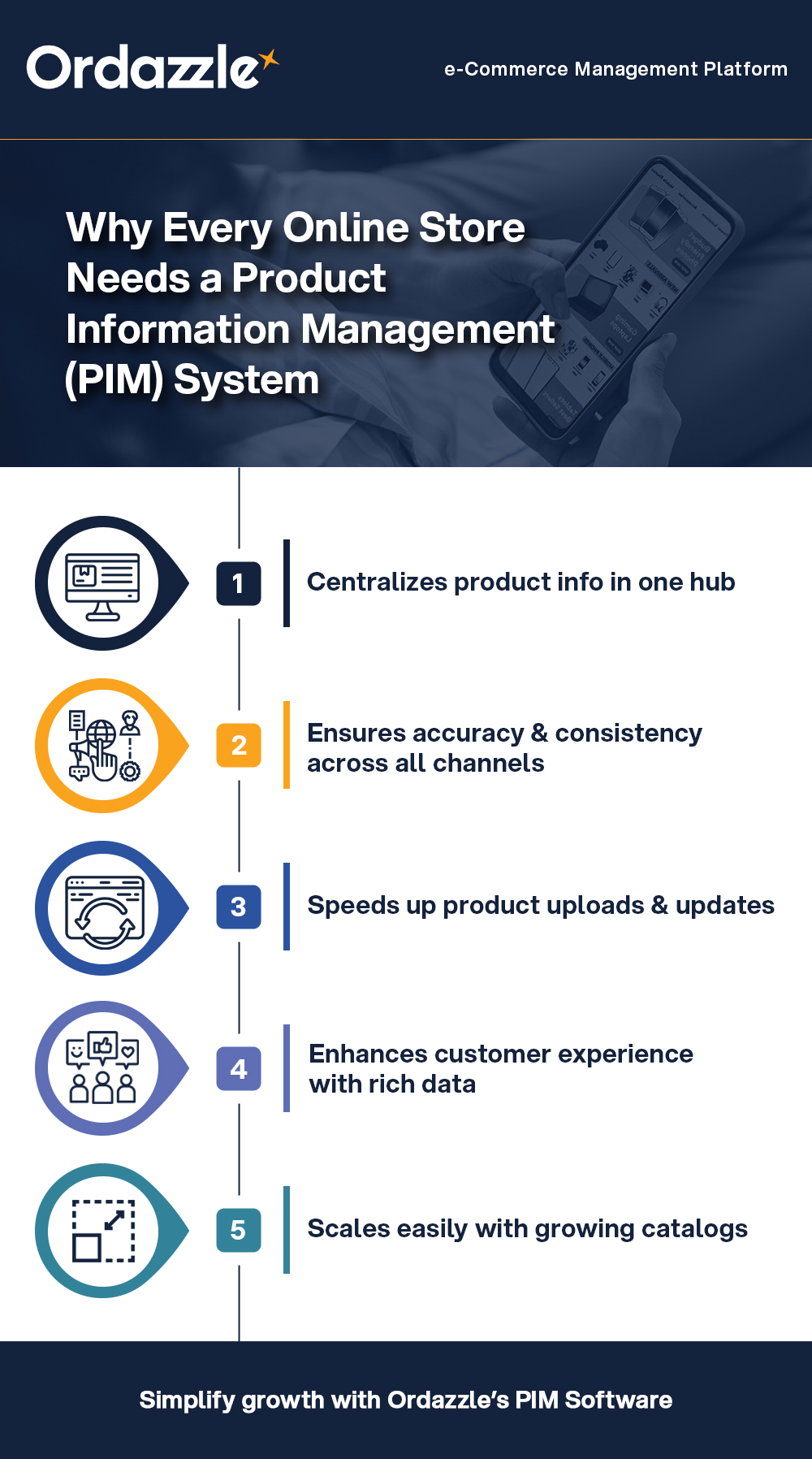
Implementing the best PIM for e-Commerce can lead to significant operational and commercial advantages. Here are the top reasons retailers are investing in this technology:
1. Centralised Product Data Repository
A PIM consolidates product information from multiple sources, including ERP, suppliers, digital asset systems, into one platform, ensuring uniformity and eliminating data silos.
2. Faster Time-to-Market
With streamlined workflows and automation, PIM in e-Commerce allows faster onboarding of new products and quicker updates across multiple marketplaces.
3. Enhanced Product Data Quality
A product information management system ensures data accuracy and completeness through validation rules, mandatory fields, and quality scoring.
4. Improved Omnichannel Consistency
Consumers expect consistent experiences. PIM software ensures your product listings are uniform across websites, apps, marketplaces, and print catalogues.
5. Reduced Manual Errors
By automating data entry and updates, product information management software eliminates manual inconsistencies that can lead to order cancellations or poor user experiences.
6. Scalability for Growth
As your business grows, a robust PIM system scales effortlessly to handle larger product assortments and new selling channels without burdening operations.
Essential Features to Look for in the Best PIM for e-Commerce
When choosing a product information management software, priorities features that directly impact usability, scalability, and integration.
| Feature | Why It Matters |
Centralised Repository | Maintains one version of truth for all product data. |
Bulk Import & Export Tools | Simplifies large-scale data handling. |
Data Validation & Enrichment | Ensures accuracy and completeness of product details. |
Digital Asset Management (DAM) | Links images, videos, and other media with product SKUs. |
Multi-Channel Syndication | Automatically adapts product content for each marketplace or platform. |
Workflow Automation | Streamlines approvals, reviews, and updates. |
Localization Support | Handles regional languages, currencies, and compliance effortlessly. |
API Integrations | Connects with ERP, CMS, OMS, and analytics tools for seamless operations. |
How to Choose the Right Product Information Management System for e-Commerce
Selecting the best PIM for e-Commerce isn’t just about ticking feature checklists; it is about aligning technology with business goals. Follow this structured approach:
1. Assess Your Business Needs
How many SKUs or product lines do you manage?
Which marketplaces or regions do you sell in?
What data pain points exist today (e.g., inconsistencies, slow updates, translation errors)?
A clear understanding of these will help shortlist the most relevant PIM systems.
2. Evaluate Ease of Integration
Your product information management system should integrate seamlessly with existing tech, such as WMS, ERP, CRM, CMS, and order management. Check for open APIs and plug-and-play connectors.
3. Consider Scalability and Performance
Choose a PIM software that can grow with your business, handle bulk data operations, and ensure fast load times even as catalogues expand.
4. Priorities User Experience
Since multiple teams (marketing, merchandising, tech) use PIM daily, intuitive design, configurable dashboards, and low learning curves are crucial.
5. Focus on Data Governance
Look for robust permission controls, version tracking, and audit logs — especially for enterprise-scale e-Commerce operations.
6. Evaluate Vendor Support and Training
Ensure your PIM vendor provides responsive technical support, onboarding assistance, and product training for long-term success.
Common Mistakes to Avoid When Implementing PIM in e-Commerce
Even the best PIM for e-Commerce can fail if not implemented correctly. Avoid these pitfalls:
- Skipping Data Cleansing: Inconsistent legacy data can undermine your new system.
- Ignoring Change Management: Train teams early to adopt new workflows confidently.
- Underestimating Integration Time: Proper API setup ensures smoother deployment.
- Lack of Ongoing Optimisation: Continuously monitor and refine your PIM for efficiency gains.
Future of PIM in e-Commerce
The next generation of PIM software is leveraging AI and automation to enhance data quality, generate enriched content, and predict missing attributes. AI-powered enrichment engines and auto-tagging will soon redefine how retailers manage and publish product information at scale.
As customer experiences become more data-driven, a modern product information management system will no longer be optional — it will be mission-critical for omnichannel success.
Why Choose Ordazzle Product Information Management (PIM)
Forward-thinking e-Commerce brands are turning to unified commerce platforms like Ordazzle, which integrate PIM, OMS, WMS, and channel management in one ecosystem.
Ordazzle’s PIM enables brands to manage millions of SKUs with ease, ensuring central visibility, real-time updates, and automated marketplace syndication.
If you are looking for one of the best PIM for e-Commerce to power your growth, schedule a demo and see how Ordazzle can simplify your product data management.
Frequently Asked Questions
1. What is Product Information Management (PIM) in e-Commerce?
It is a centralized system that manages, enriches, and distributes all product data across multiple channels, ensuring consistency and accuracy.
2. How does a PIM system differ from regular product management software?
While product management tools oversee a product’s lifecycle, PIM software focuses solely on managing and optimising product information for selling channels.
3. What are the benefits of using PIM software for e-Commerce?
Improved data accuracy, faster time-to-market, omnichannel consistency, and scalability.
4. How do you select the right product information management system for e-Commerce?
Evaluate your business needs, integration capabilities, scalability, user experience, and vendor reliability before choosing the right product information management software.