Enterprise PIM Software for Multi-Channel Retailers and Online Stores

Selling online today isn’t just about having great products. It’s about managing how those products show up, everywhere.
A single SKU might live on your website, multiple marketplaces, social commerce platforms, and even in-store systems. Each channel has its own format, rules, and expectations. Now multiply that across hundreds or thousands of products, and you start to see the real challenge.
Here’s the thing: most e-Commerce brands don’t struggle because they lack demand. They struggle because their product data is scattered, inconsistent, and hard to control.
That’s where PIM in e-Commerce becomes critical.
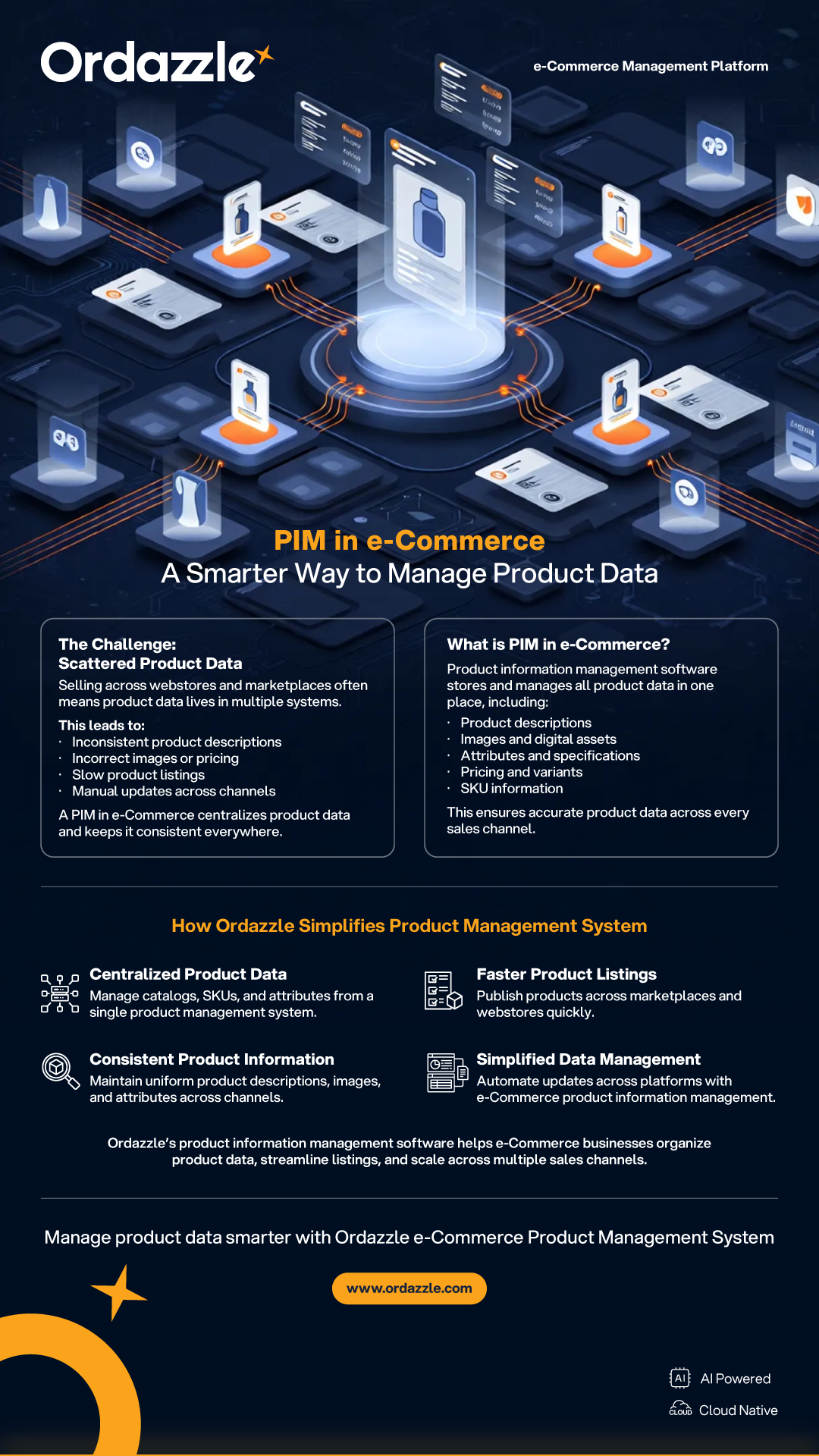
What is PIM in e-Commerce?
Product Information Management (PIM) is a system that centralises, manages, enriches, and distributes product data across multiple sales channels like websites, marketplaces, mobile apps, and retail systems.
In simple terms, a product information management system ensures that every product listing across every platform has consistent, accurate, and complete information.
This includes:
- Product titles
- Descriptions
- Images
- SKUs
- Pricing
- Attributes (size, color, specs)
- Localised content
Why Do Multi-Channel e-Commerce Brands Struggle With Product Data?
Short answer: Product data gets scattered across systems like spreadsheets, ERPs, marketplaces, and content tools, creating inconsistencies and operational bottlenecks.
Most fast-growing brands don’t start with a PIM. They scale first, and then the cracks begin to show. Here’s what typically happens:
- Teams manage product data in Excel sheets
- Marketplace listings are updated manually
- Different platforms require different formats
- Updates don’t sync in real time
“e-Commerce brands that rely on disconnected product data systems often struggle with consistency, speed, and scalability.”
What Problems Does Poor Product Information Management Cause?
Short answer: Poor product data leads to errors, delays, and lost revenue across the entire e-Commerce lifecycle.
Common operational issues:
- Incorrect or incomplete product listings
- Marketplace rejections due to data mismatches
- High return rates due to misleading descriptions
- Delayed product launches
- Inconsistent customer experience across channels
Operational Scenario
Scenario: A D2C brand selling across Amazon, Shopify, and Flipkart
The brand updates product descriptions on Shopify but forgets to update them on marketplaces. Pricing differs across platforms. Customers receive inconsistent information, leading to confusion and returns.
Without a central system, product data becomes a liability instead of an asset.
How Does e-Commerce Product Information Management Work?
Short answer: A PIM system acts as a single source of truth for all product data and distributes it across channels in the required formats. Here’s how it typically works:
- Data Collection
Product data is pulled from suppliers, internal systems, or spreadsheets
- Data Standardisation
Attributes are structured and formatted consistently
- Data Enrichment
Teams enhance product content with descriptions, images, and SEO elements
- Central Management
All product data is stored in one unified system
- Channel Distribution
Data is pushed to marketplaces, websites, and apps in real time
Why is PIM Necessary for Multi-Channel e-Commerce Businesses?
Short answer: Because managing product data manually across multiple channels does not scale.
As brands grow, complexity increases:
- More SKUs
- More marketplaces
- More regional variations
- More customer expectations
Without a pim in ecommerce, operations slow down and errors multiply.
Key reasons Product Information Management Software becomes essential:
- Faster product launches
- Consistent brand experience
- Reduced manual effort
- Improved data accuracy
- Better SEO and discoverability
The 4 Pillars of Scalable Product Information Management
To scale effectively, e-Commerce brands need more than just a tool; they need a structured approach.
1. Centralised Product Data
A single system that stores all product information
2. Data Standardisation
Consistent formats across all SKUs and channels
3. Real-Time Synchronisation
Instant updates across marketplaces and websites
4. Enrichment & Localisation
Optimised content tailored for different regions and platforms
Signs Your Product Data Is Becoming Unmanageable
- Product data is stored in multiple spreadsheets
- Listings differ across marketplaces
- Frequent product data errors or rejections
- Delays in launching new SKUs
- Manual updates across platforms
- High return rates due to incorrect information
How Does PIM Connect With Broader e-Commerce Operations?
Product data doesn’t exist in isolation. It directly impacts:
- Order management
- Inventory accuracy
- Fulfilment efficiency
- Customer experience
For example:
- Incorrect product dimensions affect shipping costs
- Missing SKU data disrupts inventory tracking
- Poor descriptions lead to returns
Where Ordazzle Fits In
Modern e-Commerce operations platforms like Ordazzle bring PIM, OMS, inventory, and fulfilment into a single ecosystem.
Instead of managing product data separately, brands can:
- Sync product data with inventory in real time
- Align product listings with fulfilment logic
- Detect anomalies in product or pricing data using AI
- Ensure consistency across marketplaces automatically
Ordazzle’s Product Information Management software integrates with:
- Marketplace platforms
- Warehouse systems
- Order management workflows
This creates a unified operational layer where product data drives smarter decisions.
How AI Is Changing Product Information Management
Short answer: AI is helping brands improve product data quality, detect inconsistencies, and automate enrichment.
Key AI-driven capabilities:
- Detecting missing or incorrect attributes
- Auto-generating product descriptions
- Identifying pricing anomalies
- Flagging duplicate or inconsistent listings
Who Needs Product Information Management Software?
Short answer: Any business managing multiple SKUs across multiple channels.
Ideal users:
- D2C brands scaling across marketplaces
- Fashion and lifestyle retailers with large catalogs
- Electronics brands with complex specifications
- Marketplace sellers managing high SKU volumes
- Fast-growing digital-first brands
What This Means for Growing e-Commerce Brands
Product data is no longer just a backend function, it’s a growth driver. Brands that invest in product information management software gain:
- Faster go-to-market speed
- Better operational control
- Improved customer experience
- Stronger marketplace performance
If you’re looking to simplify product data, unify operations, and scale without chaos, it might be time to rethink how you manage your product information. Let’s talk!
Common Questions e-Commerce Leaders Ask
What is PIM in e-Commerce?
PIM is a system that centralises and manages product data, ensuring consistency across all sales channels.
How does e-Commerce product information management work?
It collects, standardises, enriches, and distributes product data from a single system to multiple platforms.
Who needs product information management software?
Any brand managing multiple SKUs across multiple sales channels, especially D2C and marketplace-driven businesses.
Is PIM necessary for multi-channel e-Commerce businesses?
Yes. Without PIM, managing product data across channels becomes inefficient and error-prone.
How does PIM impact customer experience?
Accurate and consistent product data improves trust, reduces returns, and increases conversions.