Festive e-Commerce Inventory Management Software: How Brands Keep Stock Accurate Across Every Channel
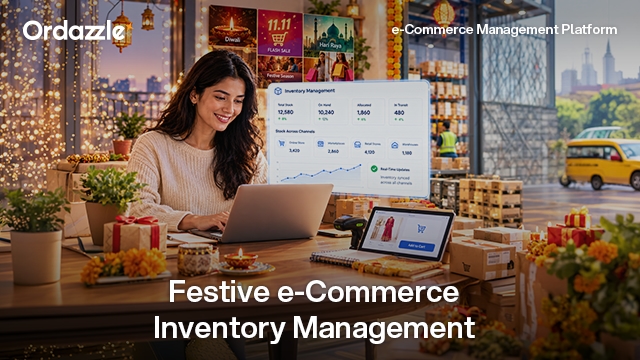
Festive demand can turn inventory accuracy into an operational problem very quickly.
A product that shows 12 units available on one marketplace may have only 8 left after orders from another channel. A stock update from a warehouse may not reach the webstore immediately. A high-selling SKU can move through several fulfilment nodes before the next inventory update reaches every sales channel.
When order volumes are normal, teams may be able to catch these discrepancies manually.
During peak demand, they usually cannot.
That is where inventory management software becomes important. The goal is not simply to know how much stock a business has. It is to know where that stock is, which channel can sell it, how quickly its availability changes, and whether every channel is working from the same inventory position.
For brands selling through multiple marketplaces and webstores, that visibility becomes particularly important during the festive season.
Festive demand exposes weak inventory processes
Peak periods create a different operating environment.
Orders arrive faster. Popular SKUs move more quickly. Promotions can suddenly change demand. Inventory moves between warehouses and fulfilment nodes. Returns and cancellations add more stock movements to the picture.
At the same time, the business may be selling through several channels.
That creates a simple but difficult question:
Which stock number should the business trust?
If every channel maintains its own view, the answer can change depending on where the team looks.
This is how inventory problems begin.
A marketplace shows stock that has already been sold elsewhere. A webstore continues accepting orders because its inventory was not updated. A warehouse team works from a different number than the marketplace team.
The issue is not necessarily that the business has insufficient stock.
The issue is that the business does not have a sufficiently current view of its stock.
The real inventory problem is synchronisation
Consider a festive promotion on a popular SKU.
At 10:00 a.m., there are 100 units available.
The product is listed on a webstore and several marketplaces.
Orders begin coming in from different channels.
By 11:00 a.m., 35 units have been sold.
By noon, another 30 units have moved.
But if each channel does not receive the inventory update at the same time, some channels may still show a higher available quantity.
That creates two problems.
Overselling: Customers can place orders for products that are no longer available.
Stockouts: A channel may show no availability even though sellable stock exists elsewhere.
Both problems start with the same underlying issue: inventory information is not moving as quickly as inventory itself.
For festive e-Commerce, that gap can become expensive.
What should accurate inventory management look like during peak season?
A useful inventory operation needs to answer more than "How much stock do we have?"
It should answer:
- Where is the stock?
- Which fulfilment node holds it?
- Which channels can currently sell it?
- How much stock has already been committed?
- What changed after the latest order?
- Which SKUs are approaching their reorder levels?
- Is inventory being updated consistently across marketplaces and webstores?
This is where real-time inventory visibility becomes more than a reporting requirement.
It becomes part of the operating process.
When inventory data is updated as stock moves, teams have a more current view of availability. When that information is synchronised across channels, customers are less likely to encounter conflicting stock positions.
Five inventory pressure points festive retailers need to control
1. Inventory visibility across fulfilment nodes
Stock is rarely sitting in one place.
A growing e-Commerce operation may have multiple warehouses, fulfilment centres or other nodes handling orders.
Without a consolidated view, teams may know the total inventory but not necessarily the inventory available at each node.
That distinction matters.
A product may technically be in stock but located at a node that cannot efficiently fulfil a particular order.
A strong inventory management system should therefore provide visibility into stock across relevant warehouses and fulfilment nodes rather than treating inventory as one undifferentiated number.
2. Inventory updates across every sales channel
Selling on more channels increases the number of places where inventory needs to stay accurate.
The same SKU may appear on a webstore and several marketplaces.
Every order changes the available quantity.
If those changes depend on manual updates, inventory accuracy becomes dependent on people keeping multiple systems aligned throughout the day.
That is difficult enough during normal trading.
During a festive campaign, it becomes much harder.
Inventory synchronization allows stock changes to flow across connected sales channels instead of requiring teams to repeatedly update each channel individually.
3. Stock allocation
Not every unit of inventory should necessarily be treated the same way.
A business may need to allocate stock according to its fulfilment setup, marketplace requirements or available nodes.
This is particularly important when demand is uneven.
One SKU may be selling rapidly in one channel while remaining relatively slow in another. Meanwhile, available stock may be distributed across multiple locations.
Inventory allocation software can help businesses manage how available stock is assigned across their operating environment rather than relying entirely on manual decisions.
The objective is not simply to distribute stock.
It is to make the available stock usable.
4. Reorder points for fast-moving SKUs
Festive demand can change the rate at which products move.
A SKU that normally sells steadily may suddenly experience a sharp increase in orders.
Waiting until inventory is almost depleted before taking action can leave very little room to replenish.
This is where defined SKU reorder rules become useful.
An inventory management system can help teams establish and monitor inventory thresholds so that fast-moving products receive attention before they become operational emergencies.
The exact rules will vary by business, product and fulfilment model.
The important part is having a system that can track the stock position consistently.
Also read: How e-Commerce Inventory Management Improves Order Accuracy and Customer Satisfaction
5. Inventory accuracy after every movement
Inventory does not change only when a customer places an order.
Stock can also move when goods are received, allocated, rejected, inspected, returned or adjusted.
If these movements are not reflected properly, the system can gradually move away from the physical stock position.
That creates a particularly frustrating situation:
The system says the product is available.
The warehouse cannot find it.
Or the warehouse has the product, but the sales channel does not know it can be sold.
Accurate inventory management therefore depends on tracking inventory movements, not simply checking stock levels at the end of the day.
Why spreadsheets become harder to rely on during festive demand
Spreadsheets are not inherently the problem.
They become a problem when the operation outgrows the process.
If teams are manually exporting marketplace data, updating stock sheets, reconciling warehouse numbers and then publishing revised quantities across channels, every additional channel adds another opportunity for something to be missed.
The process also becomes difficult to monitor.
When a discrepancy appears, the team has to work backwards:
Which channel changed?
When did the stock change?
Which warehouse processed it?
Was another order placed at the same time?
Which number is correct?
By the time the discrepancy is identified, the customer may already have received an incorrect availability message.
For a peak-season operation, the better question is not whether manual reconciliation can be done.
It is whether the process can keep up with the speed of inventory movement.
What to look for in e-Commerce inventory management software
Choosing inventory management software for e-Commerce should go beyond checking whether the platform can record stock.
The more important question is whether it can support the way the business actually sells.
For a multi-channel e-Commerce operation, key capabilities include:
Real-time inventory visibility
Teams should be able to see current stock positions across relevant warehouses and fulfilment nodes without maintaining separate views.
Multi-channel inventory synchronization
Inventory changes should be reflected across connected marketplaces and webstores so that each channel has a more current view of availability.
SKU-level control
The system should allow businesses to manage stock at the SKU level and apply relevant reorder rules.
Flexible stock allocation
Businesses should be able to manage how available inventory is allocated across their sales and fulfilment environment.
Support for fulfilment workflows
Inventory should not exist separately from order fulfilment.
The availability of a SKU needs to connect with where and how the order can actually be fulfilled.
Visibility into inventory movement
Teams need to understand not just the current number, but the movements that are changing that number.
These capabilities are particularly useful when e-Commerce inventory management needs to operate across multiple sales channels rather than a single online store.
Inventory accuracy is also a customer experience issue
Inventory is often treated as an operations metric.
Customers experience it differently.
They see:
"In stock."
They place an order.
Then they receive a cancellation because the product was not actually available.
Or they see a product as unavailable even though the business has sellable stock sitting at another fulfilment node.
From the customer's perspective, this is not an inventory problem.
It is a reliability problem.
That makes inventory accuracy part of the broader e-Commerce experience.
During the festive season, when customers are already shopping against specific occasions and delivery expectations, accurate product availability matters even more.
How Ordazzle approaches e-Commerce inventory management
Ordazzle's e-Commerce Inventory Management is designed around the challenge of managing inventory across multiple online sales channels.
The platform provides real-time stock data across fulfilment nodes and a unified view of inventory across channels.
It can also auto-sync inventory to marketplaces and webstores, helping keep channel-level stock information updated as inventory changes.
For operations teams, the value is not just having another inventory dashboard.
It is having inventory information connected to the broader e-Commerce operation.
Ordazzle supports:
- Multi-node inventory management to track stock across fulfilment locations.
- Unified inventory visibility for more accurate stock information across channels.
- Real-time inventory synchronization across marketplaces and webstores.
- SKU reorder rules for individual marketplaces or webstores.
- Smart order routing based on fulfilment-node considerations.
- Inventory publishing and stock allocation across the multi-channel operation.
- Bundling support with real-time inventory syncing.
This creates a more connected approach to multi channel inventory management software, where inventory is not managed as isolated channel data.
Instead, the focus is on maintaining a consistent view of available stock while orders and inventory move through the operation.
The festive inventory test
Before the next peak campaign goes live, ask five questions:
1. Can we see inventory across every relevant node?
If not, your total stock number may not tell the whole story.
2. How quickly does an order update inventory across our channels?
If the answer involves manual intervention, there is room for inventory discrepancies.
3. Can we identify which SKUs are approaching their reorder thresholds?
Fast-moving festive products need attention before they become stockouts.
4. Can we allocate available stock intelligently?
Having inventory somewhere is not the same as having inventory available for every order.
5. Can operations teams identify the current inventory position without reconciling multiple spreadsheets?
If not, the process may struggle as order volumes increase.
The answers reveal whether the business is actually prepared for peak-season inventory management or simply prepared for higher demand.
Festive growth needs inventory accuracy behind it
More orders are only useful when the business can fulfil them with the stock it has.
That makes inventory accuracy one of the foundations of festive e-Commerce operations.
The objective is not to eliminate every inventory challenge. Demand will change, stock will move and exceptions will happen.
The objective is to make sure the business sees those changes quickly enough to respond.
For brands selling through multiple marketplaces and webstores, that means moving beyond isolated stock updates towards real-time inventory visibility, inventory synchronization and centralised inventory management.
Because during peak season, the difference between "available" and "actually available" is not a small operational detail.
It is the difference between an order the business can fulfil and an order it has to explain.
Want to see how Ordazzle manages inventory across e-Commerce channels? Let’s connect!
Common Questions e-Commerce Leaders Ask
What is e-Commerce inventory management?
e-Commerce inventory management is the process of tracking, controlling and synchronising stock across online sales channels, warehouses and fulfilment locations. For multi-channel brands, it helps maintain accurate product availability across marketplaces and webstores while orders and stock movements occur.
Why is inventory management important during the festive season?
Festive demand can increase order volumes and accelerate stock movement across channels. Without accurate inventory visibility and timely synchronisation, brands can face overselling, stockouts, inventory discrepancies and fulfilment issues. A reliable inventory management process helps teams respond to these changes with a more current view of available stock.
How does inventory management software prevent overselling?
Inventory management software can synchronise stock levels across connected sales channels as orders are placed and inventory changes. This reduces the reliance on manual stock updates and helps marketplaces and webstores work with a more consistent view of available inventory.
What is real-time inventory visibility?
Real-time inventory visibility means having a current view of inventory across relevant warehouses, fulfilment nodes and sales channels. Instead of relying on separate spreadsheets or delayed reports, operations teams can see where stock is available and how inventory positions are changing.
How can brands manage inventory across multiple marketplaces?
Brands can use a multi-channel inventory management system to centralise inventory information and synchronise stock across marketplaces and webstores. This helps reduce discrepancies between channels and gives operations teams greater control over inventory allocation and availability.
What should businesses look for in e-Commerce inventory management software?
Businesses should evaluate whether the software supports real-time inventory visibility, multi-channel inventory synchronization, SKU-level control, stock allocation, reorder rules and integration with their broader order and fulfilment workflows. The right capabilities will depend on the brand's sales channels, inventory model and fulfilment setup.
Can inventory management software help with peak-season demand?
Yes. During peak periods, inventory management software can help teams monitor rapidly changing stock levels, synchronise inventory across channels and manage allocation and reorder rules. This gives operations teams better visibility as order volumes and inventory movements increase.