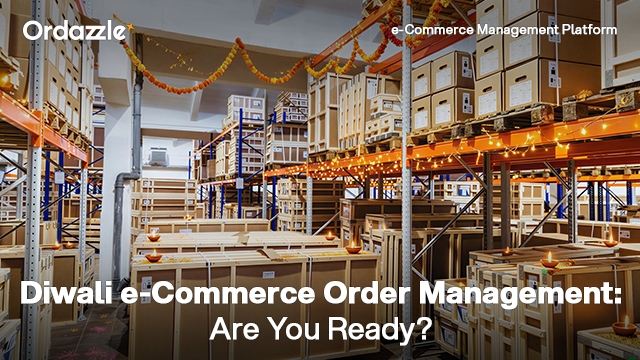
Festive Rush or Not, Is Your Warehouse Really Ready for Peak e-Commerce?

A warehouse can run perfectly well on an ordinary Tuesday and still struggle when order volumes suddenly double.
The problem is rarely one big failure.
It is usually a series of small delays.
A picker cannot find an item. A picklist is generated late. Two people pick the same order incorrectly. Packing queues build up. Dispatch gets delayed. Customer service starts asking where orders are.
By the time the problem reaches the customer, the original bottleneck may have happened hours earlier inside the warehouse.
This becomes even more visible during festive sales, flash sales and other peak periods when order volumes increase faster than normal operations can comfortably absorb.
So the question is not simply:
"Do we have enough warehouse capacity?"
It is:
"Can our warehouse process more orders without creating more errors, delays and manual work?"
That is where a warehouse management system becomes important.
Why Peak Volume Changes the Warehouse Equation
Most warehouses develop processes that work for their usual order volume.
Teams know where products are stored. Supervisors know how work moves through the warehouse. Pickers have familiar routes. Dispatch follows a predictable rhythm.
Then peak season arrives.
Suddenly, there are more orders to process, more products moving through the warehouse and less room for delays.
A process that takes five minutes when handling 100 orders can become a serious bottleneck when the same team is handling thousands.
Manual processes are particularly vulnerable.
If orders need to be manually sorted, picking instructions need to be created one by one, inventory has to be checked separately, or dispatch information is maintained across different systems, additional volume does not simply mean additional work.
It multiplies coordination.
Peak demand does not create warehouse problems. It exposes the ones that were already there.
The First Bottleneck: Picking
Picking is one of the most important stages in e-Commerce fulfilment.
An order cannot move to packing until the right products have been picked.
And when picking slows down, everything after it slows down too.
Consider a warehouse with hundreds of orders waiting to be fulfilled. If pickers are moving inefficiently between locations, searching for products or working from poorly organised picklists, valuable time is lost before the order even reaches the packing station.
A modern WMS can bring more structure to this process by organising picking workflows and helping warehouse teams follow optimised routes.
Instead of asking:
"Which order should I pick next?"
The warehouse can work from defined picking priorities and routes.
This matters during peak volume because small improvements in each picking cycle accumulate across hundreds or thousands of orders.
Then Comes Packing: Where Errors Become Expensive
Picking the wrong product is an obvious warehouse error.
But packing introduces another opportunity for mistakes.
The right items need to be matched to the right order, packed correctly and prepared for dispatch.
When packing depends heavily on manual verification, higher order volumes can increase the risk of:
- Wrong items being packed
- Items being missed
- Orders being packed under the wrong shipment
- Delays caused by rechecking
- Orders waiting unnecessarily at packing stations
A warehouse management system can connect picking and packing workflows so that warehouse teams have the information they need as an order moves through fulfilment.
The goal isn't simply to pack faster.
It is to move the correct order through the warehouse with fewer opportunities for error.
Inventory Accuracy Has a Direct Impact on Fulfilment
Warehouse efficiency depends on knowing what is actually available.
If the system says a product is in a particular location but the warehouse team cannot find it, the problem is no longer just an inventory issue.
It becomes a fulfilment issue.
The picker loses time searching.
The order waits.
Another team member may have to investigate.
Customer service may eventually need to intervene.
This is why inventory visibility needs to exist at the warehouse level.
A WMS should help teams understand where inventory is located and how stock is moving through receiving, storage, picking and dispatch.
For e-Commerce businesses, this becomes even more important when inventory is being sold across multiple channels.
The customer sees "available to order." The warehouse has to turn that promise into an actual product.
Also read: Warehouse Management System Integration: Why It Matters for Modern e-Commerce
What Happens When Dispatch Becomes the Bottleneck?
Even when picking and packing are working well, dispatch can become the point where orders pile up.
Peak periods create larger dispatch queues, tighter carrier cut-offs and more pressure to get shipments out on time.
A warehouse needs visibility into which orders are ready, which are still being processed and which may be at risk of missing their dispatch window.
This is where connected warehouse workflows matter.
Instead of treating receiving, picking, packing and dispatch as separate activities, a WMS can provide visibility across the warehouse journey.
That gives operations teams a clearer picture of where orders are in the process and where intervention may be required.
The objective is simple:
Don't let a completed order sit in the warehouse because the next step wasn't visible.
What a Peak-Ready Warehouse Actually Looks Like
A peak-ready warehouse does not necessarily mean a warehouse with more people, more space or more equipment.
It means the existing operation can handle higher volumes with controlled processes.
Look at these five areas before your next peak period.
1. Receiving is controlled
Incoming inventory needs to be received and recorded accurately.
If stock enters the warehouse incorrectly, every process that follows starts with bad information.
2. Inventory locations are visible
Teams should know where products are stored and be able to identify stock without unnecessary searching.
3. Picking is organised
Orders should move into structured picking workflows rather than depending on individual employees to determine the most efficient route.
4. Packing is connected to fulfilment
The packing team should have clear order information and visibility into what needs to be dispatched.
5. Dispatch has clear visibility
Completed orders should not get stuck because teams cannot see what is ready to leave or what is approaching a dispatch deadline.
These may sound like basic warehouse processes.
At higher volumes, however, basic processes become the difference between controlled fulfilment and operational firefighting.
The Bigger Problem: Manual Work Doesn't Scale Linearly
One of the biggest misconceptions about warehouse scaling is that you can simply add people when order volumes increase.
Sometimes you can.
But if the underlying process is inefficient, adding more people can also add more coordination.
- More pickers need more organised picking.
- More packing stations need better order visibility.
- More shipments require better dispatch coordination.
- More inventory movements require better stock tracking.
The technology needs to support the increased activity.
This is why warehouse management software is increasingly being treated as part of the wider e-Commerce operation rather than simply a tool for tracking warehouse stock.
The warehouse has to stay connected to orders, inventory, and fulfilment activity.
Where Ordazzle WMS Fits
For growing e-Commerce businesses, a WMS needs to do more than record where products are stored.
Ordazzle's Warehouse Management System is designed around the operational journey inside the warehouse, supporting processes from receiving and putaway through picking, packing, dispatch and returns.
Its WMS capabilities include mobile-led warehouse workflows, optimised picking, real-time operational visibility and warehouse inventory visibility. Ordazzle also positions its WMS alongside its order, inventory and logistics capabilities, allowing warehouse activity to connect with the wider e-Commerce fulfilment process.
That connection matters.
An order enters the operation.
Inventory determines what can be fulfilled.
The warehouse determines how it gets picked and packed.
Logistics determines how it leaves.
When these processes operate from disconnected information, manual handoffs increase.
When they are connected, warehouse teams have a clearer operational flow to work with.
5 Signs Your Warehouse Is Not Ready for Peak Volume
You may not need to wait for the festive rush to find out.
Look at what happens today.
1. Pickers spend too much time looking for products.
If employees regularly need to search for stock, check another system or ask someone where an item is located, the warehouse is losing time before fulfilment even begins.
2. Teams rely heavily on spreadsheets or manual reconciliation.
Manual tracking can work at smaller volumes but becomes increasingly difficult to control as order activity grows.
3. Errors increase when order volume rises.
If mistakes are noticeably higher during sales periods, the process may not be designed to absorb peak demand.
4. Completed orders wait before dispatch.
A warehouse can have good picking and packing performance and still lose time at the final handoff.
5. Managers lack a clear view of warehouse performance.
If supervisors have to ask multiple people for updates before understanding what is happening on the floor, operational visibility is already a problem.
Don't Prepare the Warehouse Only for the Festive Rush
Festive season is an obvious reason to review warehouse operations.
But the bigger benefit is building a warehouse that can handle change.
Order volumes will rise and fall.
New products will be introduced.
New marketplaces may be added.
Promotions will create spikes.
Returns will increase after major sales periods.
The warehouse therefore needs processes that can adapt without requiring the team to reinvent its workflow every time volume changes.
That is the real value of a WMS.
Not simply doing more work.
Doing more work without allowing operational complexity to grow at the same rate.
The Warehouse Is Part of the Customer Experience
Customers may never see the warehouse.
They do see the consequences of what happens there.
A wrong product.
A delayed shipment.
An order that gets cancelled because inventory was not where the system said it was.
A delivery that missed its expected date.
These are customer-facing outcomes of warehouse processes.
That is why warehouse efficiency is not only an operations metric.
It directly affects the experience a brand delivers after the customer clicks Buy.
So before the next festive campaign, don't ask only whether your warehouse has enough space or people.
Ask:
Can it receive, store, pick, pack and dispatch a much higher volume of orders without losing control?
If the answer depends on spreadsheets, manual checks and people constantly chasing updates, your warehouse may not be as ready as it looks.
A warehouse management system can provide the structure, visibility and workflow automation needed to make peak fulfilment more controlled.
And that readiness is useful long after the festive rush is over.
Explore how Ordazzle WMS can help your e-Commerce warehouse improve fulfilment efficiency, reduce manual bottlenecks and handle growing order volumes with greater control. Let’s talk!
Frequently Asked Questions
What is a warehouse management system for e-Commerce?
A warehouse management system (WMS) is software that helps manage and optimise warehouse activities such as receiving, putaway, inventory control, picking, packing, dispatch and returns. For e-Commerce businesses, a WMS also needs to support the faster order cycles and fulfilment requirements created by online sales.
How does a WMS help during peak eCommerce periods?
A WMS can structure and automate warehouse workflows so teams can process higher order volumes with greater control. Optimised picking, connected packing workflows, inventory visibility and dispatch monitoring can help reduce the manual coordination that often becomes a bottleneck during peak periods.
Can a WMS reduce picking and packing errors?
A WMS can help reduce errors by giving warehouse teams structured workflows and clearer order and inventory information. Picking processes can be organised around defined routes and priorities, while packing teams can work from the relevant order information instead of relying on manual reconciliation.
What should an e-Commerce business look for in warehouse management software?
Look for capabilities that address the complete warehouse workflow rather than only inventory tracking. These can include receiving, putaway, inventory visibility, picking, packing, dispatch, returns, operational dashboards and integration with the systems managing orders, inventory and logistics.
Can a WMS help an e-Commerce business scale without adding operational chaos?
A WMS can provide more structured workflows and automation as order volumes increase. This does not eliminate the need for people or operational planning, but it can reduce the amount of manual coordination required to move orders through the warehouse and give teams better visibility into what is happening.
Is a WMS useful only during festive or peak seasons?
No. Peak periods make warehouse weaknesses easier to see, but the same processes affect everyday fulfilment. A well-designed WMS can support receiving, inventory control, picking, packing, dispatch and returns throughout the year while giving businesses a stronger operational foundation for periods of higher demand.