Selling Across Marketplaces This Diwali? Keep Orders, Inventory and Listings in Sync

Selling across multiple online marketplaces during Diwali requires more than keeping products available on every platform. Businesses need to ensure that incoming orders, available inventory and product listings remain synchronised as sales volumes increase. Effective marketplace management brings these operations together, reducing the risk of overselling, incorrect stock availability and delayed order processing.
For businesses selling through Amazon, Flipkart, Myntra and their own e-Commerce websites, festive campaigns can create overlapping demand for the same products. An item sold on one marketplace may still appear available on another if inventory updates are delayed. Meanwhile, inconsistent product information or promotional pricing can create problems even before an order reaches the warehouse.
Managing these activities independently becomes increasingly difficult during high-volume sales periods. The challenge is to maintain accurate information across channels while keeping fulfilment operations moving.
The Marketplace Problem That Becomes Harder During Diwali
Consider a fashion brand selling festive collections across three marketplaces and its own website.
A popular kurta is listed with 100 units available. As Diwali promotions begin, orders arrive from different channels within minutes. One marketplace records 30 sales, another receives 25 orders, and the brand's website sells another 20 units.
If inventory is updated separately on each platform, the remaining stock may not be reflected quickly enough. Customers could continue placing orders for products that are no longer available.
The same business may also be managing marketplace-specific discounts, size variations, delivery commitments and product listings.
During regular operations, teams might resolve discrepancies through manual checks. During Diwali, the number of orders and updates can make that approach difficult to sustain.
Three areas require particular attention: inventory availability, order processing and product listing accuracy.
1. Keep Marketplace Inventory Synchronised Across Every Sales Channel
Inventory accuracy becomes particularly important when multiple marketplaces are selling from the same stock pool.
Without effective marketplace inventory management, businesses may have to reconcile stock figures across individual seller dashboards, warehouse records and their own e-Commerce systems.
Even a short delay in updating stock availability can create problems when fast-moving products are being purchased across several channels.
Why marketplace inventory synchronization matters
A connected inventory management process helps businesses maintain a more accurate view of available stock across marketplaces.
When an order is placed, the corresponding inventory should be updated across connected channels according to the configured stock allocation and synchronisation rules.
This helps businesses:
- Reduce the risk of overselling products across multiple marketplaces.
- Maintain better visibility of stock availability.
- Identify fast-moving and low-stock products.
- Reduce manual inventory reconciliation.
- Make more informed stock allocation decisions during festive promotions.
Inventory accuracy also depends on accounting for reserved stock, returns, cancellations and items already committed to fulfilment.
For example, if 50 units are physically present in a warehouse but 35 have already been allocated to confirmed orders, the available-to-sell quantity should reflect those commitments rather than the full physical stock.
Businesses that manage inventory across marketplaces need to distinguish between stock physically available and stock that can still be promised to customers.
2. Bring Marketplace Orders Into a Centralised Management Process
Inventory accuracy addresses one part of the problem. The next challenge is processing orders arriving from different marketplaces without creating operational bottlenecks.
A business selling through multiple channels may receive orders with different fulfilment requirements, delivery timelines and marketplace service-level agreements (SLAs).
When teams manage each marketplace independently, they may need to switch between seller dashboards to download orders, check their status and coordinate fulfilment.
This increases administrative work and makes it harder to identify orders requiring immediate attention.
How marketplace order management improves visibility
A marketplace order management system consolidates incoming orders from connected channels, giving operations teams a centralised view of order activity.
Rather than checking each marketplace separately, teams can monitor orders across channels and coordinate their processing.
For example, a seller receiving orders from Amazon, Flipkart and its own website can review order information through a common operational interface, provided those channels are integrated.
Centralised marketplace order synchronization can support better visibility of new orders, order status changes and fulfilment requirements.
It also helps teams identify exceptions such as:
- Orders awaiting processing or fulfilment.
- Orders affected by inventory discrepancies.
- Orders approaching marketplace dispatch deadlines.
- Cancelled orders requiring inventory reconciliation.
During Diwali, visibility into these exceptions matters because a delayed order can affect fulfilment commitments even when the product is available.
Centralising order information does not eliminate operational issues automatically. Businesses still need defined workflows for prioritisation, exception handling and warehouse coordination.
3. Maintain Accurate Product Listings, Pricing and Promotions
A product may be available in the warehouse and ready for dispatch, but an incorrect marketplace listing can still prevent a successful sale.
Product information often varies across channels because marketplaces have different catalogue requirements, product attributes and listing formats.
A fashion retailer, for instance, may need to manage product sizes, colours, descriptions, images and prices across several platforms.
If product details are maintained manually, inconsistencies can develop as new products are introduced or existing listings are updated.
Where marketplace listing management becomes important
Effective marketplace listing management helps businesses maintain consistent product information while accommodating channel-specific requirements.
Consider a festive apparel collection with several size and colour variants. If a particular size is unavailable but the listing remains active with incorrect stock information, customers may place orders that cannot be fulfilled.
Pricing creates another challenge.
A brand may offer a marketplace-specific Diwali discount while maintaining a different promotion on its own website. Without clear controls, outdated prices or incorrect promotional information may appear on individual channels.
Businesses should establish a reliable process for managing:
- Product descriptions, images and attributes.
- SKU and product variant mapping.
- Product availability and listing status.
- Channel-specific pricing and discounts.
- Promotional updates and catalogue changes.
Marketplace catalog synchronization helps reduce the effort involved in maintaining this information across multiple channels.
Product Information Management (PIM) also plays a useful role by maintaining a structured source of product information that can be distributed to connected sales channels.
The objective is not necessarily to make every listing identical. It is to keep product information accurate while meeting the requirements of each marketplace.
Also read: Smarter Marketplace Management for Growing e-Commerce Businesses in the Philippines
What Happens When Orders, Inventory and Listings Are Not Connected?
The operational impact becomes clearer when these activities are viewed together.
| Operational gap | Potential Diwali impact |
| Delayed inventory updates | Products remain available for purchase after sellable stock is exhausted |
| Separate marketplace order dashboards | Teams spend more time consolidating and checking orders |
| Incorrect product listings | Customers receive inaccurate product or variant information |
| Inconsistent promotional pricing | Price discrepancies and additional manual corrections |
| Limited visibility of order exceptions | Fulfilment delays may be identified too late |
These issues are connected.
An inventory discrepancy can lead to an order that cannot be fulfilled. An incorrect product listing can result in customer dissatisfaction or returns. Delayed order updates can make it difficult for teams to respond to marketplace deadlines.
Businesses therefore need to look beyond individual processes and understand how information moves between marketplaces, inventory systems and fulfilment operations.
A Practical Marketplace Readiness Checklist Before Diwali Sales
Technology alone cannot compensate for inaccurate product data or unclear operating procedures. Before launching festive campaigns, e-Commerce teams should review the following areas.
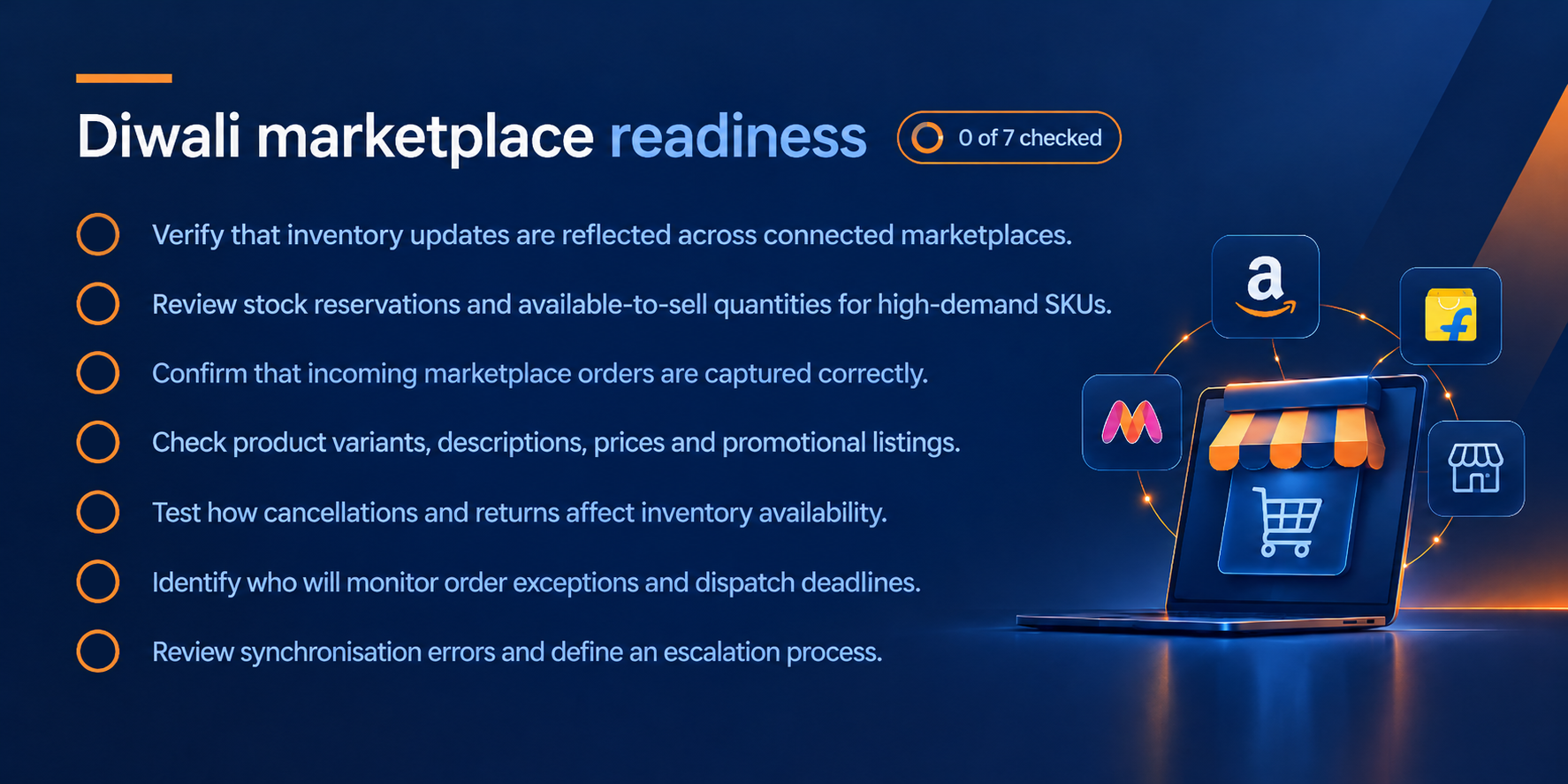
A useful additional step is to conduct a controlled test before the main campaign begins.
For example, place a test order through one connected channel and verify whether the order is captured, inventory is updated correctly and the relevant order status is reflected in the operational system.
Where supported, repeat the test for cancellations, product variants and pricing changes.
These checks can reveal configuration or data issues before higher order volumes make them more difficult to resolve.
How Ordazzle Supports Marketplace Management
For businesses operating across multiple marketplaces, maintaining separate processes for orders, inventory and product listings can increase operational complexity.
Ordazzle's marketplace management solution brings connected marketplace and webstore operations into a centralised environment.
The platform supports multiple shop management, marketplace inventory synchronisation, product and price listing updates, and promotion synchronisation.
Through its marketplace management capabilities, Ordazzle enables businesses to consolidate orders from connected online stores, monitor inventory across sales channels and synchronise product information, pricing and orders.
These capabilities can help e-Commerce teams reduce manual coordination and maintain better visibility across their marketplace operations.
For sellers preparing for Diwali demand, the value lies in having a more connected process for managing the information that drives marketplace sales and fulfilment.
Prepare Your Marketplace Operations for the Diwali Rush
Diwali sales can create opportunities to reach more customers across online marketplaces. But expanding sales channels also increases the number of orders, inventory movements and product updates that businesses must manage.
Accurate marketplace management helps sellers maintain control over these activities as order volumes rise.
The most important preparation is to ensure that stock availability reflects actual commitments, orders move into the right processing workflows and product listings remain accurate across connected channels.
Businesses that address these operational requirements before their festive campaigns are better positioned to handle higher demand without relying heavily on manual corrections.
CTA: See how Ordazzle helps you manage orders, inventory and product listings across connected marketplaces. Let’s talk!
Common Questions e-Commerce Leaders Ask
1. How can businesses manage inventory across multiple marketplaces during Diwali?
Businesses can use a centralised inventory management process to maintain stock visibility across connected sales channels. Inventory synchronisation helps reflect stock changes as orders are placed, reducing the risk of overselling and manual reconciliation.
2. What is marketplace order synchronization?
Marketplace order synchronization is the process of transferring and updating order information between online marketplaces and a central order management system. It helps businesses maintain visibility into incoming orders, status changes and fulfilment activities.
3. How does marketplace listing management help during festive sales?
Marketplace listing management helps businesses maintain accurate product descriptions, variants, prices and availability across sales channels. During festive promotions, it reduces the effort required to update multiple listings and helps prevent inconsistent product information.
4. Can marketplace inventory management software prevent overselling?
Marketplace inventory management software can reduce overselling by synchronising stock availability across connected channels. Its effectiveness depends on accurate inventory records, integration performance, stock reservation rules and timely updates.
5. What should sellers check before launching Diwali marketplace promotions?
Sellers should verify inventory accuracy, order integrations, product listings, promotional pricing and fulfilment readiness. They should also test order synchronisation and establish procedures for handling stock discrepancies, cancellations and delayed orders.
6. Why is centralised marketplace management important for growing e-Commerce businesses?
As businesses expand across marketplaces, managing orders, stock and product data independently becomes more time-consuming. Centralised marketplace management helps teams coordinate operations, reduce repetitive manual work and maintain better visibility across connected sales channels.