Inventory Control System: Top Features for e-Commerce Businesses

Managing inventory has become one of the most complex operational challenges for modern digital retailers. Fast-growing brands often sell across multiple marketplaces, e-Commerce stores, and warehouses, making stock visibility difficult to maintain.
An effective inventory management system helps e-Commerce brands track stock across channels, prevent overselling, automate replenishment, and streamline fulfilment operations.
For brands scaling across India, Southeast Asia, and APAC, adopting modern e-Commerce inventory management software is no longer optional. It is essential for operational efficiency, accurate order fulfilment, and sustainable growth.
What Is an Inventory Control System?
An inventory control system is a technology framework that helps e-Commerce businesses track, manage, and optimize inventory across sales channels, warehouses, and fulfilment locations. A modern inventory management system typically enables:
- Real-time stock visibility across channels
- Automated stock updates after every sale
- Inventory synchronization across marketplaces
- Demand forecasting and replenishment planning
- Fulfilment coordination with warehouses
For e-Commerce brands selling across multiple platforms, an advanced e-Commerce inventory management system ensures that every sales channel reflects accurate stock availability. Without this capability, operational errors quickly multiply.
Why Do Fast-Growing e-Commerce Brands Struggle With Inventory Control Management?
Fast-growing digital retailers often face inventory challenges because operations scale faster than systems. Most brands initially manage inventory through spreadsheets or disconnected software tools. As order volume increases, this approach breaks down.
Common problems include:
- Inventory mismatches across marketplaces
- Overselling due to delayed stock updates
- Stockouts during peak sales periods
- Difficulty managing multiple warehouses
- Manual reconciliation between platforms
“e-Commerce brands that rely on disconnected operational systems often struggle with inventory accuracy, fulfilment delays, and limited operational visibility.”
What Causes Inventory Control System Mismatches Across Marketplaces?
Inventory mismatches occur when different sales channels do not share real-time stock updates.
For example, a brand selling on a direct-to-consumer website and multiple marketplaces may have separate dashboards for each channel.
When an order is placed on one platform, inventory updates may not immediately reflect on others. This creates scenarios where:
- Products are oversold
- Orders must be cancelled
- Customers receive delayed shipments
An integrated e-Commerce inventory management software solution solves this problem by synchronizing stock levels across all platforms in real time.
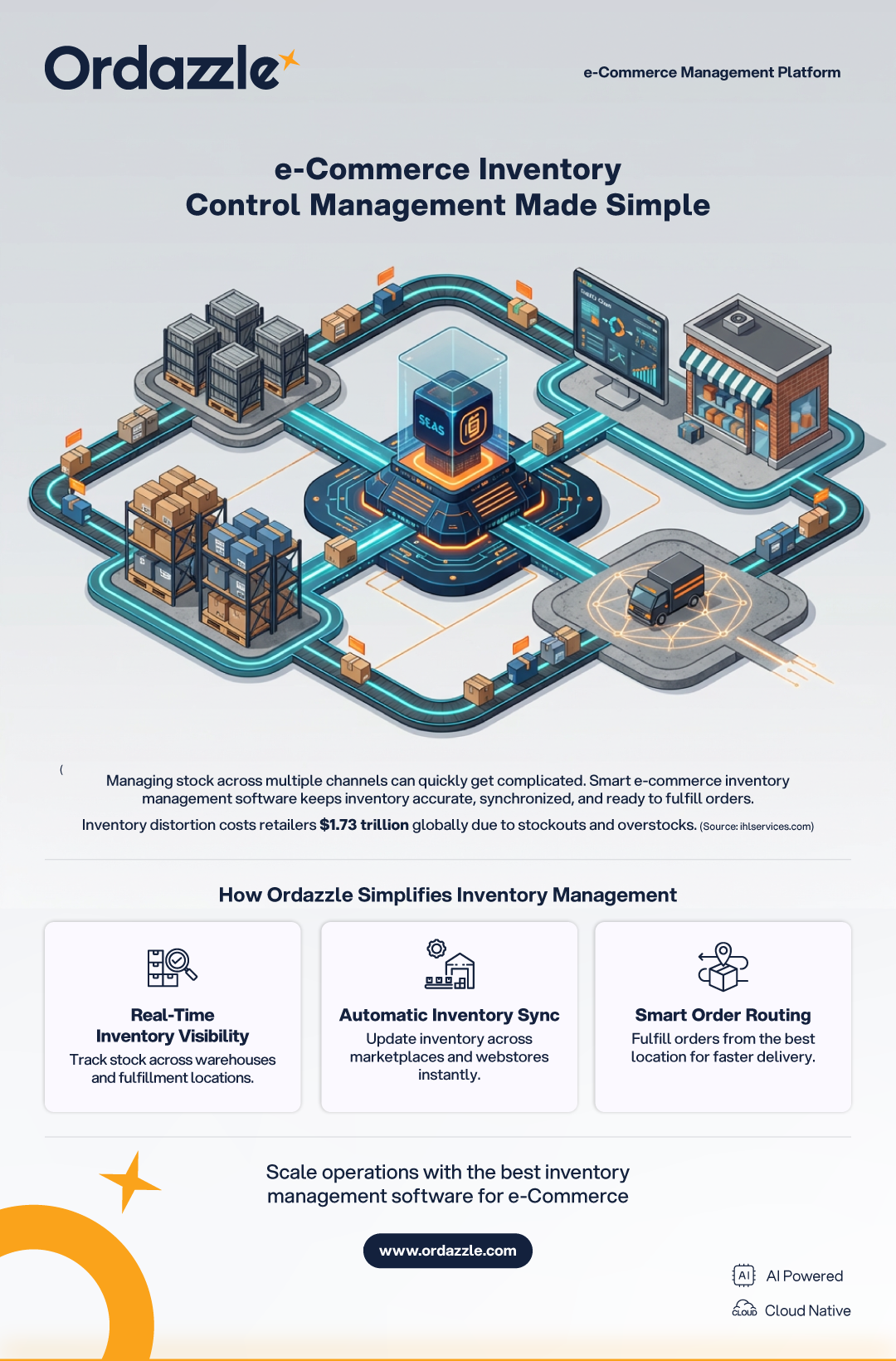
The 5 Most Important Features of Modern Inventory Management Software
Not all inventory platforms are designed for the complexity of modern e-Commerce operations. The best inventory management software includes features that support scalability, automation, and operational visibility.
1. Real-Time Inventory Visibility
The foundation of any inventory management system is accurate stock visibility. Retailers must be able to track inventory across:
- Multiple warehouses
- Marketplace channels
- e-Commerce storefronts
- Fulfilment centers
- Real-time visibility reduces overselling and improves order fulfilment speed.
2. Multi-Warehouse Inventory Management
Many growing brands operate across multiple fulfilment locations. An advanced inventory control management platform allows brands to track stock across:
- Central warehouses
- Regional fulfilment hubs
- Third-party logistics providers
- This capability supports faster shipping and better stock distribution.
3. Automated Inventory Synchronisation
Automation is essential for scaling e-Commerce operations.
A modern e-Commerce inventory management system automatically updates stock levels whenever:
- An order is placed
- A product is returned
- New inventory is received
- Orders are cancelled
- This automation prevents manual errors and improves operational efficiency.
4. Order and Fulfilment Integration
Inventory systems should not operate independently from order management. When inventory data connects with fulfilment workflows, brands can:
- Allocate stock to the nearest warehouse
- Prioritize urgent orders
- Prevent fulfilment delays
- This integration is critical for brands operating across multiple marketplaces.
5. Operational Intelligence and Anomaly Detection
Inventory errors can sometimes indicate deeper operational problems. Modern e-Commerce inventory management software increasingly uses analytics and AI to detect anomalies such as:
- Unusual order spikes
- Potential fraud transactions
- Abnormal inventory movements
These insights help e-Commerce teams respond quickly before operational issues escalate.
Operational Scenario: A Growing D2C Brand Managing Multiple Marketplaces
Imagine a fashion brand selling through:
- Its Shopify store
- Amazon marketplace
- Flipkart marketplace
Orders arrive through separate dashboards. Inventory is tracked through spreadsheets, and warehouses update stock manually.
As order volume increases, the brand starts facing:
- Frequent stock mismatches
- Order cancellations due to overselling
- Delayed fulfilment
- Operational confusion across teams
With a unified inventory management software platform, orders from all channels are consolidated, stock updates occur in real time, and fulfilment decisions become automated.
This transformation enables brands to scale operations without increasing operational complexity.
The Operational Framework for Scalable e-Commerce Inventory Management
Successful digital retailers rely on several core operational pillars.
The 4 Pillars of Scalable e-Commerce Operations
- Unified order management
- Real-time inventory visibility
- Fulfilment orchestration across warehouses
- Intelligent anomaly detection
Together, these pillars create a resilient operational foundation that supports growth across multiple sales channels.
Signs Your e-Commerce Inventory System Is Failing
Many e-Commerce leaders recognise operational problems only after they begin affecting customer experience.
Watch for these warning signs.
✔ Orders are processed across multiple dashboards
✔ Inventory mismatches across marketplaces
✔ Frequent overselling or stockouts
✔ Manual reconciliation between systems
✔ Limited visibility across warehouses
✔ Increasing fulfilment delays during sales spikes
If several of these problems exist, it may be time to adopt a modern inventory control system.
How Modern e-Commerce Operations Platforms Solve Inventory Challenges
Managing inventory effectively requires more than standalone stock tracking tools. Modern e-Commerce operations platforms combine multiple capabilities, including:
- Order management systems
- Warehouse management
- Product information management
- Marketplace integrations
- Inventory orchestration
- Fraud monitoring and anomaly detection
Platforms such as Ordazzle e-Commerce Operations Platform help brands unify these functions into a single operational system. This integrated approach allows e-Commerce businesses to manage orders, products, inventory, and fulfilment workflows from one dashboard while maintaining complete operational visibility.
Key Takeaways
- Inventory management is one of the most critical operational challenges for e-Commerce brands.
- Disconnected systems often lead to stock mismatches and fulfilment delays.
- Modern e-Commerce inventory management software enables real-time stock visibility across channels.
- Automation and AI-driven insights improve operational efficiency and reduce errors.
- Integrated operations platforms help e-Commerce brands scale without increasing complexity.
Conclusion
As e-Commerce brands expand across marketplaces, warehouses, and fulfilment networks, operational complexity increases dramatically. A modern inventory management system provides the visibility and automation needed to manage stock effectively while maintaining a seamless customer experience.
Brands that invest in scalable inventory control management frameworks will be better equipped to handle rapid growth, marketplace expansion, and rising customer expectations.
See How Ordazzle Helps e-Commerce Brands Scale
Ordazzle helps fast-growing e-Commerce brands streamline order management, inventory orchestration, warehouse operations, and marketplace integrations in a unified operations platform.
Explore how Ordazzle simplifies e-Commerce operations and enables scalable growth.
Let’s connect with our experts today.
Common Questions e-Commerce Leaders Ask
What is e-Commerce inventory management?
e-Commerce inventory management refers to the process of tracking, controlling, and optimizing product stock across online sales channels, warehouses, and fulfilment networks.
It ensures that accurate inventory levels are reflected across all marketplaces and e-Commerce stores.
Why do D2C brands need inventory management software?
D2C brands often sell through multiple channels, including their own website and marketplaces. Inventory management software ensures stock levels remain synchronized across these platforms, preventing overselling and improving fulfilment efficiency.
What is the difference between an inventory control system and an inventory management system?
An inventory control system focuses primarily on tracking stock levels and movements, while an inventory management system includes additional capabilities such as demand forecasting, warehouse coordination, and fulfilment automation.
How does AI help improve e-Commerce inventory management?
AI-powered systems analyse patterns in orders and stock movements to detect anomalies such as fraud, unusual order spikes, or inventory discrepancies. These insights help e-Commerce teams respond quickly to operational risks.
What causes stockouts in e-Commerce?
Stockouts often occur due to inaccurate demand forecasting, delayed inventory updates across marketplaces, and disconnected operational systems that prevent real-time stock visibility.