Why Inconsistent Product Listings Across Channels Are Costing e-Commerce Brands Sales
Quick Summary
- Product listings often become inconsistent as brands expand across websites, marketplaces, and social commerce channels.
- Different titles, images, descriptions, and attributes create customer confusion and hurt conversions.
- Inconsistent product information increases returns, operational costs, and time-to-market.
- A centralized product information management software solution helps brands maintain accurate and consistent product data across every channel.
The Hidden Cost of Product Data Inconsistency
Scaling an e-Commerce business today means selling everywhere.
Brands operate across their own websites, marketplaces, quick commerce platforms, and social commerce channels. Every new channel creates another opportunity for growth—but also another source of operational complexity.
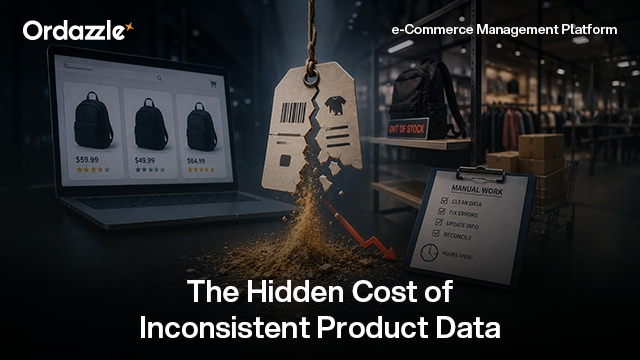
A product may be called "Women's Running Shoes" on one marketplace, "Ladies Sports Sneakers" on another, and carry different specifications, images, or descriptions elsewhere.
Customers notice these inconsistencies.
And when they do, trust suffers.
According to a consumer study by Salsify, 87% of shoppers say product content is extremely or very important when deciding whether to make a purchase online. Inaccurate or incomplete information can directly impact conversions and customer confidence.
Product information is no longer just data. It has become part of the customer experience.
What Is Product Information Management?
Product Information Management (PIM) is the process of centralizing, enriching, and distributing product information from a single source of truth across all sales channels.
A product information management system enables brands to manage:
- Product titles
- Descriptions
- Images and videos
- Attributes and specifications
- Category mapping
- Marketplace-specific content requirements
Instead of updating listings manually across multiple channels, brands can manage product information centrally and publish it consistently everywhere.
Why Do Product Listings Become Inconsistent Across Channels?
Product listings become inconsistent because product data often lives across disconnected systems such as spreadsheets, ERP systems, marketplace portals, and supplier databases.
As brands add more channels and SKUs, managing product information manually becomes increasingly difficult.
Common causes include:
- Multiple teams updating product information
- Different marketplace requirements
- Lack of centralized product governance
- Manual data entry
- Frequent product changes and launches
- Missing approval workflows
The result is operational friction that compounds as the business scales.
Why Does Product Data Consistency Matter So Much?
Consistent product information improves customer trust, marketplace performance, and operational efficiency. Inconsistent data creates confusion, increases returns, and slows down growth.
According to research from the National Retail Federation, 16.9% of retail sales were returned in 2024, with inaccurate product information being one of the contributors to avoidable returns.
For e-Commerce brands, every incorrect specification, missing image, or inconsistent description creates potential revenue leakage.
The Business Impact of Inconsistent Product Listings
Lower Conversion Rates
Customers rely heavily on product information before making a purchase decision. Missing or conflicting information creates uncertainty and increases abandonment rates.
Higher Return Rates
Incorrect product descriptions and specifications often result in customers receiving products that do not meet expectations.
Poor Marketplace Performance
Many marketplaces reward complete and accurate listings with improved search visibility and conversion performance.
Slower Product Launches
Teams spend significant time updating and validating information across multiple channels.
Increased Operational Costs
Manual product management requires additional resources and increases the likelihood of errors.
Checklist: Signs Your Product Data Is Becoming Unmanageable
- Product titles differ across marketplaces.
- Teams maintain multiple spreadsheets.
- Product launches take weeks.
- Images and specifications are frequently incorrect.
- Marketplace teams manually update listings.
- Product information errors are causing returns.
- Customer support receives frequent product-related complaints.
If several of these challenges sound familiar, your business may have outgrown manual product management.
Why Fast-Growing Brands Need Product Information Management Software
As businesses scale, product complexity increases faster than order volume.
Managing thousands of SKUs across multiple channels requires operational discipline and automation.
Product information management software helps brands:
- Improve product data accuracy
- Accelerate time-to-market
- Deliver consistent customer experiences
- Reduce operational effort
- Support omnichannel growth
- Improve marketplace performance
Expert Commentary:
e-Commerce brands that rely on disconnected systems to manage product data often struggle with operational efficiency and customer trust. A centralized product information strategy creates the foundation for scalable growth.
How Ordazzle Helps Brands Manage Product Information at Scale
Modern e-Commerce operations platforms such as Ordazzle help brands centralize and orchestrate product information across channels.
Ordazzle's product information management software for e-Commerce enables brands to:
- Centralize product data management
- Synchronize listings across marketplaces
- Standardize product attributes
- Automate product updates
- Detect anomalies in product information
- Integrate product data with OMS, inventory, and fulfilment systems
As brands scale across channels, product consistency becomes a competitive advantage.
Key Takeaways
- Product information consistency is essential for customer trust and conversions.
- Inconsistent listings create operational inefficiencies and increase returns.
- Manual product management does not scale across multiple channels.
- Product Information Management creates a single source of truth for product data.
- Fast-growing brands need centralized product data management to support omnichannel expansion.
Final Thoughts
As e-Commerce becomes increasingly multi-channel, product information is no longer just operational data—it is a growth driver.
The brands that succeed will be the ones that can deliver consistent, accurate, and compelling product experiences across every customer touchpoint.
Discover how Ordazzle's Product Information Management solution helps brands simplify operations and scale faster across marketplaces and digital channels.
Book a demo with Ordazzle experts today.
How Modern Platforms Like Ordazzle Support Product Information Management
What is a PIM system in e-Commerce?
A PIM system centralizes and manages product information so it can be distributed accurately across multiple sales channels.
Why is product information important in e-Commerce?
Product information directly influences customer trust, conversions, and return rates.
Can PIM improve marketplace performance?
Yes. Accurate and complete product listings often improve discoverability and conversion performance on marketplaces.
When should a business invest in PIM software?
Businesses should consider PIM when managing multiple channels, large SKU catalogs, or experiencing product data inconsistencies.
Does PIM replace an ERP?
No. ERP systems manage operational and financial processes, while PIM focuses specifically on product information management and distribution.