e-Commerce Logistics Software: When Should You Upgrade to a Logistics Management System?

Every e-Commerce business hits a logistics inflection point. Orders are coming in faster than you can process them, delivery exceptions are mounting, and your team is spending more time firefighting than optimising.
At some stage, the tools that got you here - manual tracking, fragmented systems, carrier spreadsheets - simply can't take you further.
The question isn't whether to invest in e-Commerce logistics software. It's knowing when the right time is and what to look for when you do.
What Is a Logistics Management System?
A logistics management software or system (LMS) is a technology platform that enables businesses to plan, execute, and optimise the movement of goods across the supply chain. In an e-Commerce context, this spans everything from order routing and carrier selection to last-mile tracking and returns management.
Unlike generic supply chain tools, modern e-Commerce logistics software is built for the speed, volume, and complexity of online retail with real-time data, API integrations, and automation at its core.
The Limitations of Managing Logistics Manually
Before investing in a logistics management software solution, many growing e-Commerce brands rely on a patchwork of tools: carrier portals, manual rate comparisons, shared spreadsheets, and email chains. This works, until it doesn't.
The operational ceiling of manual logistics management typically presents as:
- Increasing order errors and misroutes as volume scales
- No centralised view of shipments across multiple carriers
- Limited ability to proactively flag or resolve delivery exceptions
- Slow returns processing leading to customer dissatisfaction
- Inability to compare carrier rates automatically, leading to cost inefficiencies
When these signs appear consistently, the ROI case for integrated logistics management becomes clear.
What Is Integrated Logistics Management?
Integrated logistics management refers to a unified approach where all logistics functions - warehousing, order processing, carrier management, tracking, and returns - operate from a single connected system rather than isolated tools.
An integrated logistics management system connects with your e-Commerce platform, warehouse management system (WMS), and carrier network to create a seamless, automated flow of orders from placement to delivery.
This integration eliminates data silos, reduces manual handoffs, and gives you operational visibility you simply can't get from disconnected tools.
Key Benefits of Upgrading to Logistics Management Software
1. Reduced Operational Costs
Logistics management software automates carrier rate comparison, route optimisation, and shipment allocation, ensuring every order ships via the most cost-effective method without manual intervention. Over time, these micro-efficiencies compound into significant cost savings.
2. Faster Order Fulfilment
With automated order routing and carrier assignment, the time between order confirmation and dispatch shortens dramatically. For e-Commerce brands competing on delivery speed, this is a meaningful advantage.
3. Real-Time Visibility
A robust logistics information system provides live tracking data across all carriers, centralised in a single dashboard. Customer-facing tracking updates can be automated, reducing WISMO (Where Is My Order?) enquiries to your support team.
4. Better Exception Management
Delivery exceptions - delays, failed attempts, address issues - are inevitable at scale. Logistics software solutions flag these proactively, enabling your team to resolve them before they escalate into customer complaints or refund requests.
5. Improved Returns Management
Returns are a major cost centre for e-Commerce brands. Integrated logistics management software streamlines the returns process - from label generation to inspection and restocking - reducing processing time and improving the customer experience.
Components of an Integrated Logistics System
A well-implemented integrated logistics management system typically includes:
- Order management module: Receives and processes orders from all channels in real time.
- Carrier management: Multi-carrier rate shopping, label generation, and shipment booking.
- Tracking and visibility: Real-time shipment status across all carriers and delivery stages.
- Returns management: Automated returns initiation, tracking, and processing.
- Analytics and reporting: Performance metrics by carrier, region, and time period to drive smarter decisions.
- API integrations: Connections with e-Commerce platforms, WMS, ERP, and marketplace channels.
Ordazzle's integrated logistics management platform covers all of these components within a single, purpose-built platform.
When Is the Right Time to Upgrade?
The right time to invest in logistics management software is before your logistics problems become customer experience problems. Specifically, consider upgrading when:
- Daily order volume exceeds 200–300 shipments
- You're working with more than 2–3 carrier partners simultaneously
- Your team is spending more than 2 hours/day on manual logistics tasks
- You're receiving regular complaints about delivery accuracy or tracking updates
- You're expanding into new regions or adding new fulfilment centres
At this scale, the cost of not upgrading - in time, errors, and customer churn - outweighs the investment in a proper integrated logistics management system.
How Logistics Software Improves Order Fulfilment
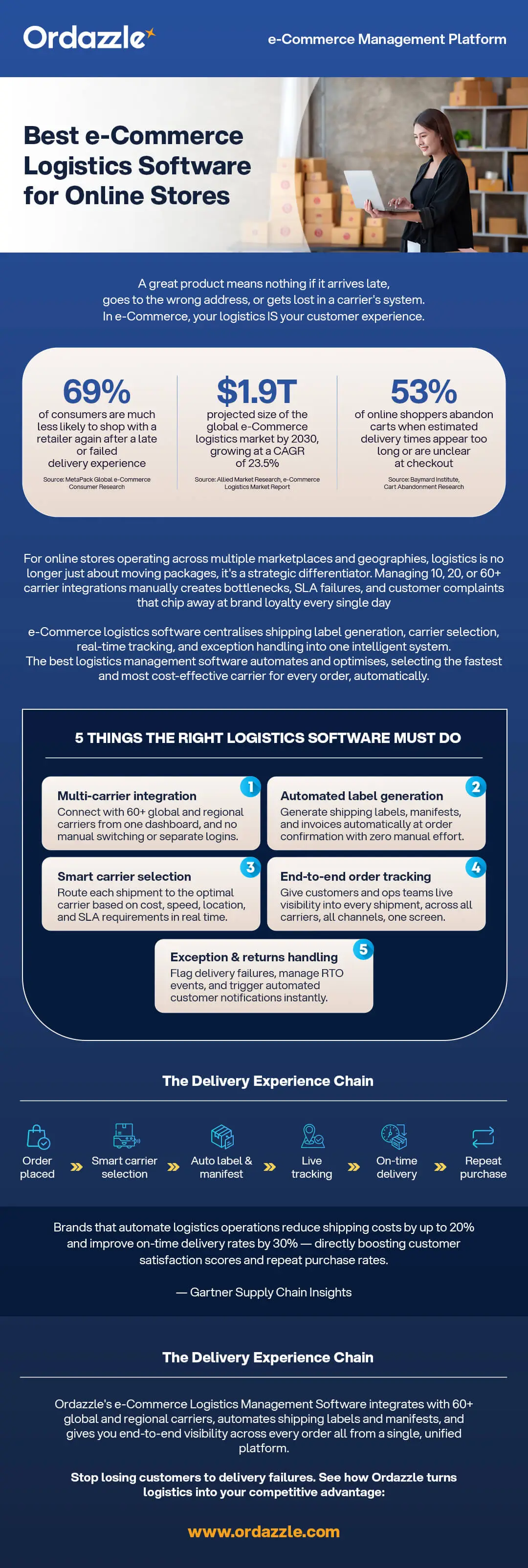
Order fulfilment is the operational core of e-Commerce. Logistics management solutions improve it in several ways:
- Smart order routing: Orders are automatically assigned to the optimal fulfilment centre based on proximity, inventory levels, and carrier availability.
- Automated carrier selection: Rate shopping logic ensures each shipment uses the best carrier for cost and speed.
- Batch processing: High-volume operations can process hundreds of shipments simultaneously with minimal manual input.
- SLA monitoring: Built-in alerts flag orders at risk of breaching delivery commitments before they become failures.
The result is a faster, more reliable fulfilment operation that scales with your growth — without proportionally scaling your headcount.
Ordazzle’s Logistics Management
If your logistics operations are slowing you down, it's time to think differently. Ordazzle's e-Commerce logistics software is built to give high-growth e-Commerce brands the visibility, automation, and control they need to deliver reliably at scale.
Explore the solution and see how Ordazzle can transform your fulfilment operations.
Frequently Asked Questions
How does logistics software reduce operational costs?
By automating carrier rate comparison, optimising delivery routes, and reducing manual handling errors, logistics management software drives cost efficiency at every stage of the shipping process.
What are the benefits of using logistics management software?
Faster fulfilment, lower costs, better tracking visibility, proactive exception management, and streamlined returns are the primary benefits of a robust integrated logistics management system.
What are the components of an integrated logistics system?
Order management, carrier management, real-time tracking, returns management, analytics, and API integrations are the core components of an effective logistics information system.
How can logistics software improve order fulfilment?
Through smart order routing, automated carrier selection, batch processing, and SLA monitoring, e-Commerce logistics software significantly accelerates the time from order confirmation to doorstep delivery.
Is logistics management software suitable for small e-Commerce businesses?
Yes, though the ROI typically becomes most compelling at higher order volumes. Many logistics software solutions offer modular pricing that scales with your business.
Can logistics software handle cross-border shipments?
Absolutely. Advanced logistics management software includes cross-border capabilities such as customs documentation, duty calculation, and international carrier integrations.