Why Every Online Store Needs an e-Commerce Inventory Management System
Running a modern online store is no longer only about great products and strong marketing. It also entails operational precision. Today’s e-Commerce ecosystem is fast, multi-channel, competitive, and unforgiving. You’re selling on marketplaces, your own website, social commerce platforms, and maybe even offline channels. Orders flow in from everywhere. Stock moves across multiple locations. Marketplaces penalize delays. And customer expectations are high.
In this landscape, inventory becomes your most vulnerable, and most powerful, lever for profitability.
This is exactly why every online retailer, regardless of size or scale, now needs a robust e-Commerce inventory management system. It is no longer “good to have.” It is foundational to growth, customer experience, and operational control.
The New Reality of e-Commerce: High Velocity, High Complexity
The last five years have reshaped retail. Online marketplaces have multiplied. D2C brands have exploded. Customers expect next-day delivery everywhere. And competition is intense. This has introduced three realities for online sellers:
1. Demand is unpredictable.
Peak events, influencer campaigns, marketplace sales, and seasonal spikes create volatility.
2. Inventory is fragmented.
Brands now stock across multiple nodes, including warehouses, dark stores, franchise stores, 3PLs.
3. Channels have multiplied.
Amazon, Flipkart, Meesho, Myntra, Shopify, WooCommerce, each with its own rules.
Manual management or spreadsheets simply cannot keep up with this pace. This complexity is exactly where an inventory management software becomes indispensable.
What is an e-Commerce Inventory Management System?
A dedicated e-Commerce inventory management system is software designed to track, sync, and control stock across all online channels in real time.
Unlike traditional retail inventory systems, which often revolve around store-level stock, e-Commerce requires:
- Marketplace syncing
- Real-time updates
- Multi-warehouse visibility
- Automated replenishment
- Automated routing
- Centralized catalogue control
- Handling of cancellations, returns, and RTO
- SLA-driven order fulfilment
In short: e-Commerce needs automation. Because every minute of stock delay can lead to overselling, penalties, lost Buy Box opportunities, and poor customer experience.
Common Inventory Challenges Online Stores Struggle With
Stockouts That Kill Conversions and Repeat Sales
Out-of-stock items are one of the biggest causes of lost revenue. If your bestseller goes out of stock, customers don’t wait, they switch. Marketplaces penalize repeatedly unavailable SKUs, reducing your visibility further.
Overselling Due to Poor Syncing
This is the biggest nightmare for online sellers. Orders flowing from multiple channels, without a real-time sync, overbook your stock. Overselling leads to:
- Cancellation penalties
- Customer dissatisfaction
- Lower marketplace scores
- Poor Buy Box chances
An e-Commerce stock management software eliminates this by centralizing and updating stock instantly.
Inaccurate Demand Forecasting
Without unified data, forecasting becomes guesswork. This results in:
- Overstocking (dead capital)
- Understocking (lost revenue)
- Higher warehousing costs
- Poor purchase planning
Siloed Catalogue & Marketplace Operations
Every marketplace has its own formats, rules, and templates. Manual updates lead to:
- Listing errors
- Wrong prices
- Delisting's
- Brand credibility issues
Inefficient Returns (RTO and RTV)
Returns are messy without automation. Delayed reconciliation means stock remains blocked, unavailable for sale, and inaccurately recorded.
These issues may seem small, but across thousands of orders every month, the business impact is massive.
Why Online Stores Need an Advanced Inventory Management Software Today
Real-Time Multi-Channel Syncing
A modern multi-channel inventory management software syncs stock across all selling channels instantly.
- Amazon → updated
- Website → updated
- Myntra → updated
- Warehouse → updated
No delays. No human intervention.
Accurate Stock Across Multiple Warehouses
If your stock is spread across dark stores, FCs, or 3PLs, accuracy becomes critical An. e-Commerce stock management software ensures one view of inventory across nodes.
Automated Replenishment & Reorder Rules
A reliable and AI-powered inventory management software gives you automated SKU-level triggers based on:
- Safety stock
- Sales velocity
- Ageing
- Forecasting
This ensures you never run out of fast-moving items.
Reduction in Manual Errors
Automation in your e-Commerce inventory management system removes repetitive tasks like:
- Daily stock uploads
- Manual catalogue updates
- Manual recon
- Spreadsheets cleanup
Better SLA Management for Faster Dispatch
Accurate inventory → Better pick-pack efficiency → Faster deliveries → Better marketplace ratings.
Marketplace-Specific Logic & Catalog Compliance
This is where a marketplace inventory management software becomes essential. It adapts to marketplace-specific formats, variations, procurement rules, and dispatch SLAs.
How Does an Inventory Management Software Work?
- Pulls inventory and catalogue data from all channels (marketplaces, website, ERP, WMS).
- Consolidates them into a unified dashboard.
- Pushes stock updates instantly whenever a sale happens.
- Smart Order Routing where marketplace orders are automatically routed to the nearest or most optimal warehouse.
- Handles RTO/RTV seamlessly ensuring reverse logistics is synced, and stock is auto-updated upon return.
- Manages safety stock and marketplace buffers, reducing overselling risk significantly.
This is exactly why online-first brands rely heavily on automation to scale efficiently.
Multi-Channel Inventory Management Software: The Backbone of Scaling Online
Selling on one channel is simple. Selling everywhere is profitable, but complex.
Why Multi-Channel = Higher Growth
More channels mean:
- More customers
- More revenue
- Better visibility
- Higher brand trust
But it also means:
- More stock splits
- More reconciliations
- More routing rules
- More operational load
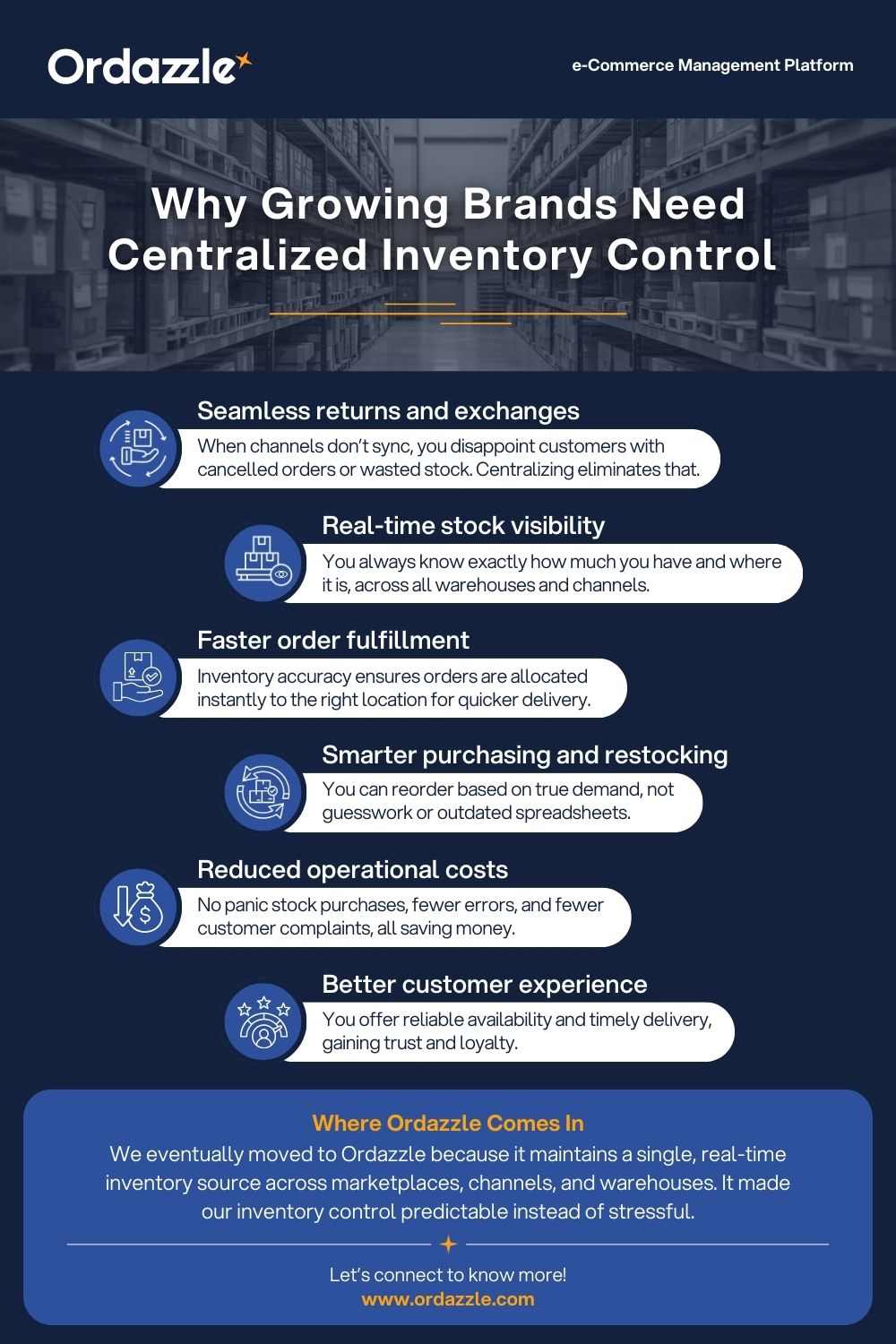
This is why sellers need a strong e-Commerce stock management software that manages inventory from one central location.
Benefits of Using the Right System
- Zero overselling
- Unified SKU master
- Correct stock across all channels
- Better forecasting
- Streamlined warehouse operations
- Higher customer satisfaction
Key Features Every e-Commerce Inventory Management System Should Have
To decide whether an inventory management system for e-Commerce is capable enough, look for:
- Centralized catalogue and product attributes
- Multi-warehouse inventory view
- Reorder automation
- Marketplace syncing
- SKU-level safety stock
- Cycle counting & stock audits
- Batch/lot/expiry tracking
- Ageing analysis
- Vendor and purchase order management
- Demand forecasting
- RTO/RTV workflows
- Real-time dashboards and reports
The goal is stock visibility as well as operational intelligence.
Impact of Using an Inventory Management System for e-Commerce on Profitability
Lower Carrying Costs
The right stock at the right time prevents overstocking and reduces dead inventory.
Reduced Cancellations & RTO
Accurate stock leads to smoother fulfilment outcomes.
Improved Cash Flow
Better forecasting reduces unnecessary purchase orders.
Higher Customer Satisfaction and LTV
Customers return to brands that reliably deliver what they promise.
How to Choose the Right e-Commerce Inventory Management System for Your Online Store
Your checklist should include:
- Does it integrate with all your channels and marketplaces?
- Does it scale as your SKUs and order volumes increase?
- Does it automate daily repetitive tasks?
- Does it offer intelligent routing and warehouse visibility?
- Does it simplify reconciliation?
- Does onboarding require minimal effort?
- Is reporting deep, customizable, and real time?
Why Ordazzle Stands Out as a Multi-Channel Inventory Management Software
With 35+ years of retail and omni-commerce expertise behind it, Ordazzle brings a strong technology and operational heritage to e-Commerce brands. Ordazzle’s inventory management system for e-Commerce centralizes:
- Catalogue
- Inventory
- Orders
- Routing
- Pick-pack workflows
- Replenishment
- Marketplace integrations
Analytics
Key advantages include:
- Unified, real-time inventory visibility across all selling channels
- Smart, automated order routing for faster SLAs
- A centralized product master to prevent catalogue errors
- AI-driven fulfilment intelligence for stock allocation
- Excel-based onboarding for fast go-live
- Multi-node management for scaling across warehouses and FCs
If you are ready to build that foundation, explore a modern marketplace inventory management software with Ordazzle today and prepare your business for its next stage of growth.
Final Thoughts: Inventory is Your Online Store’s Invisible Revenue Engine
Inventory is a backend process. It is also your operational backbone. Your ability to sell, fulfil, retain customers, and scale profitably depends on it. With increasing competition, short delivery expectations, and multi-channel retail becoming the norm, sellers need strong systems, not more manpower or spreadsheets.
A modern inventory management system for e-Commerce equips your business with real-time visibility, accurate stock updates, automated replenishment, and operational control. To stay competitive, efficient, and profitable, every online store, every D2C startup or a multi-marketplace brand should invest in a robust, automated, and scalable inventory management solution.
Frequently Asked Questions (FAQs)
1. What is an e-Commerce inventory management system?
An e-Commerce inventory management system is a software solution that tracks, updates, and controls stock across online channels in real time. It centralizes catalogue data, syncs inventory across marketplaces and webstores, automates replenishment, manages warehouse stock, and ensures products remain available for sale without overselling or stockouts.
2. How does marketplace inventory management software work?
Marketplace inventory management software connects your catalogue, stock, and order data with all online marketplaces. It pulls real-time inventory from warehouses, updates stock instantly after every sale, manages channel-specific rules, routes orders to the best fulfillment node, and reconciles returns (RTO/RTV) automatically. This prevents overselling and improves fulfilment accuracy.
3. Why is multi-channel inventory management important for online businesses?
A multi-channel inventory management software ensures a single, real-time view of stock across marketplaces, D2C websites, and warehouses. It prevents overselling, improves order accuracy, reduces cancellations, and helps retailers scale across channels without operational chaos. Accurate multi-channel control directly supports faster fulfilment and higher customer satisfaction.
4. What are the benefits of using inventory management software for e-Commerce?
An inventory management software helps e-Commerce brands avoid stockouts, prevent overselling, automate replenishment, reduce manual errors, streamline warehousing, and improve delivery SLAs. This leads to better customer experience and higher profitability.
5. How does real-time inventory syncing help online sellers?
Real-time inventory syncing updates stock instantly across all channels after every order, return, or stock adjustment. This ensures accurate availability, prevents duplicate sales, and improves marketplace performance metrics like cancellation rate and Buy Box visibility.