Choosing the Right e-Commerce Order Fulfilment Model: 4 Key Options Explained
Customer expectations around delivery have changed dramatically. Shoppers now expect faster shipping, real-time order updates, and seamless delivery experiences regardless of where they purchase, whether from your website, marketplaces, or social commerce channels.
At the same time, managing fulfilment has become increasingly complex. Businesses must coordinate inventory across multiple sales channels, meet marketplace delivery SLAs, and maintain accurate stock visibility while keeping costs under control.
This is why an efficient e-Commerce order fulfilment strategy has become a critical growth driver. The right fulfilment model doesn't just ensure products reach customers on time—it improves customer satisfaction, reduces operational costs, and creates the foundation for scalable growth.
Order fulfilment, by definition, is the process of receiving, processing, packing, shipping, and delivering customer orders while efficiently managing returns. A robust order management system e-commerce helps businesses streamline these processes and deliver consistent customer experiences.
What Does e-Commerce Order Fulfilment Cover?
Inventory Receiving
- Before products can be sold, they need to be:
- Received at warehouses or fulfilment centres
- Inspected for quality and quantity
- Categorized and stored efficiently
- Updated in inventory systems for real-time visibility
Order Processing
When a customer places an order, the fulfilment process automatically triggers:
- Order validation
- Inventory allocation
- Picking and packing
- Shipping label generation
- Invoice creation
Shipping & Delivery
This stage focuses on getting products to customers efficiently through:
- Carrier selection
- Shipping cost optimization
- Delivery tracking
- Last-mile fulfilment management
Read more: How to Choose the Right Logistics Management Software
Returns Management
A strong reverse logistics process includes:
- Return requests and approvals
- Product inspection
- Refund or exchange processing
- Inventory updates after returns
Common eCommerce Order Fulfilment Challenges
1. Inventory Stockouts and Overstocking
Poor inventory visibility can lead to stock shortages or excess inventory, both of which directly impact profitability and customer satisfaction.
2. Multi-Channel Order Complexity
Managing inventory and orders across websites, marketplaces, and retail stores often creates data silos and operational inefficiencies.
3. Marketplace SLA Pressure
Online marketplaces have strict fulfilment timelines. Delayed shipments can result in penalties, poor seller ratings, and lost visibility.
4. Inventory Synchronization Issues
Without real-time inventory synchronization, businesses risk overselling, cancelled orders, and inaccurate stock information.
5. Shipping Costs and Logistics Complexity
Carrier costs, delivery zones, and international shipping regulations can significantly impact margins.
6. Demand Fluctuations
Seasonal sales and promotional events often put immense pressure on fulfilment operations.
7. Returns and Exchanges
An inefficient returns process can increase operational costs and negatively impact customer loyalty.
8. Delivery Delays and Customer Experience
Late deliveries can damage brand trust and lead to negative reviews, higher support costs, and reduced repeat purchases.
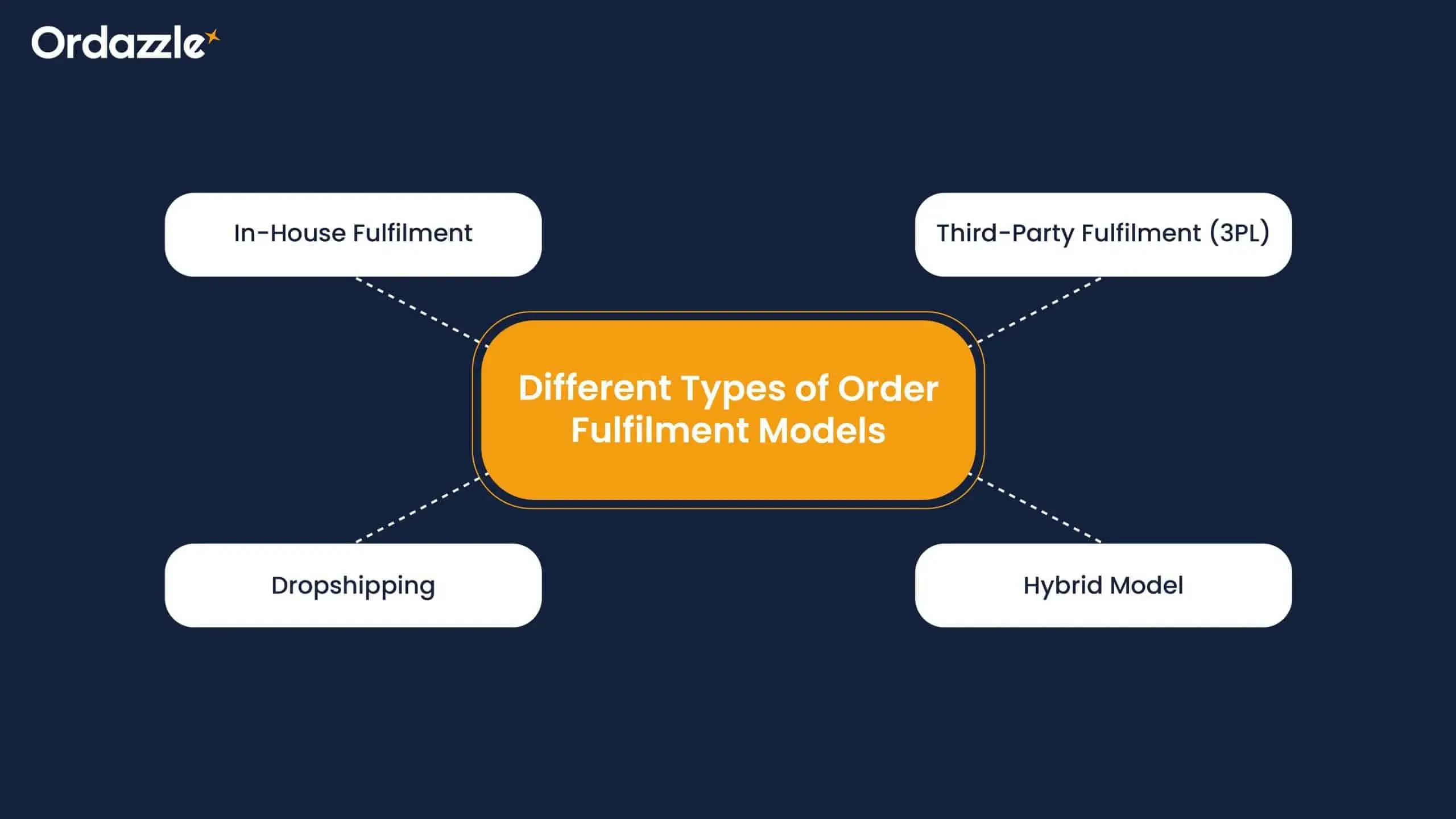
Comparison of eCommerce Order Fulfilment Models
| Fulfilment Model | Best For | Advantages | Challenges |
|---|---|---|---|
| In-House Fulfilment | Established businesses with stable demand | Complete control, branding flexibility | Higher operational costs |
| Third-Party Fulfilment (3PL) | Growing and scaling businesses | Logistics expertise, lower shipping costs | Reduced operational control |
| Dropshipping | Startups and low-risk market entry | Minimal inventory investment | Supplier dependency |
| Hybrid Fulfilment | Omnichannel and multi-region businesses | Maximum flexibility and scalability | Operational complexity |
Read more: e-Commerce Order Fulfillment Challenges and How Ordazzle Solves Them
Types of e-Commerce Order Fulfilment Models
In-House Fulfilment
Advantages
- Full control over inventory and operations
- Greater branding and packaging flexibility
- Direct oversight of customer experience
- Faster decision-making
Limitations
- Requires warehouse infrastructure
- Higher staffing and operational costs
- Complex inventory management requirements
Best For
Businesses with predictable demand and strong operational capabilities.
Scalability
Moderate. Scaling requires additional warehouse space and resources.
Cost Considerations
High initial investment but can become cost-efficient at larger volumes.
Third-Party Fulfilment (3PL)
Advantages
- Outsourced logistics management
- Reduced warehouse requirements
- Lower shipping costs through carrier partnerships
- Faster market expansion
Limitations
- Less control over fulfilment operations
- Dependence on third-party service quality
- Integration challenges with existing systems
Best For
Businesses experiencing rapid growth or seasonal demand fluctuations.
Scalability
Very high.
Cost Considerations
Lower capital expenditure but ongoing service fees.
Dropshipping
Advantages
- Minimal upfront investment
- No inventory holding costs
- Easy product expansion
Limitations
- Supplier dependency
- Limited control over delivery times
- Lower profit margins
- Product quality risks
Best For
Startups and businesses testing new markets.
Scalability
High, depending on supplier reliability.
Cost Considerations
Low initial investment but reduced profit margins.
Hybrid Fulfilment
Advantages
- Combines in-house and outsourced fulfilment
- Supports marketplace-specific strategies
- Enables regional fulfilment optimization
- Improves multi-warehouse management
Limitations
- More complex operations
- Requires strong technology integration
- Higher coordination requirements
Best For
Large omnichannel retailers and businesses with diverse product categories.
Scalability
Very high.
Cost Considerations
Flexible costs depending on fulfilment mix.
Factors to Consider Before Choosing a Fulfilment Model
Order Volume
Evaluate current and future order volumes, including seasonal demand spikes.
Budget and Operational Costs
Assess warehouse costs, staffing requirements, and outsourcing expenses.
Geographic Expansion
Consider whether your fulfilment strategy can support regional and international growth.
Customer Experience Goals
Determine how much control you need over packaging, delivery speed, and post-purchase experiences.
Technology Requirements
Choose a model that supports:
- Real-time inventory synchronization
- Smart order routing
- Multi-channel integration
- Warehouse visibility
- Automated returns management
Scalability Needs
Your fulfilment strategy should support long-term growth without increasing operational complexity.
Why Technology and OMS Integration Matter
Modern fulfilment operations require more than warehouses and shipping partners. An advanced Order Management System (OMS) helps businesses:
- Synchronize inventory across channels in real time
- Automatically route orders to the best fulfilment location
- Integrate marketplaces, webstores, and retail outlets
- Automate returns and exchanges
- Improve warehouse visibility and operational efficiency
- Reduce fulfilment errors and delivery delays
A centralized OMS creates a connected fulfilment ecosystem that enables businesses to scale efficiently while delivering exceptional customer experiences.
Simplify e-Commerce Fulfilment with Ordazzle
Accelerate fulfilment, improve inventory visibility, and manage orders across every sales channel from a single platform.
With Ordazzle's Order Management Solution, you can:
- Automate order processing
- Synchronize inventory in real time
- Reduce delivery errors
- Scale across marketplaces and regions
- Deliver faster and more reliable customer experiences
Ready to streamline your e-Commerce fulfilment operations? Connect with Ordazzle today.
Common Questions e-Commerce Leaders Ask
What is e-Commerce order fulfilment?
e-Commerce order fulfilment is the complete process of receiving, processing, packing, shipping, and delivering customer orders while also managing returns and exchanges.
Which order fulfilment model is best for growing businesses?
Third-party fulfilment (3PL) and hybrid fulfilment models are often ideal for growing businesses because they offer scalability and operational flexibility.
How can businesses reduce order fulfilment costs?
Businesses can reduce fulfilment costs by optimizing inventory management, automating order processing, improving warehouse efficiency, and using technology for smart shipping decisions.
Why is an Order Management System important for fulfilment?
An OMS provides real-time inventory visibility, automates order routing, integrates multiple sales channels, and improves fulfilment accuracy, helping businesses scale efficiently.