e-Commerce Order Fulfillment Challenges and How Ordazzle Solves Them

e-Commerce growth appears very attractive from the outside. More and more sales channels. More and more orders. More and more customers.
However, what happens in the background is that the complexity of order fulfillment increases exponentially. Each new marketplace, warehouse, logistics partner, or peak in customer acquisition adds to the complexity. What was manageable before becomes unmanageable. Delays rise. Errors creep in. Profits dwindle quietly.
This is where most companies go wrong. They view order fulfillment as a back-office operation rather than a strategic asset. And without a robust oms order management system, the back office will eventually set the pace for business growth.
Let’s discuss the challenges of order management in e-Commerce, and how Ordazzle’s OMS is designed to tackle them in an organized and scalable manner.
The Real Bottlenecks in e-Commerce Order Fulfillment
1. Order Volume Is Not the Problem. Variability Is.
Processing 500 predictable orders a day is feasible. Processing 500 orders on five marketplaces, three delivery options, cash on delivery and prepaid payment flows, and various warehouse rules is a different story altogether.
The nature of modern e-Commerce order fulfillment is not linear. It is dynamic. Each order has parameters:
- Pin code-based delivery SLAs
- Payment validation rules
- Inventory split rules
- Warehouse priority rules
- Marketplace regulations
When such complexity is manually or loosely integrated, operational gaps begin to show.
Ordazzle’s solution begins at the point of entry. Orders are not merely captured. They are validated, filtered, and processed according to business rules. Orders can be automatically accepted, held, or rejected according to predefined rules.
This prevents chaos from entering the fulfillment chain.
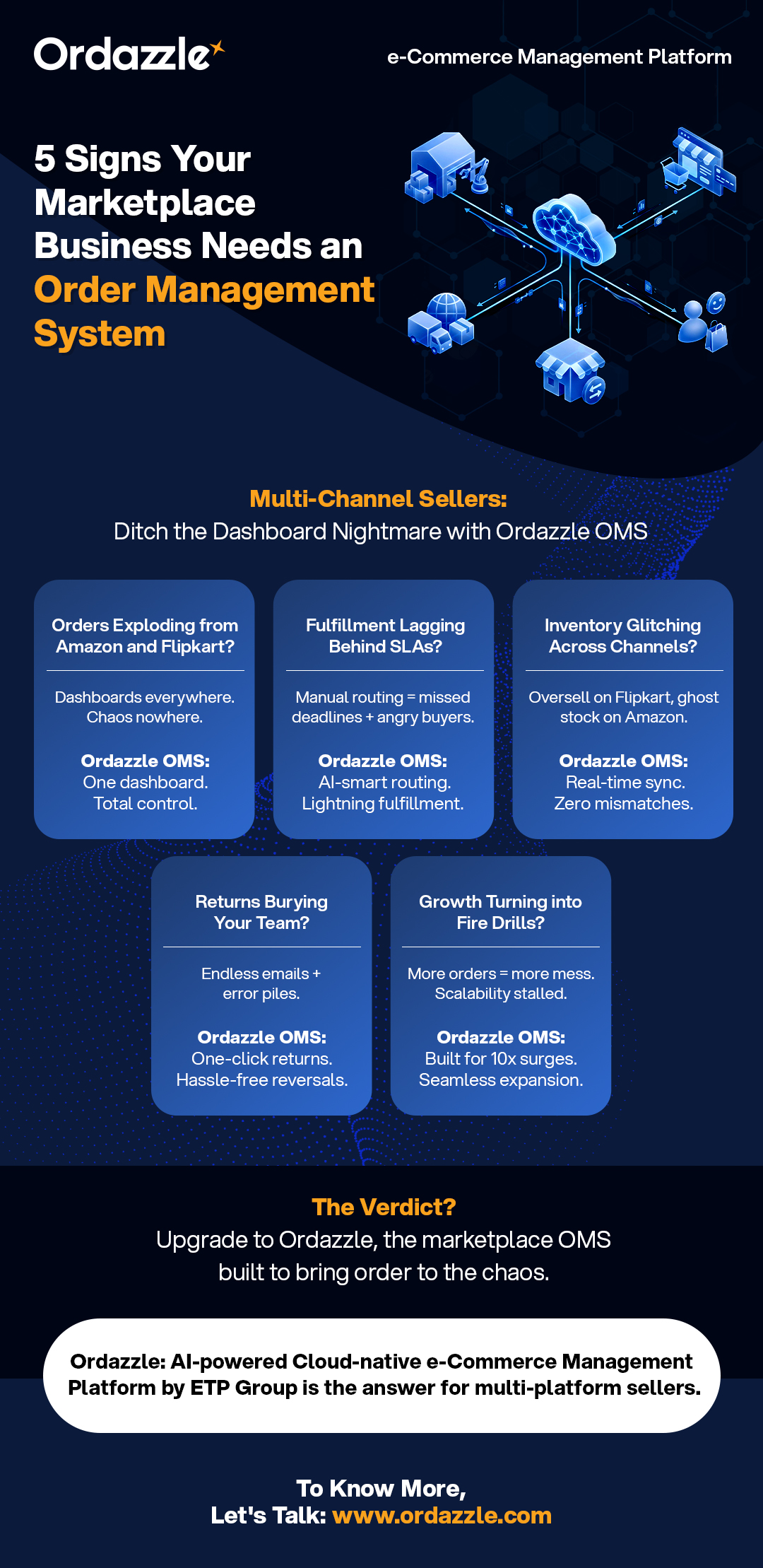
2. Marketplace Order Management Is Fragmented
Marketplace growth drives revenue. However, each marketplace brings unique workflows, rules, and time zones. Without a unified view, teams resort to managing multiple dashboards and spreadsheets.
The problem is not marketplace growth. The problem is a lack of unified orchestration.
To manage marketplaces effectively, order management must include:
- Real-time synchronization
- SLA tracking
- Exception handling
- Combined tracking updates
Ordazzle brings all marketplace orders into a unified control layer. Teams no longer have to log in and out of multiple portals. They work from a single place where status, allocation, and shipping processes are synchronized.
What this improves is decision velocity. With everything in one place, teams can respond instead of react.
3. Inventory Disconnect Is the Silent Revenue Killer
Inaccuracy in inventory is among the costliest mistakes in e-Commerce. Overselling results in cancellations and charges. Under-selling results in lost sales. Inefficient allocation results in higher logistics costs.
A sophisticated order management system for e-Commerce should consider the inventory as a dynamic variable, not a fixed value.
Ordazzle automatically synchronizes inventory across warehouses, marketplaces, and online stores in real-time. The moment an order is placed, inventory levels are updated everywhere. Allocation rules check inventory before allocating.
This minimizes:
- Inventory shortages
- Overselling
- Split-shipments
- High last-mile delivery costs
It also creates something of greater value: trust. Consumers trust brands that keep promises.
4. Order Routing Is Often Too Basic
Many brands are still using order routing based on a default location or geographic routing. This may be fine for small volumes, but it does not optimize cost or delivery.
Optimized fulfillment needs decision intelligence.
Ordazzle’s OMS uses rule-based routing. Orders are routed based on:
- Availability of inventory
- Closest to the customer
- Fulfillment priority
- Cost factors
- Delivery SLAs
This dynamic routing ensures that the most efficient node is used for each order. This optimizes shipping cost and delivery time together.
When routing becomes intelligent, the fulfillment process shifts from being reactive to being strategic.
5. Manual Fulfillment Processes Don’t Scale
Picking, packing, labeling, shipping, and tracking. When these processes are not integrated or are semi-manual, the chances of errors are directly proportional to the volume of orders.
A good e-Commerce order management software should integrate the entire operational process flow from allocation to shipping.
Ordazzle integrates the following processes:
- Order allocation
- Pick list creation
- Packing confirmation
- Labeling
- Shipping notifications
All these processes occur in one single workflow process. Exceptions are identified at the earliest opportunity. There is a process to work with, rather than winging it.
This leads to fewer errors, quicker shipping, and a predictable volume of orders even during peak periods.
6. Returns Are Treated as Damage Control
Returns are no longer a secondary process. Return rates in many product categories are above 20 percent. This affects the bottom line and customer retention.
Returns are handled poorly in most systems as manual afterthoughts. However, a good e-Commerce order management system is one that weaves reverse logistics into the main process.
- Ordazzle automates:
- Return validation
- QC workflows
- Inventory reintegration
- Refund or replacement triggers
It also monitors important metrics such as RTO and customer-driven returns. High RTO in an area could mean problems with the delivery partners. Regular returns of a product could mean inconsistencies in listings.
Returns become a feedback loop, not just an expense.
Why Traditional Order Management Software Falls Short
Most of the older order management systems were designed for more straightforward models of commerce. They are centered on the recording of transactions, rather than their orchestration.
However, today’s order management for e-Commerce needs:
- Multi-channel ingestion
- Intelligent routing
- Real-time inventory management
- Automated exception handling
- Reverse logistics integration
If you are simply tracking orders, rather than orchestrating them, you are constantly compensating by manually handling the process.
The approach taken by Ordazzle is different. It is a central nervous system. Orders are ingested, validated, routed, fulfilled, tracked, and closed in a single environment.
It is this clarity that enables scalability without chaos.
How Ordazzle’s OMS Order Management System Drives Scalable Growth
Let’s shift the perspective from problem solving to growth enablement.
A strong oms order management system does more than prevent errors. It enables expansion.
- Faster Marketplace Expansion
Because integrations are API-driven, adding new marketplaces does not require rebuilding operational workflows. Orders from new channels flow into the same orchestration layer.
Growth does not increase complexity linearly. It becomes manageable.
- Consistent Customer Experience
Customers do not care which warehouse shipped their order. They care about speed, visibility, and accuracy.
With centralized orchestration:
- Tracking updates are consistent
- Delivery commitments are realistic
- Cancellations are minimized
- Refunds are processed systematically
- Operational excellence directly correlates to brand credibility.
- Data-Driven Operational Decisions
With all orders processed through one system, you get visibility into structured data points:
- Order turnaround time
- Warehouse performance
- SLA performance
- Return trends
- Channel performance
This enables leadership teams to make decisions not by assumption but by data.
An advanced e-Commerce order management software should provide visibility into these operational areas. Ordazzle offers visibility that helps with strategic decisions, not just operational ones.
The Strategic Role of an e-Commerce Order Management System
Let’s take a step back.
In today’s market, driving traffic is marketing. Driving spikes is promotions. Driving reach is marketplaces. But sustainability is fulfillment.
Without a structured e-Commerce order fulfillment system:
- Marketing investment is lost due to cancellation
- Customer acquisition costs increase
- Review ratings fall
- Operational staff burnout
What this actually means is this: fulfillment discipline equals brand maturity.
An order management system for e-Commerce is more than infrastructure. It’s a differentiator.
Ordazzle is that differentiator. It coordinates orders across channels, executes business rules at scale, routes orders for optimal delivery, tracks inventory in real-time, and reverse-logistics integration is seamless.
Brands can stop fighting operational fires and start growing.
Building Future-Ready Order Management e-Commerce Operations
The future of business will not make things simpler. It will raise:
- Expectations for same-day delivery
- Hyperlocal delivery models
- Cross-border transactions
- Diversity in marketplaces
- Flexibility for returns
- Rigid systems will not be able to adapt.
A future-proof e-Commerce order management system should be flexible, API-centric, and rule-based. It should handle growth without having to re-engineer core business processes annually.
The OMS at Ordazzle is built with adaptability in mind. Business rules can change. Routing decisions can change. New connections can be added. The system grows with the brand.
This is what will ensure long-term growth.
Final Perspective
Success in e-Commerce is no longer about opening an online store and attracting customers. It is about managing complexity with precision.
Each order is a promise. The question is whether your technology is able to keep that promise.
A fragmented stack will eventually constrain growth. A corporealized and intelligent order management software platform enables scale.
Ordazzle’s OMS solution solves the fundamental problems of contemporary order management e-Commerce:
- Multi-channel ingestion
- Automated order validation
- Intelligent routing
- Real-time inventory sync
- Unified fulfillment
- Reverse logistics
This is not about optimizing. It is about developing operational strength sufficient to support digital growth.
In a market where customer demands continue to escalate, fulfillment excellence is no longer a choice. It is a foundation.
Want to know more about Ordazzle OMS? Let’s talk
FAQs
What is the significance of order statuses in the order fulfillment process?
Order statuses give real-time visibility into every stage of e-Commerce order fulfillment, helping teams track, prioritize, and resolve issues faster. An OMS order management system ensures each status update is accurate and automatically synced across channels.
Why is e-Commerce order fulfillment important, and how can an OMS streamline it?
e-Commerce order fulfillment directly impacts delivery speed, accuracy, and customer satisfaction. An order management e-Commerce solution automates routing, inventory allocation, and tracking to reduce delays and manual errors.
What are the benefits of using order management software for online marketplaces?
Order management software centralizes marketplace order management, syncing inventory, orders, and shipping updates across platforms in real time. This prevents overselling and simplifies operations as volumes grow.
Why is order management software essential for scaling online stores and improving fulfillment efficiency?
As order volumes increase, e-Commerce order management software automates workflows, reduces manual tasks, and improves accuracy. A robust order management system for e-Commerce helps businesses scale without operational chaos.