Best Multi-Channel e-Commerce Management for 2026
Selling online in 2026 is no longer about being present on one platform. Customers discover brands on marketplaces, compare prices on social channels, and complete purchases on websites or apps. For sellers, this means one thing: complexity.
Orders, inventory, fulfillment, pricing, and customer expectations now span multiple channels. Without the right e-Commerce management approach, growth quickly turns into operational chaos. This is why multi-channel management has become a non-negotiable capability for modern sellers.
Let’s break down what the best multi channel e-Commerce management looks like in 2026 and how sellers can stay in control as channels multiply.
What Is e-Commerce Management in a Multi-Channel World?
At its core, e-Commerce management is about running your online business as one connected system rather than a collection of disconnected platforms.
A modern e-Commerce system brings together:
- Orders from all channels
- Inventory across warehouses
- Listings and pricing
- Fulfillment and shipping workflows
- Performance and operational data
Instead of logging into multiple dashboards and reconciling data manually, sellers manage everything from one centralized e-Commerce solution.
In 2026, this level of integration isn’t advanced. It’s expected.
Why Multi-Channel Management Is Critical for Online Sellers
Selling on multiple channels increases reach, but it also increases risk.
Without strong multi-channel management, sellers face:
- Overselling due to inventory mismatches
- Delayed shipments caused by manual order handling
- Inconsistent pricing and listings
- Marketplace penalties and poor customer experience
A proper multi channel e-Commerce management setup ensures that all channels operate in sync, even during high-volume sales or seasonal peaks.
What this really means is fewer fires to fight and more time to focus on growth.
e-Commerce Fulfillment: The Backbone of Multi-Channel Success
No matter where an order comes from, fulfillment decides how customers remember your brand.
e-Commerce fulfillment becomes complex when orders flow in from multiple channels. Each platform may have different SLAs, shipping rules, and customer expectations.
The right e-Commerce system helps sellers:
- Route orders automatically to the right warehouse
- Prioritize orders based on delivery promises
- Reduce fulfillment errors with centralized processing
- Track shipments across channels in real time
In 2026, fast and accurate e-Commerce fulfillment is not a differentiator. It’s the baseline.
How an e-Commerce Solution Simplifies Channel Complexity
A strong e-Commerce solution acts as the control center of your business.
Instead of treating marketplaces, D2C websites, and social channels as separate entities, the system unifies them. Orders, inventory, and fulfillment rules flow through one platform.
For sellers, this means:
- One order pipeline instead of many
- Centralized inventory visibility
- Standardized workflows regardless of channel
- Better control over scaling operations
The best e-Commerce business solutions reduce operational noise and bring consistency to daily execution.
Multi Channel e-Commerce Management and Inventory Accuracy
Inventory is the first thing to break in a multi-channel setup.
Without a unified e-Commerce system, stock updates lag, overselling happens, and cancellations rise. This directly affects seller ratings and revenue.
With proper multi channel e-Commerce management:
- Inventory updates in real time across all channels
- Stock buffers can be set per marketplace
- High-demand SKUs are protected during sales events
- Sellers can confidently scale listings without fear
In 2026, inventory accuracy is not just an operational metric. It’s a competitive advantage.
To know how Ordazzle manages multi-channel inventory Management system.
Why Sellers Need an End-to-End e-Commerce System
Point solutions solve individual problems. They don’t solve the whole business.
An end-to-end e-Commerce system connects:
- Channel management
- Order orchestration
- Inventory sync
- Fulfillment workflows
- Performance analytics
This unified approach matters because decisions in one area impact everything else. A pricing change affects demand. A stock update affects fulfillment. A delayed shipment affects marketplace performance.
The best e-Commerce solution provider understands these dependencies and designs systems that work together, not in isolation.
The Role of Automation in e-Commerce Management
Manual processes don’t scale. Automation does.
Modern e-Commerce management relies heavily on automation to:
- Auto-sync inventory across channels
- Auto-route orders for fulfillment
- Auto-update order statuses and tracking
- Auto-handle cancellations and returns
For sellers, automation reduces dependency on people and eliminates avoidable errors. This is especially critical during peak seasons when order volumes spike overnight.
In 2026, automation is the engine behind reliable multi-channel management.
e-Commerce Business Solutions That Support Growth
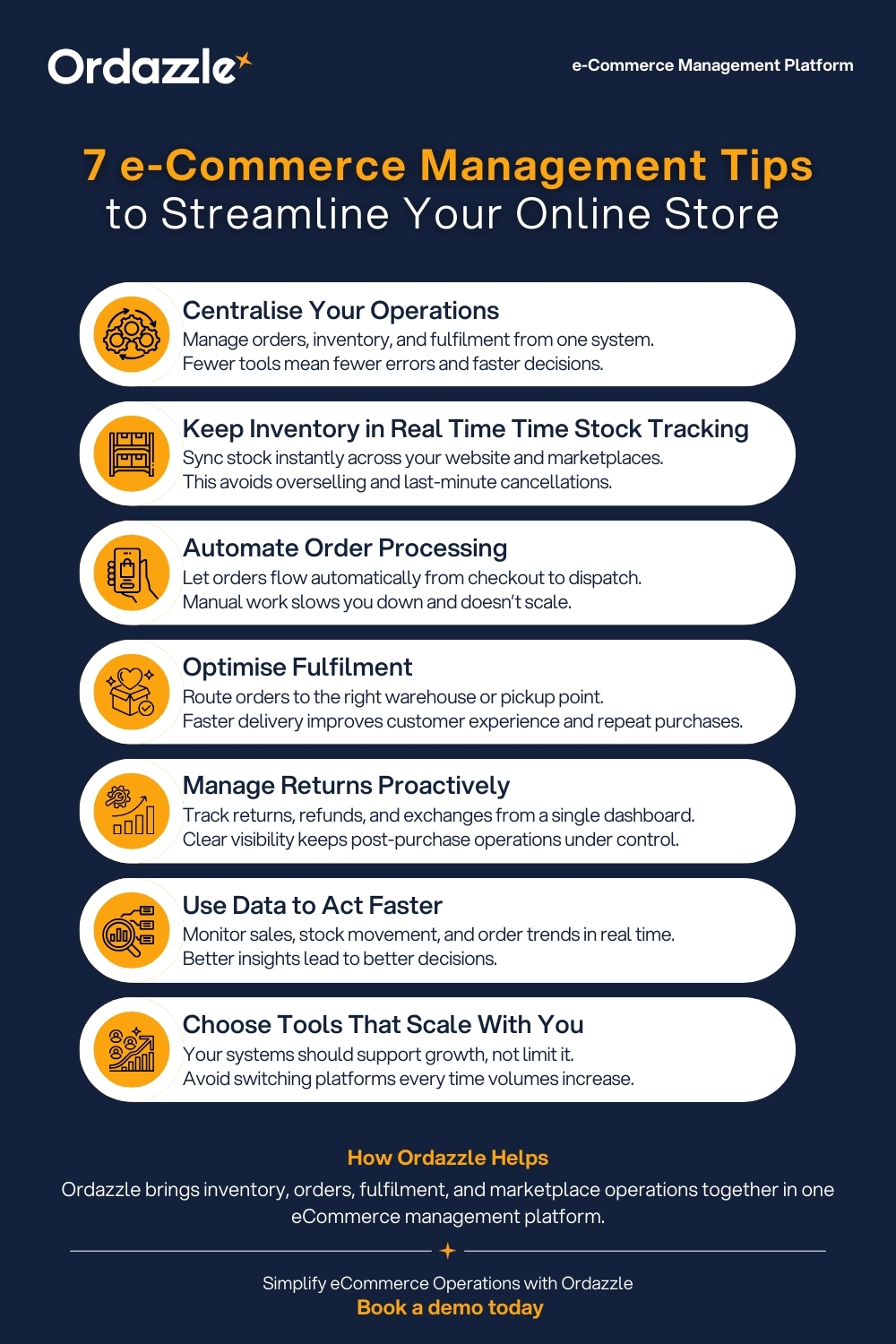
Growth isn’t just about selling more. It’s about handling more without breaking.
The right e-Commerce business solutions support growth by:
- Handling higher order volumes effortlessly
- Supporting new marketplaces and regions
- Maintaining consistent customer experience
- Providing data to guide smarter decisions
Sellers who invest early in scalable e-Commerce management systems grow with confidence. Those who don’t often stall under operational pressure.
Choosing the Right e-Commerce Solution Provider
Not all platforms are built for serious multi-channel sellers.
When evaluating an e-Commerce solution provider, sellers should look for:
- Strong multi-channel management capabilities
- Deep marketplace integrations
- Real-time inventory and order sync
- Scalable fulfillment workflows
- Clear operational visibility
The best providers don’t just offer features. They offer stability, control, and long-term scalability.
Common Mistakes Sellers Make in Multi-Channel e-Commerce
Even experienced sellers fall into these traps:
- Managing each channel independently
- Relying on manual inventory updates
- Using disconnected tools for orders and fulfillment
- Reacting to issues instead of preventing them
These problems compound as channels increase. A unified e-Commerce system prevents these issues before they affect customers or revenue.
Why 2026 Demands Smarter e-Commerce Management
Customer expectations are rising. Marketplaces are stricter. Competition is intense.
In 2026, sellers who succeed will be those who:
- Operate with real-time visibility
- Fulfill orders fast and accurately
- Manage channels from a single system
- Scale without losing control
This level of execution requires more than effort. It requires the right e-Commerce solution.
Ordazzle Multi-Channel Management for Modern e-Commerce Sellers
This is where Ordazzle fits in.
Ordazzle is a comprehensive e-Commerce management platform built specifically for online sellers operating across multiple marketplaces and digital channels. Its multi-channel management capabilities allow sellers to control listings, orders, inventory, and fulfillment from one unified system.
With Ordazzle’s omni-channel marketplace management system, sellers can:
- Manage multiple online channels from a single dashboard
- Sync inventory in real time across all platforms
- Streamline e-Commerce fulfillment with centralized order processing
- Reduce errors, overselling, and manual effort
- Scale operations confidently as channels and order volumes grow
As an experienced e-Commerce solution provider, Ordazzle delivers practical, scalable e-Commerce business solutions designed for how online selling actually works today.
For sellers looking to future-proof their operations and master multi-channel e-Commerce management in 2026, Ordazzle provides the structure, visibility, and control needed to grow without chaos.
Want to know more? Schedule a call today!
Frequently Asked Questions
What is e-Commerce fulfillment?
e-Commerce fulfillment covers the entire process of storing inventory, processing orders, packing, shipping, and tracking deliveries for online sales. A strong e-Commerce system ensures fulfillment is fast, accurate, and consistent across all channels.
What are the solutions for e-Commerce threats?
Effective e-Commerce business solutions address threats like overselling, delayed shipments, and data mismatches through automation and centralized control. A reliable e-Commerce solution reduces operational risks by keeping orders, inventory, and fulfillment in sync.
How does an e-Commerce system work for online businesses?
An e-Commerce system connects sales channels, inventory, orders, and fulfillment into one platform. This enables smooth e-Commerce management and supports scalable multi-channel management.
What are e-Commerce business solutions and how do they help businesses grow?
e-Commerce business solutions are tools that manage inventory, orders, fulfillment, and channels from a single system. They help businesses grow by improving efficiency, enabling multi channel e-Commerce management, and supporting faster e-Commerce fulfillment.