How Small Businesses Benefit from Warehouse Management Software

If you’re running a small business with physical products, you know what a juggling act inventory and fulfillment can be. One day you’re dealing with stockouts, the next you’re hunting down misplaced pallets. The thing is, growth exposes inefficiencies fast. That’s where a warehouse management system comes in.
A warehouse management system (WMS) isn’t just for big enterprises with sprawling distribution centers. Small businesses can get even more value out of it because they lack the people and processes to absorb mistakes. The right wms software can turn chaos into clarity, and frustration into consistency.
Let’s break down exactly how warehouse systems help small businesses operate smarter, faster, and with fewer headaches.
What a Warehouse Management System Actually Is
Before we get into the benefits, let’s be clear on what we’re talking about.
A warehouse management system for e-Commerce is software that helps businesses automate and optimize warehouse operations from the moment goods arrive until they leave. This includes receiving, put away, inventory tracking, picking, packing, and shipping.
You’ve probably used spreadsheets or paper logs in the early days. But those tools can’t give you real-time stock levels, fail to coordinate tasks, and always lag behind reality. A wms system software replaces that guesswork with data, automation, and workflow control.
For a small business, that shift is huge.
Better Inventory Control, Fewer Surprises
Inventory is the backbone of any product business. Get it right, and operations run smoothly. Get it wrong, and you spend more time fixing errors than growing the business.
Here’s what a warehouse management software small business setup gives you:
- Real-time inventory visibility: Instead of guessing what’s in stock, you see exact levels as they change — across locations if you have more than one.
- Accurate counts with barcode or RFID tracking: Manual counts miss things. A WMS captures every transaction digitally, reducing stock discrepancies.
- Fewer stockouts and overstocks: When you know what’s actually on hand, reorder planning gets smarter and purchasing gets leaner.
What this really means is fewer “where did it go?” moments and fewer emergency restocks that kill your margins.
Faster, More Accurate Order Fulfillment
Customers today expect orders to ship fast and correctly. Small businesses lose credibility when packages go out late or with the wrong items.
This is where warehouse systems shine:
- They guide workers on the best routes to pick orders, so teams aren’t wandering around the warehouse.
- They help automate packing checks and shipping label generation.
- They cut down on mis-picks and returns because every scan confirms the right item at the right time.
The bottom line: your fulfillment process becomes faster and more reliable. Fewer errors mean fewer customer complaints and less rework that’s direct cost savings and better brand reputation.
Save Time, Save Money
Small teams don’t have the luxury of dedicated inventory clerks, stock auditors, or fulfillment managers. Every hour a person spends manually checking inventory or correcting errors is an hour lost to growth.
A warehouse management system reduces manual work in a few ways:
- Automated updates eliminate repetitive data entry.
- Optimized task allocation spreads work evenly so no one is stuck waiting for directions.
- Smart picking routes and layouts minimize travel time inside the warehouse.
Those savings add up. You’ll see faster throughput without hiring extra staff, which keeps payroll costs under control as you scale.
Better Use of Warehouse Space
Small businesses often work with limited storage. Inefficient use of that space can cost money or slow operations.
A warehouse management system helps in two ways:
- It suggests where items should be stored based on how often they move. Fast movers go in easy reach, slow movers go further back.
- It tracks capacity and suggests better layouts so space doesn’t go under-used or over-crowded.
For a business renting warehouse space, that efficiency directly impacts storage costs. For a business owning the space, it means you’re making every square foot count.
A Foundation for Scaling
Here’s the tricky thing about growth: it exposes weaknesses fast. What worked with 50 SKUs and ten orders a day won’t work with 500 SKUs and 200 orders.
The transition from spreadsheets to a warehouse management system makes growth predictable:
- You get real-time dashboards that show trends and bottlenecks.
- You add new locations or channels without reinventing all your processes.
- You handle peak seasons without collapsing under pressure.
Put simply, a WMS gives you structure. Which means you can grow without your operations falling apart.
Better Reporting and Decision Making
Small business owners wear many hats. You need data to make decisions faster and with confidence.
Warehouse management software gives you:
- Daily operational reports showing performance and trends.
- Inventory turnover stats so you can plan purchases better.
- Labor productivity metrics so you can optimize staff allocation.
All of this turns gut decisions into informed ones.
The Competitive Edge
Here’s the truth: almost every business selling products today is competing on speed, accuracy, and cost.
Small companies that stick with manual processes find themselves outpaced by competitors with even basic wms software. With a warehouse management system, you get:
- More reliable delivery performance
- Fewer errors that cost money
- Better use of your human and physical resources
In other words, you’re not just catching up to competitors, you’re setting yourself up to outperform them.
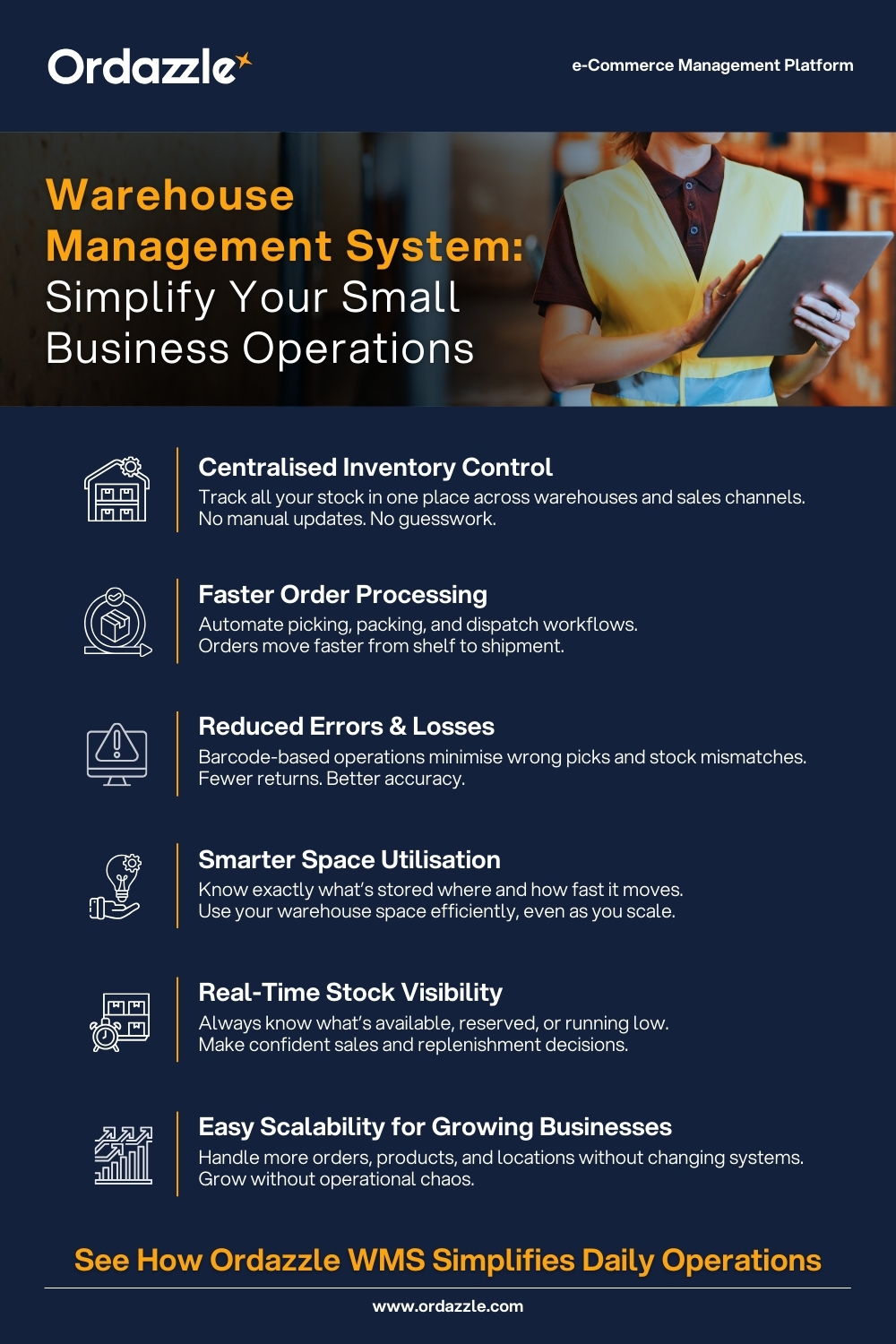
Choosing the Right WMS Software Small Business Needs
Not all systems are equal. Small businesses should look for systems that are:
- Easy to implement without heavy IT support
- Affordable without sacrificing core features
- Scalable, so you don’t outgrow them
Integrated with whatever you already use (ERP, e-Commerce platforms, logistics tools)
A good warehouse management system small business setup should feel like it gives you control without adding complexity.
Ordazzle WMS: Built for Growing Businesses
Now, let’s talk about a specific solution that’s designed with modern small and mid-size operations in mind.
Ordazzle Warehouse Management System (WMS) brings the power of a structured warehouse management system into an intuitive, cloud-ready platform. It’s built to accelerate warehouse operations, cut costs, and give you real-time control over your stock and fulfillment processes.
What makes it stand out for small businesses:
- Enhanced picking, packing, and shipping workflows that reduce errors and speed up order cycles.
- Real-time visibility into stock across zones, bins, and racks, so you always know exactly what you have and where it is.
- Mobile-led control and dashboards that let you manage operations from anywhere.
- Rapid deployment with cloud-native architecture and Excel-based onboarding makes setup easy without a big tech team.
Ordazzle’s WMS integrates with broader operations too, so as you grow into e-Commerce, marketplaces, or multi-location retail, your warehouse system scales with you.
In short, you get enterprise-grade warehouse stock management without the enterprise-grade complexity which is exactly what a small business needs right now.
To know more, Book A Demo Today !
Frequently Asked Questions
What are the core components of a warehouse management system?
A warehouse management system includes inventory tracking, receiving and putaway, picking and packing, shipping, and reporting. Modern wms software also supports barcode scanning and real-time warehouse stock management.
What’s a warehouse management system and do you really need one?
A warehouse management system is software that helps you manage inventory and warehouse operations in one place. If manual tracking causes stock errors, delays, or confusion, a wms system software becomes essential.
How to control the stock in a warehouse?
You control stock by using warehouse systems that track every inbound and outbound movement in real time. A wms warehouse management software ensures accurate counts, faster audits, and fewer stock mismatches.
How do small businesses benefit from warehouse management software?
Warehouse management software small business teams use reduces errors, saves time, and improves order fulfillment. With the right wms software, small businesses gain better visibility and control without adding complexity.