What is Multi-Channel e-Commerce Integration? Benefits & Use Cases

The modern consumer doesn't shop in one place. They discover products on Instagram, compare prices on Amazon, check reviews on your website, and complete the purchase on a marketplace app. For e-Commerce brands, this reality demands more than just a presence across channels. It demands seamless, intelligent integration between them.
That's what multi-channel e-Commerce solutions are built to deliver. This guide breaks down what multi-channel integration means, why it matters, and how the right e-Commerce solution can accelerate your growth.
What Is Multi-Channel e-Commerce Integration?
Multi-channel e-Commerce integration is the process of connecting your sales channels, your website, marketplaces, social commerce platforms, and physical stores, into a unified operational system. Rather than managing each channel in isolation, integration enables you to synchronise inventory, orders, product data, and customer information in real time across all touchpoints.
An effective e-Commerce system underpinning this integration acts as the central nervous system of your operations: receiving orders from all channels, routing them efficiently, and ensuring consistency in pricing, availability, and product content everywhere a customer might find you.
Why Multi-Channel Commerce Requires Integrated Technology
Selling across multiple channels without integration is operationally unsustainable at scale. Without a connected e-Commerce management layer, you're likely dealing with:
- Manual inventory updates across each channel, leading to overselling and stockouts
- Inconsistent product information causing customer confusion and returns
- Fragmented order data making fulfilment slow and error-prone
- No unified view of customer behaviour across channels
- Difficulty scaling to new channels without proportionally increasing team size
The right e-Commerce solution provider addresses all of this through a purpose-built integration architecture.
Core Benefits of Multi-Channel e-Commerce Integration
Real-Time Inventory Synchronisation
Inventory availability updates automatically across every channel the moment a sale is made — eliminating overselling, stockout errors, and the customer frustration that follows. This is one of the most immediate and tangible benefits of multi-channel e-Commerce solutions.
Centralised Order Management
All orders, regardless of which channel they originated from, flow into a single e-Commerce management interface. This gives your operations team a single place to process, track, and manage fulfilment, dramatically reducing manual effort and error rates.
Consistent Product Information
With integrated systems, product data is managed once and distributed uniformly across all channels. No more manually updating ten separate listings when a product description changes or a price is updated.
Improved Customer Experience
Customers who encounter consistent pricing, accurate stock availability, and reliable fulfilment regardless of where they shop develop stronger brand trust — and higher lifetime value.
Data-Driven Decision Making
A unified e-Commerce system consolidates performance data across channels, giving leadership a complete picture of which channels are performing, where margin is being lost, and where to invest next.
Key Use Cases for Multi-Channel e-Commerce Solutions
Marketplace Expansion
Brands looking to expand from their own website to marketplaces like Amazon, Noon, or Flipkart use multi-channel e-Commerce solutions to manage listings, sync inventory, and centralise orders without creating new operational silos.
Omnichannel Retail
Retailers operating both physical stores and digital channels use integration platforms to unify inventory and order data across all locations, enabling services like buy-online-pick-up-in-store (BOPIS) and ship-from-store.
Cross-Border Commerce
Global e-Commerce solutions allow brands to sell across geographies through localised marketplace integrations, handling currency, language, compliance, and carrier routing from a single platform.
D2C and Wholesale Combined
Brands running direct-to-consumer channels alongside wholesale relationships can use integration to manage different pricing tiers, fulfilment workflows, and inventory allocation rules within the same system.
What to Look for in an e-Commerce Solution Provider
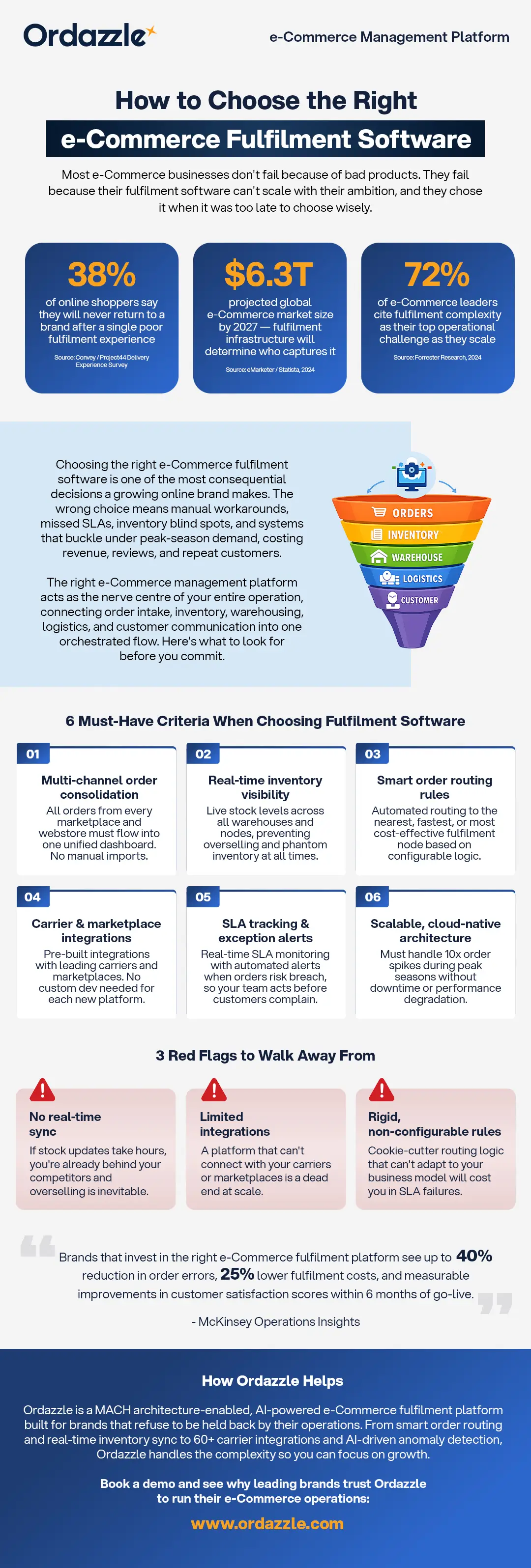
Choosing the right e-Commerce solution provider is a strategic decision. Your provider's platform becomes the backbone of your operations, so look for:
- Breadth of integrations: Native connections with the marketplaces, carriers, and platforms you use today and those you plan to use tomorrow.
- Real-time data synchronisation: Inventory, orders, and product data should update in real time, not in batch cycles.
- Scalability: The platform should handle growth in order volume, SKU count, and channel count without performance degradation.
- e-Commerce fulfilment software: e-Commerce fulfilment software capabilities built into or tightly integrated with the platform.
- Reporting and analytics: Cross-channel performance data accessible in a single dashboard.
- Support and SLA guarantees: Uptime commitments and dedicated support are non-negotiable for business-critical infrastructure.
Ordazzle's platform is designed from the ground up as a global e-Commerce solutions provider for brands operating at scale across complex multi-channel environments.
How e-Commerce Management Systems Improve Business Operations
Beyond channel integration, a robust e-Commerce management system transforms how your entire business operates:
- Automation replaces manual processes: Order routing, inventory updates, and reporting run automatically, freeing your team for strategic work.
- Errors decrease: Systematic data flows reduce the human error that plagues manual, multi-system operations.
- Speed increases: Faster order processing, faster fulfilment, faster customer response.
- Scalability improves: You can add new channels or geographies without rebuilding your operations from scratch.
The result is an operation that can grow without growing pains — and a customer experience that remains consistently strong as you scale.
How Secure Are e-Commerce Management Systems?
Security is rightly a top concern for any brand evaluating e-Commerce solution platforms. Enterprise-grade systems include role-based access controls, encrypted data transmission, regular security audits, and compliance with regional data protection regulations.
When evaluating providers, request documentation on their security architecture, uptime history, and data handling practices.
Ordazzle's multi-channel e-Commerce solutions are built with enterprise security standards at their core.
Ordazzle e-Commerce Solutions
If you're ready to move beyond fragmented, manual multi-channel management, Ordazzle's e-Commerce solutions gives you a single, intelligent platform to manage every channel, every order, and every product — at any scale.
See how it works and take the first step toward truly integrated commerce.
Frequently Asked Questions
What is an e-Commerce solution provider and why do you need one?
An e-Commerce solution provider offers the technology platform that powers your multi-channel commerce operations, from order management and inventory to fulfilment and analytics. You need one when manual or fragmented tools can no longer keep pace with your growth.
How secure are e-Commerce management systems?
Reputable e-Commerce management systems include encryption, role-based access controls, and compliance with regional data protection standards. Always verify security credentials and SLA commitments before committing.
How does e-Commerce management improve business operations?
By automating manual processes, centralising data, and enabling real-time decision-making across channels, e-Commerce management systems reduce costs, improve speed, and enable sustainable scaling.
What's the difference between multi-channel and omnichannel commerce?
Multi-channel means selling through multiple channels; omnichannel means those channels are deeply integrated to create a seamless customer experience. The best multi-channel e-Commerce solutions form the foundation of a true omnichannel strategy.
Can e-Commerce integration platforms handle high order volumes?
Yes. Enterprise-grade e-Commerce system platforms are built for scale, handling thousands of orders per day across multiple channels without performance degradation.