How an Order Management System Solves the Major e-Commerce Fulfilment Challenges

The modern online shopper isn’t just buying a product, they are evaluating fulfilment precision. Delayed deliveries, incorrect orders, lack of tracking and difficult returns instantly push customers to competitors offering better experiences. As brands scale across marketplaces, webstores, offline stores and D2C channels, fulfilment has become the single biggest deciding factor of customer loyalty and profitability.
Yet, most fulfilment challenges don’t originate inside the warehouse, they originate in fragmented systems. When orders, inventory, shipping and returns operate in silos, efficiency collapses. This is precisely where a robust Order Management System (OMS) transforms operations.
Why Modern Retail Needs an OMS Order Management System to Survive Scale
The traditional workflow that once supported 50 orders a day cannot sustain 500 or 5,000+ orders. e-Commerce brands today face multiple operational stressors:
- Multiple sales channels with independent SLAs
- High customer expectations for same-day/next-day delivery
- Frequent stock updates and dynamic catalogues
- Multi-warehouse fulfilment
- Returns and cancellations at unprecedented levels
A centralized order management solution acts as the operational brain of the business, processing orders end-to-end without human friction.
Challenge 1: Stockouts, Overselling & Inaccurate Inventory
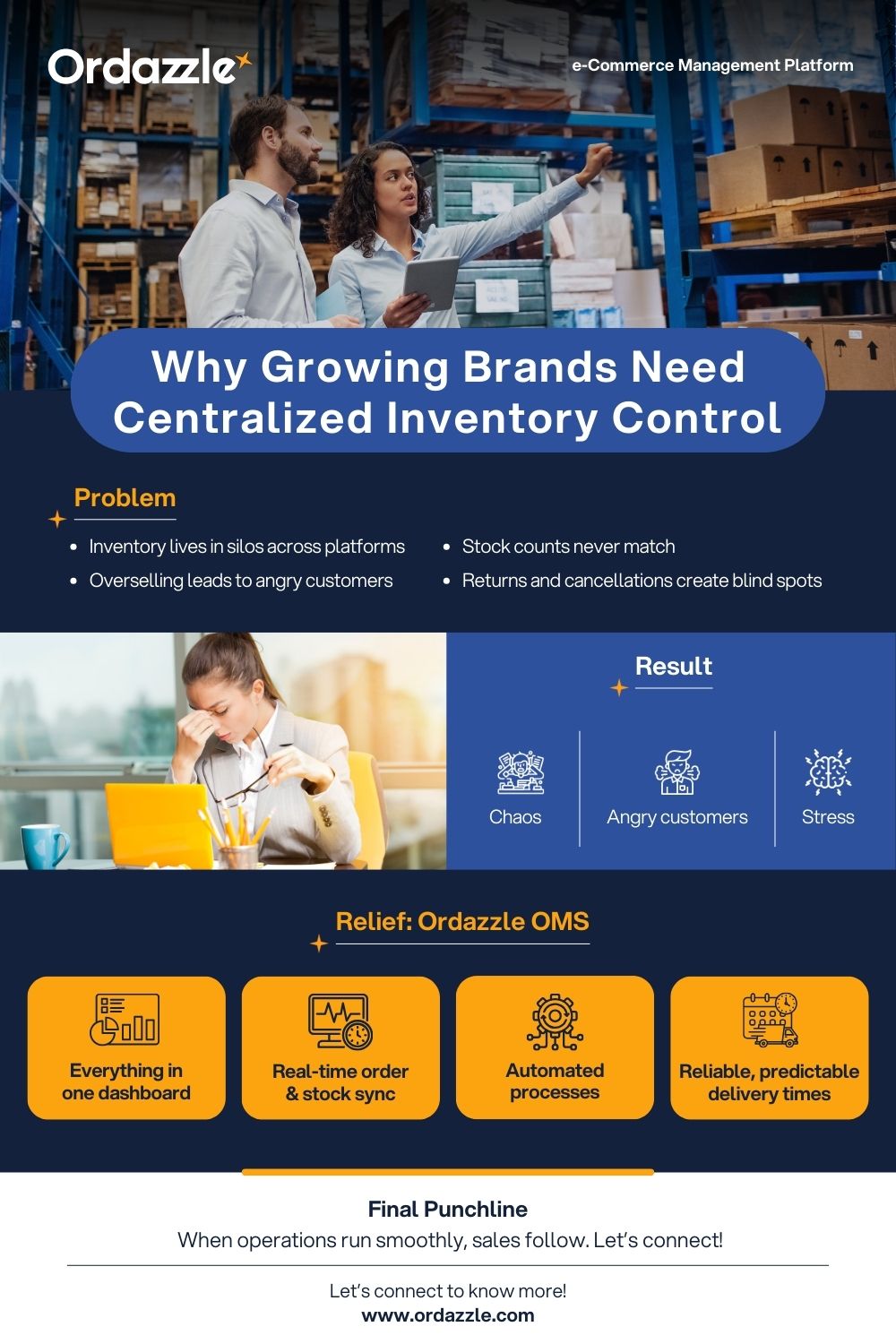
Overselling is one of the fastest ways to lose customer trust and it happens when inventory is not synchronized across channels. Manually updating stock or relying on marketplace panels is prone to delays and human error.
How an online order management system fixes inventory inconsistencies
An e-Commerce order management software synchronizes inventory in real-time across:
- Marketplaces
- Brand website
- Offline stores
- ERP / Warehouse systems
Every order reduces inventory instantly across all channels, eliminating stockouts, backorders and customer escalations.
Challenge 2: High Order Volumes and Peak-Season Bottlenecks
Festive sales, payday weekends or flash deals put tremendous pressure on operations. Manual fulfilment slows down, leading to missed SLAs and penalties.
How an order management system for e-Commerce automates and accelerates fulfilment
A smart e-Commerce order management software automatically:
- Consolidates orders from every channel
- Generates invoices and labels
- Auto-allocates orders to the right warehouse
- Prioritizes fulfilment based on SLAs and cut-off times
This reduces order processing time from minutes to seconds, enabling brands to scale volume without adding manpower.
Challenge 3: Multi-Warehouse & Multi-Channel Fulfilment Complexity
Without automated routing, assigning orders to the best fulfilment node becomes guesswork. This raises logistics costs and slows delivery.
How an online order management solution improves routing & allocation
An order management system for e-Commerce uses rule-based logic to route orders based on:
- Proximity
- Inventory availability
- Pincode serviceability
- Historical delivery performance
- Marketplace SLAs
The result: faster delivery and lower cost-to-ship.
Challenge 4: Shipping Delays, Tracking Gaps & Customer Escalations
Customers today expect real-time visibility. When brands fail to provide proactive updates, support tickets surge.
Unified tracking & proactive customer communication
A modern OMS (Order Management System) integrates with multiple carriers and enables:
- Batch shipping
- Smart courier selection
- Real-time tracking links
- Automated status notifications
Shoppers stay informed, reducing “Where is my order?” tickets drastically.
Challenge 5: Returns & Cancellations Silently Eroding Margins
Returns are unavoidable, but unmanaged returns destroy profitability through reverse logistics cost, manual processing and unsellable inventory.
How e-Commerce order management software simplifies returns & exchanges
The right online order management system for e-Commerce brands enables:
- Automated return approvals
- Exchange workflows
- Refund logic by channel
- Re-stocking of eligible items
- Inventory reconciliation
Returns become structured and measurable, instead of chaotic.
The ROI Impact: Revenue Retention, Faster Cash Flow & Lower
Without OMS | With OMS |
Manual processing & errors | Automation & zero processing delays |
High support tickets | Self-serve tracking + notifications |
High shipping cost | Smart allocation & courier logic |
Overselling & penalties | Real-time inventory sync |
Returns inefficiency | Controlled returns & asset recovery |
Brands that deploy an Order Management System (OMS) typically experience:
- 3× faster order processing
- 35–50% reduction in fulfilment cost
- 20–25% fewer cancellations
- 30–45% fewer support tickets
Where Best-in-Class Order Management Solution Platforms Stand Out
While every order management system for e-Commerce offers order processing, leading platforms differentiate through:
Feature | Operational Advantage |
Real-time multi-channel inventory | Zero overselling |
Rule-based warehouse routing | Faster & cheaper delivery |
Multi-carrier management | Courier flexibility |
Automated returns | Lower profit leakage |
Analytics & SLA dashboards | Proactive decision-making |
Why Choosing the Right Online Order Management System Matters More Than Ever!
An e-Commerce order management solution is no longer a back-office tool, it’s a competitive advantage. When evaluating a system, brands should priorities:
- API-first architecture
- Real-time channel sync
- Automation depth
- Returns workflows
- Multi-location fulfilment
- Marketplace-specific compliance
- Low learning curve
The Future of Order Management: AI & Predictive Fulfilment
Leading retailers are moving towards OMS (Order Management Systems) that can:
- Predict stock depletion
- Suggest best-fit fulfilment nodes
- Detect fraudulent orders
- Recommend optimal courier partners
- Forecast peak-season inventory and manpower needs
This shifts fulfilment from reactive to strategic.
Final Takeaways: Why Ordazzle Fits in
Every e-Commerce brand eventually reaches a point where scaling operations without intelligent automation becomes impossible. An online order management system bridges technology, logistics and customer experience into a single, controlled workflow.
Ordazzle’s cloud-native e-Commerce order management software is purpose-built for high-volume retail and multi-channel fulfilment — with automation across inventory management, marketplace operations, routing logic, cancellations and returns.
If your team is evaluating an e-Commerce order management system, you can explore how Ordazzle simplifies fulfilment complexity here: Check our other e-Commerce solutions here.
Frequently Asked Questions
- What does an Order Management System do in e-Commerce?
An order management solution automates the entire fulfilment process for e-Commerce businesses, from order capture to delivery and returns. It centralizes orders from every sales channel, syncs inventory in real time, allocates orders to the best warehouse, integrates with shipping partners, and enables tracking and returns management. This reduces processing errors, prevents overselling, accelerates fulfilment, and improves customer experience.
- How does an OMS reduce order processing errors?
An online order management system reduces fulfilment errors by automating repetitive tasks such as order validation, inventory updates, label creation, and shipping assignment. It removes manual data entry and keeps stock synced across all channels, lowering the risk of incorrect orders, missed SLAs, and cancellations.
- How can e-Commerce businesses manage high order volumes efficiently with an OMS?
e-Commerce brands manage high order volumes efficiently with an order management solution by using rule-based automation for batching, warehouse routing, SLA-based prioritization, and multi-carrier shipping. Instead of scaling manpower, an e-Commerce order management system accelerates throughput by processing thousands of orders in seconds.
- How does an OMS simplify returns and exchanges?
An order management system simplifies returns by creating automated workflows for return approvals, refund logic, exchange orders, reverse pickup, and restocking. It centralizes return status tracking and ensures inventory reconciliation after products re-enter the warehouse.
- Why do e-Commerce brands need an OMS to scale?
An order management system for e-Commerce helps brands scale because manual fulfilment becomes unreliable with multi-channel sales, flash-sale spikes, and high customer expectations. An e-Commerce order management software ensures real-time visibility, efficient fulfilment, lower delivery costs, fewer cancellations, and faster end-to-end order movement.