5 Must-Have Features of e-Commerce Inventory Management Software

If you’re looking for an all-inclusive solution for automating and streamlining your various inventory processes, e-Commerce inventory management software can help your business manage inventory more efficiently. It enables your business to function competitively and effectively by simplifying complex inventory tasks. However, not all ecommerce inventory software is built to meet every business requirement. You need to choose a solution that can seamlessly integrate with your workflows, operations, and systems.
That said, there are some key functionalities that your inventory management system for ecommerce should have to ensure efficiency, improve inventory visibility, and eliminate operational bottlenecks.
Let’s explore these essential features in more detail.
Top 5 Features to Look for in e-Commerce Inventory Management Software
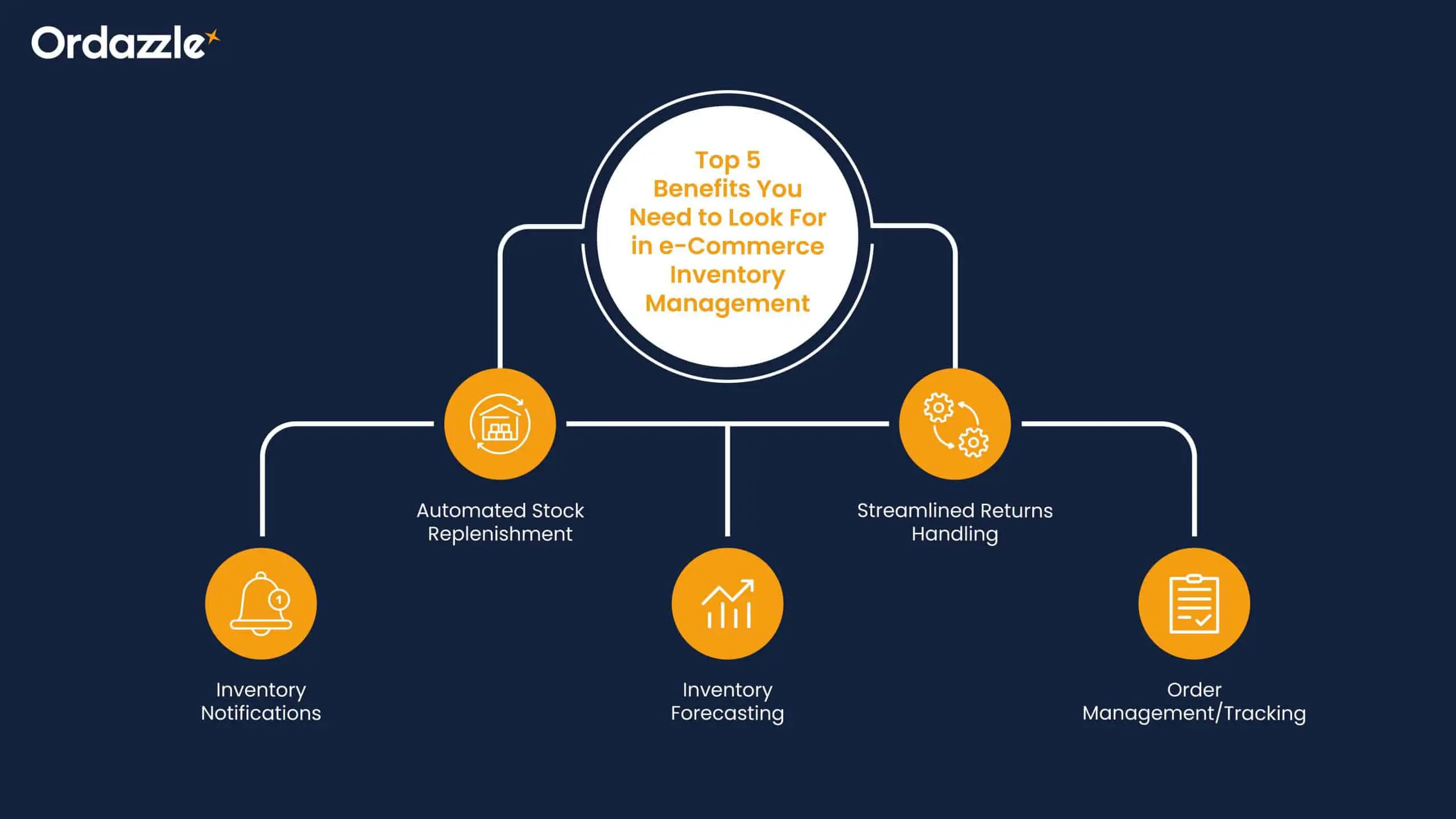
1. Automated Stock Replenishment
As you scale your business, your operations inevitably become more complex, making it difficult to manually manage every inventory task. That’s why it’s important to have automated functionalities in your e-Commerce inventory management software, particularly an automatic reordering option.
This feature becomes particularly useful if you have products that sell in small quantities across multiple stores or sales channels. It reduces the hassle of managing multiple small orders and helps your partners and stores maintain steady inventory levels.
Advanced ecommerce inventory software can also allow you to:
- Create automatic fulfilment requests for the warehouse.
- Store all supplier and partner details.
- Manage previous supplier transactions.
- Use dynamic pricing so partners can receive discounts on higher quantities.
- Automatically send purchase orders to suppliers and manufacturers.
Although some of these functionalities may seem advanced for small e-Commerce businesses, they can save considerable time, funds, and resources as your business scales.
2. Streamlined Returns Handling
Returns are an inevitable part of e-Commerce businesses. But that doesn’t necessarily have to mean losing customers or future business.
A streamlined returns process can help you build customer trust and encourage repeat purchases. An efficient returns workflow makes it easier for customers to return unwanted products while helping businesses maintain accurate inventory records.
That’s why return management should be built into your inventory management system for ecommerce to maintain accurate visibility of inventory levels and ensure returned products are properly tracked.
3. Inventory Notifications
A good e-Commerce inventory management software solution allows you to set up inventory alerts when stock reaches a predetermined level. This helps you plan restocking based on demand, sales velocity, and supplier timelines.
More advanced systems with built-in AI capabilities can calculate sales velocity, predict potential low-stock situations, and raise alerts accordingly.
After an alert is generated, a reorder point can also be automatically assigned, allowing you to create a purchase order to send to your supplier.
That’s why inventory alerts are an important feature of ecommerce inventory software. They save time by showing exactly what needs to be reordered, in what quantity, and when, without requiring you to analyse everything manually.
4. Inventory Forecasting
Inventory optimization and demand forecasting are key business processes for any e-Commerce or retail business.
Forecasting can be particularly complicated because demand changes throughout the year. Festive seasons can increase demand for various products, while some products are particularly susceptible to seasonal changes. For instance, sweaters and shorts are popular at different times of the year.
Therefore, your ecommerce inventory management system should be able to leverage historical sales data to forecast future demand. Accordingly, it can help create replenishment reports when inventory levels are expected to fall below required levels.
This foresight helps optimize inventory levels, ensuring that you are prepared for changing demand with the right amount of stock.
5. Order Management and Tracking
Order management serves as the link between sales and inventory control, facilitating a smooth flow throughout the e-Commerce business.
It is an important aspect of inventory management because it provides real-time visibility into inventory levels from order creation through fulfilment. This information is essential when you want to maintain optimal stock levels and minimize instances of overstocking and stockouts.
For businesses selling across multiple sales channels, multi channel inventory management software can help centralize inventory and order information, making it easier to monitor stock across different channels.
Similarly, businesses selling through marketplaces can benefit from inventory management software for marketplace operations, helping maintain better visibility and control over marketplace inventory.
Overall, having order management and tracking capabilities in your e-Commerce inventory management software can help streamline supply chain operations and support informed inventory decisions.
Ultimately, this can contribute to improved operational efficiency and profitability.
Get the Right e-Commerce Inventory Management Software with Ordazzle
Inventory management is an integral part of any e-Commerce and retail business, and choosing the right platform can make this task considerably easier by improving workflows while saving time and resources in the long run.
When you’re looking for suitable ecommerce inventory software, make sure it has the functionalities you require to run your business and can scale as your operations grow.
If your business sells across multiple marketplaces and sales channels, look for capabilities such as centralized inventory visibility, automated stock management, order tracking, and marketplace integrations. A marketplace inventory management system can help businesses maintain better control over inventory across different selling channels.
Or, you can cut your search short with Ordazzle. Maximise efficiency with our inventory management software with built-in real-time control, monitoring, and optimization across all touchpoints.
Effortlessly integrate with webstores and marketplaces and minimize revenue losses with a consolidated view of inventory.
Do inventory better with Ordazzle. Book a demo with us today to learn more.
Common Questions e-Commerce Leaders Ask
What is inventory management software for e-commerce?
Inventory management software for e-commerce helps businesses track, manage, and optimize stock across online stores, marketplaces, and sales channels. It provides real-time inventory visibility, stock alerts, order tracking, and replenishment capabilities.
What are the 7 types of e-commerce?
The 7 common types of e-commerce are Business-to-Business (B2B), Business-to-Consumer (B2C), Consumer-to-Consumer (C2C), Consumer-to-Business (C2B), Business-to-Government (B2G), Government-to-Business (G2B), and Government-to-Consumer (G2C).
What is FIFO, LIFO, and JIT?
FIFO means First In, First Out, where the oldest inventory is sold first. LIFO means Last In, First Out, where the newest inventory is used or sold first. JIT, or Just-in-Time inventory, involves receiving stock close to when it is needed to reduce excess inventory and storage costs.