Best Scalable WMS Software for Growing e-Commerce Companies
A warehouse management system (WMS) is software that helps businesses manage warehouse operations such as inventory tracking, order picking, stock movement, receiving, packing, and shipping.
Modern warehouse management software provides real-time visibility into warehouse inventory and enables businesses to streamline fulfilment operations across online marketplaces, physical stores, and distribution centres.
For growing e-Commerce companies, a scalable WMS solution becomes essential for maintaining operational efficiency as order volumes increase.
Why Do Growing e-Commerce Companies Need Scalable Warehouse Management Software?
Growing e-Commerce businesses quickly outgrow spreadsheets, manual inventory updates, and disconnected fulfilment systems.
As brands expand across channels like Amazon, Flipkart, Shopify, Myntra, and their own D2C websites, warehouse complexity increases significantly. Inventory must sync in real time, orders must be prioritised correctly, and fulfilment delays must be minimised.
Without scalable WMS warehouse management software, operational inefficiencies become more visible as growth accelerates.
Global e-Commerce sales are projected to surpass $7 trillion by 2025, increasing pressure on retailers to build scalable warehouse and fulfilment operations capable of handling higher order volumes efficiently. Source: Statista
What Operational Challenges Do e-Commerce Brands Face Without a Modern WMS System?
Fast-growing retailers typically face similar warehouse-related challenges.
Inventory Inaccuracies
Inventory mismatches occur when stock updates are delayed across marketplaces and warehouse systems. This often leads to overselling, cancelled orders, and customer dissatisfaction.
Slower Order Fulfilment
Manual picking, packing, and dispatch workflows slow down warehouse operations, especially during high-volume sales periods.
Multi-Warehouse Complexity
As businesses expand regionally, managing inventory across multiple warehouses becomes difficult without centralised visibility.
High Return Volumes
Returns processing becomes operationally expensive when warehouse teams lack structured workflows for reverse logistics.
Limited Operational Visibility
Disconnected systems make it difficult for operations teams to identify bottlenecks, monitor warehouse productivity, or forecast inventory movement accurately.
Signs Your e-Commerce Warehouse Operations Are Becoming Unmanageable
- Inventory discrepancies across channels
- Frequent stockouts or overselling
- Delayed order dispatches
- Heavy reliance on spreadsheets
- High fulfilment error rates
- Increasing customer complaints related to delivery
- Lack of visibility across warehouses
- Difficulty scaling during festive or promotional periods
If multiple issues from this checklist sound familiar, it may indicate the need for a scalable warehouse management solution.
How Does Warehouse Management Software Improve e-Commerce Fulfilment?
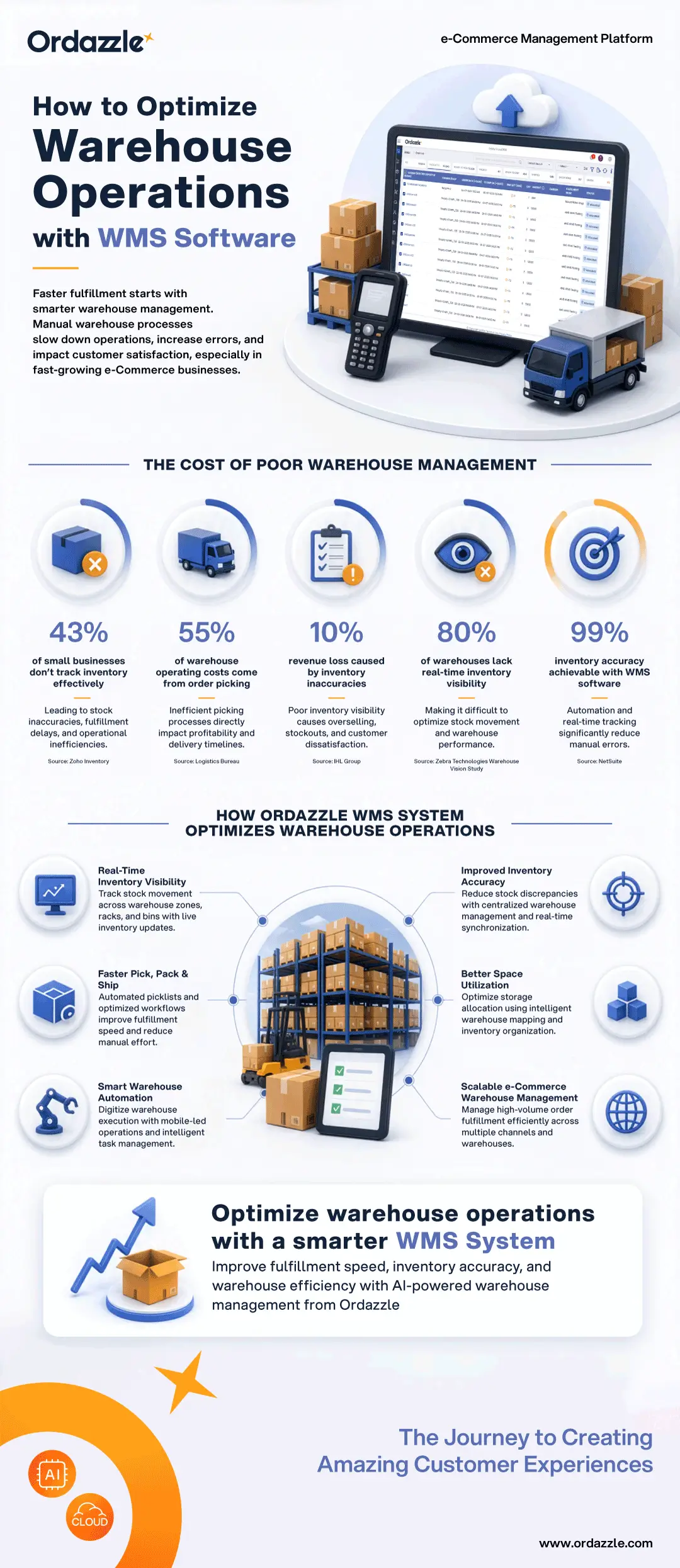
Modern WMS software helps businesses automate and optimise warehouse workflows.
Here’s how:
Real-Time Inventory Visibility
Inventory updates happen automatically across warehouses and sales channels, reducing the risk of stock discrepancies.
Intelligent Order Allocation
Orders can be routed automatically to the nearest or most efficient warehouse for faster delivery.
Faster Picking and Packing
Barcode scanning, batch picking, and workflow automation improve warehouse speed and accuracy.
Better Warehouse Productivity
Warehouse managers gain visibility into order volumes, workforce productivity, and operational bottlenecks.
Improved Returns Management
Structured returns workflows help brands process refunds, inspections, and restocking more efficiently.
According to ResearchGate, warehouse management systems can improve inventory accuracy rates to over 99% by reducing manual stock handling and improving real-time inventory visibility.
The 4 Pillars of Scalable e-Commerce Warehouse Operations
1. Unified Inventory Visibility
Inventory data must remain synchronised across marketplaces, warehouses, and fulfilment centres in real time.
2. Warehouse Workflow Automation
Automation reduces manual errors in receiving, picking, packing, and shipping operations.
3. Multi-Warehouse Orchestration
Businesses need centralised visibility and control over inventory movement across locations.
4. Fulfilment Intelligence
Operational insights help businesses improve delivery timelines, optimise warehouse utilisation, and reduce operational costs.
These pillars form the foundation of scalable e-Commerce warehouse management.
Operational Scenario: A Growing D2C Brand Expanding Across Multiple Warehouses
A D2C fashion brand initially operates from a single warehouse in Mumbai. As demand grows across India and Southeast Asia, the brand opens additional fulfilment centres in Bengaluru and Delhi.
Orders start flowing from Shopify, Amazon, Myntra, and offline retail stores simultaneously.
Without a scalable WMS system, the operations team struggles with:
- Inventory mismatches
- Delayed dispatches
- Duplicate stock allocation
- Manual reconciliation
- Lack of warehouse-level visibility
By implementing a centralised warehouse management platform, inventory updates become real-time, orders are routed intelligently, and warehouse teams gain standardised workflows.
This improves operational speed while reducing fulfilment complexity.
How Do You Choose the Right Warehouse Management Software?
Choosing the right warehouse management system depends on operational scale, fulfilment complexity, and future growth plans.
Look for Real-Time Inventory Management
The system should provide live inventory visibility across all warehouses and sales channels.
Evaluate Marketplace and ERP Integrations
A modern WMS solution should integrate seamlessly with marketplaces, ERP systems, shipping providers, and e-Commerce platforms.
Assess Scalability
The platform should support growing order volumes, additional warehouses, and international expansion.
Prioritise Automation Capabilities
Automation features such as barcode scanning, intelligent picking, and automated replenishment workflows improve operational efficiency.
Focus on Analytics and Visibility
Warehouse analytics help businesses monitor fulfilment performance and operational bottlenecks.
Is WMS Software Suitable for Small and Medium Businesses?
Yes. Modern cloud-based WMS software is increasingly accessible to small and medium-sized businesses.
Earlier, warehouse management platforms were primarily designed for large enterprises. Today, scalable SaaS-based warehouse management solutions allow growing brands to implement structured warehouse workflows without heavy infrastructure investments.
For SMBs, a WMS helps:
- Reduce manual operations
- Improve inventory accuracy
- Scale fulfilment efficiently
- Handle marketplace growth
- Improve customer experience
How Long Does It Take to Implement a WMS System?
Implementation timelines vary based on warehouse complexity, integrations, and operational requirements.
For mid-sized e-Commerce businesses, implementation may take a few weeks to a few months depending on:
- Number of warehouses
- Existing operational processes
- ERP and marketplace integrations
- Inventory migration requirements
- Team training needs
Businesses that standardise warehouse workflows before implementation often experience faster onboarding and smoother adoption.
What Challenges Can Occur During WMS Implementation?
Some common implementation challenges include:
Data Migration Issues
Incorrect inventory or SKU data can affect warehouse accuracy during migration.
Process Misalignment
Warehouse workflows may need restructuring before automation can deliver efficiency gains.
Team Adoption Challenges
Warehouse teams may require training to adapt to barcode systems, scanning workflows, and automation tools.
Integration Complexity
Connecting marketplaces, ERP systems, logistics providers, and warehouse platforms may require technical coordination.
However, businesses that approach implementation strategically often achieve long-term operational improvements.
How Modern Platforms Like Ordazzle Support Warehouse Scalability
Modern commerce operations platforms such as Ordazzle WMS help e-Commerce brands centralise warehouse operations, inventory visibility, and fulfilment workflows.
Instead of managing disconnected operational systems, brands can unify:
- Inventory visibility
- Warehouse workflows
- Marketplace fulfilment
- Order orchestration
- Returns management
This becomes especially important for retailers operating across India, Southeast Asia, and APAC markets, where operational complexity grows rapidly with scale.
What to Remember Before You Choose a WMS
Warehouse complexity increases rapidly as e-Commerce businesses scale across channels and regions.
Manual warehouse operations create fulfilment delays, inventory mismatches, and operational inefficiencies.
Scalable warehouse management software improves inventory accuracy, warehouse productivity, and fulfilment speed.
Real-time inventory visibility and workflow automation are essential for modern retail operations.
Businesses should prioritise scalability, integrations, and operational visibility when selecting a WMS system.
Unified commerce platforms help retailers simplify warehouse and fulfilment operations across multiple channels.
Your Warehouse Should Grow As Fast As Your Business Does
Warehouse operations have become a critical growth function for modern e-Commerce businesses. As brands expand across marketplaces, regions, and fulfilment networks, operational complexity increases significantly.
A scalable warehouse management system helps businesses maintain inventory accuracy, streamline fulfilment operations, and improve warehouse efficiency without relying on disconnected systems or manual processes.
See how Ordazzle WMS helps growing e-Commerce brands simplify warehouse operations, improve fulfilment visibility, and scale efficiently across markets. Let’s talk!
Common Questions e-Commerce Leaders Ask
How do I choose the right WMS for my warehouse?
Choose a WMS based on your operational complexity, integration needs, scalability, and ability to provide real-time inventory visibility across channels. The right system should support your current workflows while also handling future growth across warehouses and marketplaces.
Is WMS software suitable for small and medium businesses?
Yes, modern cloud-based WMS solutions are well-suited for SMBs as they reduce manual effort, improve inventory accuracy, and streamline fulfilment without heavy infrastructure investment. They also help smaller businesses scale operations efficiently as order volumes grow.
How long does it take to implement a WMS system?
Implementation typically takes a few weeks to a few months, depending on warehouse size, number of integrations, and process complexity. Proper planning, clean data, and clear workflows can significantly speed up deployment.
What challenges can occur during WMS implementation?
Common challenges include data migration errors, resistance to process change, integration issues with existing systems, and the need for staff training. These can be minimised with structured onboarding and phased implementation.