Warehouse Management System Process Flow: A Complete Step-by-Step Guide

In e-Commerce, the warehouse is where promises are kept or broken. A customer's expectation of two-day delivery lives or dies in the accuracy and speed of your warehouse operations. That's why understanding and optimising your warehouse management system (WMS) process flow isn't just an operational concern. It's a competitive one.
This guide walks through the complete WMS process flow, explaining each stage, the role of WMS software, and how modern warehouse systems drive efficiency, accuracy, and scalability.
What Is a Warehouse Management System?
A warehouse management system is a software platform that controls and optimises the day-to-day operations of a warehouse or fulfilment centre. From the moment goods arrive to the moment they leave in a parcel, a WMS tracks every movement, manages every task, and provides the operational data needed to continuously improve performance.
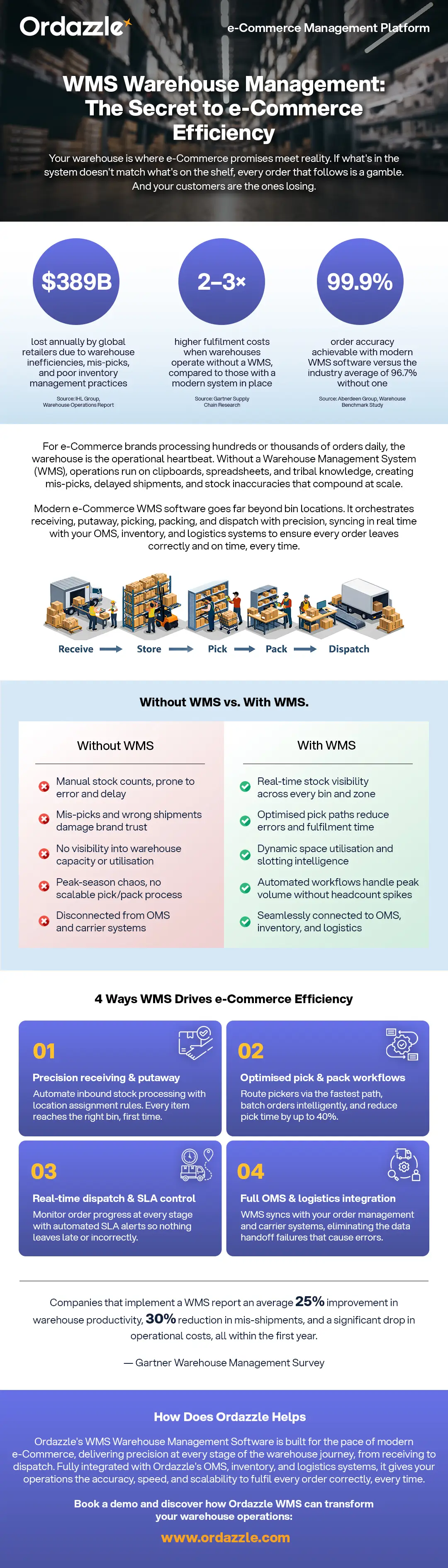
Modern WMS warehouse management systems are far more than digital stock ledgers. They orchestrate picking, packing, receiving, putaway, cycle counting, and shipping, often in real time and with deep integration into connected systems like ERPs, carrier platforms, and e-Commerce channels.
The Complete Warehouse Management System Process Flow
Stage 1: Receiving
The WMS process begins when goods arrive at the warehouse. WMS warehouse management software generates advance shipment notices (ASNs) ahead of arrival, enabling the receiving team to prepare. On arrival, items are scanned (via barcode or RFID), matched against purchase orders, and inspected for accuracy and condition.
Any discrepancies - wrong quantities, damaged goods - are flagged immediately, and the supplier is notified. This accuracy at the point of entry prevents downstream errors from compounding.
Stage 2: Putaway
Once received and logged, items are directed to their storage location. Intelligent warehouse systems don't just assign any available space, they use putaway logic to optimise location based on factors like product velocity (fast-movers near dispatch), size, weight, and storage conditions.
Staff are guided via handheld scanners or voice-directed picking systems, confirming each putaway with a scan to update inventory records in real time.
Stage 3: Inventory Management and Cycle Counting
Accurate inventory is the backbone of efficient fulfilment. WMS software maintains a live, location-specific inventory record, tracking stock levels down to the bin or shelf level.
Cycle counting, a continuous audit process where sections of inventory are counted on rotation, replaces the disruptive annual stocktake and keeps inventory accuracy consistently high.
Stage 4: Order Processing and Wave Planning
When orders arrive from connected sales channels, the WMS batches them into waves — groups of orders to be picked together based on carrier cut-off times, shipping priority, and warehouse zone.
This wave planning optimises picker routes and increases throughput, particularly in high-volume e-Commerce warehouse management environments.
Stage 5: Picking
Picking is typically the most labour-intensive stage of warehouse operations. Modern WMS warehouse management systems optimise this through:
- Zone picking: Pickers are assigned to specific areas, reducing travel time.
- Batch picking: Pickers collect items for multiple orders simultaneously.
- Voice or scan-directed picking: Real-time guidance reduces errors and eliminates paper pick lists.
- Slotting optimisation: High-velocity items are located closest to pack stations.
Each pick is confirmed with a scan, ensuring accuracy is maintained throughout.
Stage 6: Packing
Once items are picked, they move to packing stations. The WMS software guides packers on the correct packaging type based on product dimensions and weight, minimising material waste and dimensional weight charges. It also generates packing slips, inserts, and any required documentation.
For kitted or bundled products, the WMS manages component assembly and quality checks before final packing.
Stage 7: Shipping and Carrier Integration
Packed orders are handed off to the shipping stage. The warehouse management system integrates directly with carrier systems to generate shipping labels, select optimal carrier services based on speed and cost, and transmit manifest data.
Real-time carrier tracking updates are fed back into the system, providing end-to-end visibility.
Stage 8: Returns Management
Returns are an unavoidable part of e-Commerce. The WMS manages the inbound returns process — receiving returned items, inspecting their condition, updating inventory records, and routing them to the appropriate disposition (resale, refurbishment, or disposal). Efficient returns processing directly impacts both cost and customer satisfaction.
How WMS Software Improves Warehouse Efficiency
Across each stage of the process flow, WMS software delivers efficiency gains through:
- Automation: Routine decisions — where to putaway, how to route picks, which carrier to use — are automated, freeing staff for exceptions.
- Real-time data: Every movement updates inventory instantly, eliminating the lag that causes errors.
- Labour management: Task assignment, performance tracking, and productivity metrics help managers deploy labour effectively.
- Slotting optimisation: Dynamic storage assignments reduce travel time and increase throughput.
Brands that implement the best warehouse management system for their operations consistently report measurable improvements in order accuracy, pick rates, and fulfilment speed.
Can WMS Reduce Delivery Delays in e-Commerce?
Delivery delays are often symptomatic of warehouse-side inefficiencies — late picks, incorrect items, missed carrier cut-offs. A well-configured e-Commerce warehouse management system addresses all of these directly. Wave planning ensures orders are picked well ahead of carrier cut-offs; accuracy scanning eliminates mispicks; and carrier integration ensures labels are generated and manifests submitted without manual delay.
Ordazzle's warehouse systems are built to eliminate the operational bottlenecks that cause delays, so your fulfilment promises to customers are kept, every time.
How Secure Is Warehouse Management Software?
Enterprise-grade warehouse management software for small business and large-scale solutions alike include role-based access controls, audit trails, encrypted data transmission, and regular security updates. Access to sensitive inventory and shipping data is restricted by role, and all system activity is logged for compliance purposes. When evaluating platforms, confirm their security architecture, uptime guarantees, and disaster recovery protocols.
Choosing the Best Warehouse Management System
The best warehouse management system for your operation depends on your specific profile:
- Order volume and complexity: High-volume operations need robust wave planning and multi-zone capabilities.
- Fulfilment model: 1P, 3PL, or hybrid models have different WMS requirements.
- Integration needs: The WMS must connect seamlessly with your e-Commerce platforms, ERPs, and carriers.
- Scalability: Your WMS should grow with you without requiring a system replacement.
How Does Ordazzle Help
Ordazzle's e-Commerce warehouse management platform is purpose-built for high-growth brands that need enterprise-grade capability without enterprise-grade complexity.
Your warehouse is only as efficient as the system running it. Our warehouse management system gives e-Commerce brands a complete, intelligent WMS built for the demands of modern fulfilment, from receiving to returns.
Request a demo and see how Ordazzle can optimise your warehouse operations from the ground up.
Frequently Asked Questions
Can WMS reduce delivery delays in e-Commerce?
Yes. By optimising wave planning, eliminating pick errors, and integrating with carrier systems, WMS warehouse management platforms significantly reduce the warehouse-side delays that contribute to late deliveries.
How does WMS software improve warehouse efficiency?
Through automation, real-time inventory visibility, optimised pick routes, and labour management, WMS software reduces errors, increases throughput, and enables more output with the same or fewer resources.
How secure is warehouse management software?
Enterprise warehouse management system platforms include role-based access, encrypted data handling, full audit trails, and compliance with data security standards.
What is the difference between WMS and ERP?
An ERP manages business-wide operations, while a warehouse management system specialises in warehouse-specific workflows. The two are complementary and should be integrated for maximum efficiency.
Can WMS handle multi-location fulfilment?
Yes. Advanced WMS warehouse management software supports multi-site operations, enabling brands to manage inventory and fulfilment across multiple warehouses or fulfilment centres from a single platform.