From Chaos to Control: How Ordazzle’s Warehouse Management System Simplifies Warehouse Operations
Warehouse operations are the lifeblood of the modern economy. When they are running well, orders are fulfilled on time, the cost of fulfillment goes down, and customer loyalty builds. When they’re not, the effects ripple through the entire business: orders are late, returns go up, inventory accuracy plummets, and the bottom line suffers.
But the truth is, most warehouse managers understand the symptoms of a problem, missing inventory, picking issues, space constraints, before they ever recognize the underlying issue: the lack of a contemporary warehouse management system that connects people, processes, and data in real-time.
It’s not about automation for the sake of automation. It’s about taking complexity and turning it into clarity, measurable, repeatable, and predictable. And that’s where a solution like Ordazzle’s WMS Warehouse Management System comes in.
Modern Warehouse Systems Must Be Operationally Intelligent, Not Just Digital
Conventional warehouse operations tend to rely on legacy tools and manual checkpoints. This leads to some gaps:
- Inventory drift, since the stock isn’t updated in real-time
- Picking inefficiencies, since routing isn’t optimized
- Dock congestion, since inbound isn’t coordinated
- Inaccurate order commitments, since data isn’t synced.
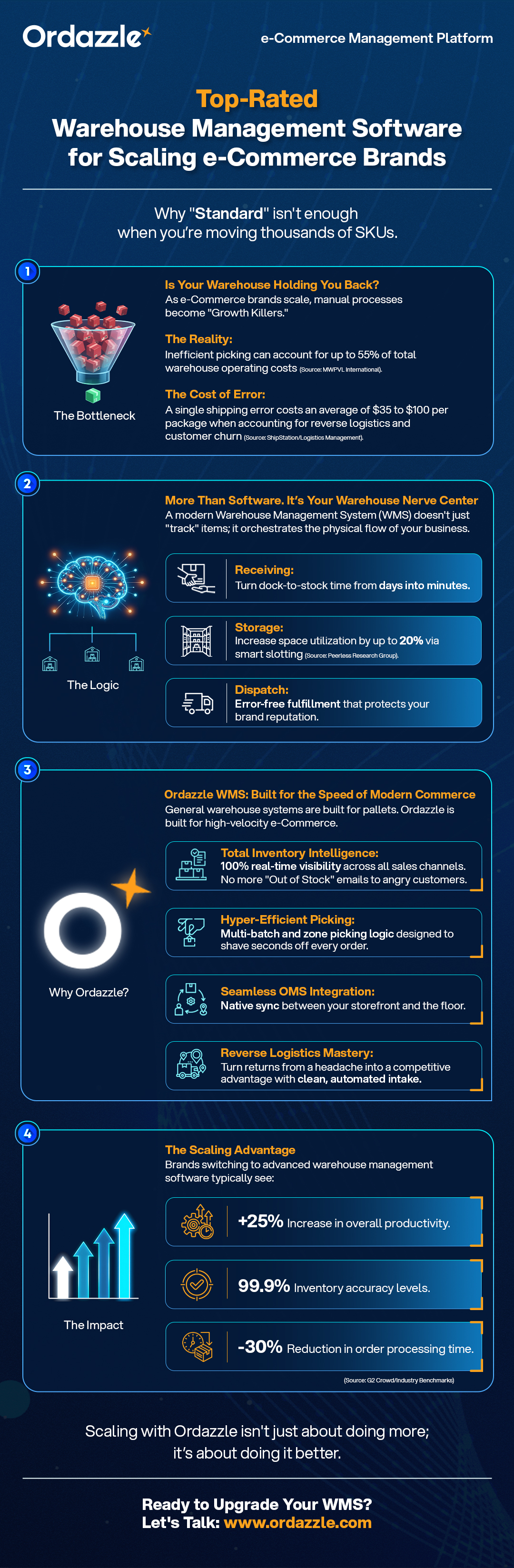
A modern warehouse management system is more than just software. It is the central nervous system that orchestrates warehouse operations with precision.
Ordazzle’s WMS is not meant to replace spreadsheets. It is meant to remove guesswork altogether. It follows inventory from receipt to putaway, storage, picking, packing, and shipping, all at the SKU and bin level. This is what most warehouses would like to see.
What this really means is this: instead of firefighting, teams can anticipate and prevent problems.
Real-Time Inventory Precision With the Best Warehouse Management System
Let’s discuss inventory accuracy because this is where most warehouses quietly leak value.
In a typical warehouse without modern WMS software:
- Stock counts are out of sync between systems
- Bins are mis-assigned
- Quantities drift after cycle counts
- Returns aren’t reconciled timely manner
- The end result: overselling, stockouts, lost revenue, and poor customer experience.
A top WMS warehouse management software, such as Ordazzle tracks every transaction. Barcode scanning, auto put away recommendations, and dynamic binning ensure that virtual inventory is always in sync with physical inventory. No reconciliation lag. No surprises.
When inventory accuracy is the norm and not the exception, planning and forecasting become a breeze.
Picking and Packing Optimization That Drives Throughout
The truth is, warehouse managers dislike pointing out that a lot of the cost of fulfillment isn’t labor, it’s inefficient labor.
The more walking, the more backtracking, the more human decision-making, the slower and less accurate the process will be.
The smartest e-Commerce warehouse management strategy leverages logic to route pickers more effectively:
- Similar SKUs are batched together
- High-velocity areas are prioritized
- Recommend the best pick routes based on current order data
Ordazzle’s WMS automatically implements these strategies so that picking isn’t a matter of tribal knowledge or “the way we’ve always done it.”
When pickers follow optimized workflows instead of best guesses, more gets picked, and mistakes are reduced, especially during peak periods.
Automated Putaway and Organized Storage Without Micromanagement
Warehouse design should facilitate efficiency, not obstruct it. But without intelligent putaway routing, products will wind up wherever there is room available, causing problems down the line.
Today’s needs to be aware of:
- SKU velocity
- Storage needs (temperature, fragility, weight)
- Picking frequency
- Space utilization strategies
Ordazzle’s solution uses these considerations for putaway routing. This means fast-moving SKUs aren’t stored behind slow-moving ones. It means fragile products aren’t stored on the same racks as heavy ones. It means every square foot of space is working, not just existing.
Intelligent putaway isn’t sexy, but it’s the building block of a high-performing warehouse.
Dynamic Workload Assignment and Labor Efficiency
Labor is one of the highest variable costs in a warehouse. And every manager knows the pain of recruiting, training, and retaining warehouse staff, especially when the demand for labor fluctuates.
A warehouse management system does more than just track inventory. It optimizes labor resource allocation.
Ordazzle’s WMS is not a passive system. It proactively influences work:
- Assigning work based on labor capacity
- Workload balancing
- Minimizing downtime
- Urgent orders take priority
Rather than managers struggling to allocate work manually, the system ensures that work is allocated efficiently and workers remain productive without constant supervision.
Seamless Integration With Fulfillment Ecosystems
Most warehouses do not function in a vacuum. They are a part of a larger fulfillment network that is selling on marketplaces, integrating with OMS (order management system), and communicating with carriers.
The best warehouse systems solution is not a spectator solution. It becomes a central hub.
Ordazzle’s WMS solution directly integrates with:
- Order management systems
- Inventory management systems
- Carrier solutions
- Marketplace feeds
- Reporting tools
By doing this, the data silos are removed, and the fulfillment decisions are made from accurate, real-time information.
When the WMS is a part of a larger ecosystem, it becomes possible for the leaders to coordinate rather than scramble to fill information gaps.
Returns and Reverse Logistics That Don’t Destroy Margin
Most conversations about warehouse operations are about forward fulfillment, but reverse logistics is just as relevant, if not more so, in today’s environment.
Returns are no longer exceptions. They’re expected.
Without a process to manage returns within the warehouse flow, you experience:
- Lost returned merchandise
- Slow refund processing
- Stuck inventory
- Loss on resealable merchandise
Ordazzle’s warehouse management system provides organized processes for:
- Processing returns
- Quality inspection
- Restocking decisions
- Connecting return results to inventory
- Returns cease to be a cost center and become an operational process.
Scalability Without Rewiring Workflows
Here’s a leadership tip that many teams learn the hard way:
Growth doesn’t wait for process improvements.
When sales increase, the number of SKUs and seasonality also increase. You need scalable systems that don’t require manual configuration every quarter.
The most effective warehouse management software for small business teams and large teams shares one commonality: flexibility. Inflexible systems break down under growth. Flexible WMS adjusts.
Ordazzle’s system is based on rule-driven configurations, not hard-coded rules. This allows:
- Easy integration of new locations
- New SKUs don’t need a new workflow
- Seasonal peaks are handled by rules, not human oversight
- Growth is manageable. Complexity is navigable.
Data Visibility That Drives Better Decisions
Warehouse managers understand this: “If you can’t measure it, you can’t improve it. ”Visibility isn’t about dashboards. It’s about insights.
Ordazzle’s WMS provides visibility into the right metrics:
- Picking accuracy
- Throughput per employee
- Inventory accuracy trends
- Order cycle times
- Space utilization
- Returns analysis
This information enables managers to ask more informed questions:
- Which areas are bottlenecks?
- Are we overstocking slow-moving items?
- Does labor resource allocation match demand patterns
- Rather than fixing issues, teams start to predict them.
Final Perspective: A Warehouse System That Enables Strategy, Not Just Execution
The true power of a warehouse management system isn’t in its ability to cut manual processes; it’s in its ability to turn warehouse operations into a strategic strength.
With the right system, you can:
- Fulfillment becomes predictable
- Costs become manageable
- Teams are empowered, not overwhelmed
- Leaders have visibility, not guesswork
- Growth doesn’t break operations
Ordazzle’s WMS solution isn’t a tick-box system. It’s a structure designed to handle complexity and give leaders control. A chaotic warehouse isn’t an inevitability. It’s a warning sign, a warning sign that your existing systems aren’t aligned with your growth strategy.
A warehouse management system solution isn’t just a way to simplify operations. It’s a way to redefine what your operations can achieve. And in a world where customer demands continue to escalate, controlling your warehouse operations isn’t a nice-to-have; it’s a necessity.
Ready to take control of your warehouse? Explore how Ordazzle’s WMS can streamline your operations and boost efficiency today. Let’s talk
FAQs
1. How do you choose the right WMS software for your business?
Choose a warehouse management system that fits your order volume, integrates with your ERP and e-Commerce stack, and scales as you grow. What works for a single warehouse won’t suit multi-location or high-SKU operations? The best warehouse management system should offer real-time visibility, automation, and easy configuration without heavy IT dependency.
2. How do warehouse systems improve efficiency?
Modern warehouse systems streamline picking, packing, putaway, and replenishment through automation and barcode scanning, reducing manual errors and delays. With smart wms warehouse management workflows, teams move faster while maintaining accurate stock data.
3. What are the benefits of using WMS software?
The right wms software improves inventory accuracy, speeds up fulfillment, lowers operational costs, and enhances customer satisfaction, especially in e-Commerce warehouse management, where speed and precision matter. Strong wms warehouse management software also provides analytics to optimize space and labor.
4. What challenges do small businesses face without WMS?
Without proper warehouse management software, small business solutions, companies struggle with stock mismatches, delayed shipments, manual tracking errors, and limited visibility across channels, making growth harder to manage.