Managing Product Information Across Channels? Solve It with PIM Software

In today's hyper-competitive e-Commerce landscape, inconsistent or incomplete product data can cost you customers before they even reach checkout. Whether you are selling across ten marketplaces or managing thousands of SKUs, the challenge of keeping product information accurate, consistent, and enriched at scale is real, and it's growing. That's where PIM software steps in.
This guide covers everything you need to know about product information management software: what it does, why it matters, and how it can transform your e-Commerce operations.
What Is PIM Software?
PIM stands for Product Information Management. At its core, PIM software is a centralised system that enables businesses to collect, manage, enrich, and distribute product data across all their sales channels - from your own website to third-party marketplaces like Amazon, Flipkart, etc.
Think of it as your single source of truth for product content: descriptions, specifications, images, pricing, categories, attributes, and more. Without a PIM system, this data typically lives scattered across spreadsheets, ERPs, and internal drives, leading to errors, duplications, and delays.
Why Product Information Management (PIM) Matters in E-Commerce
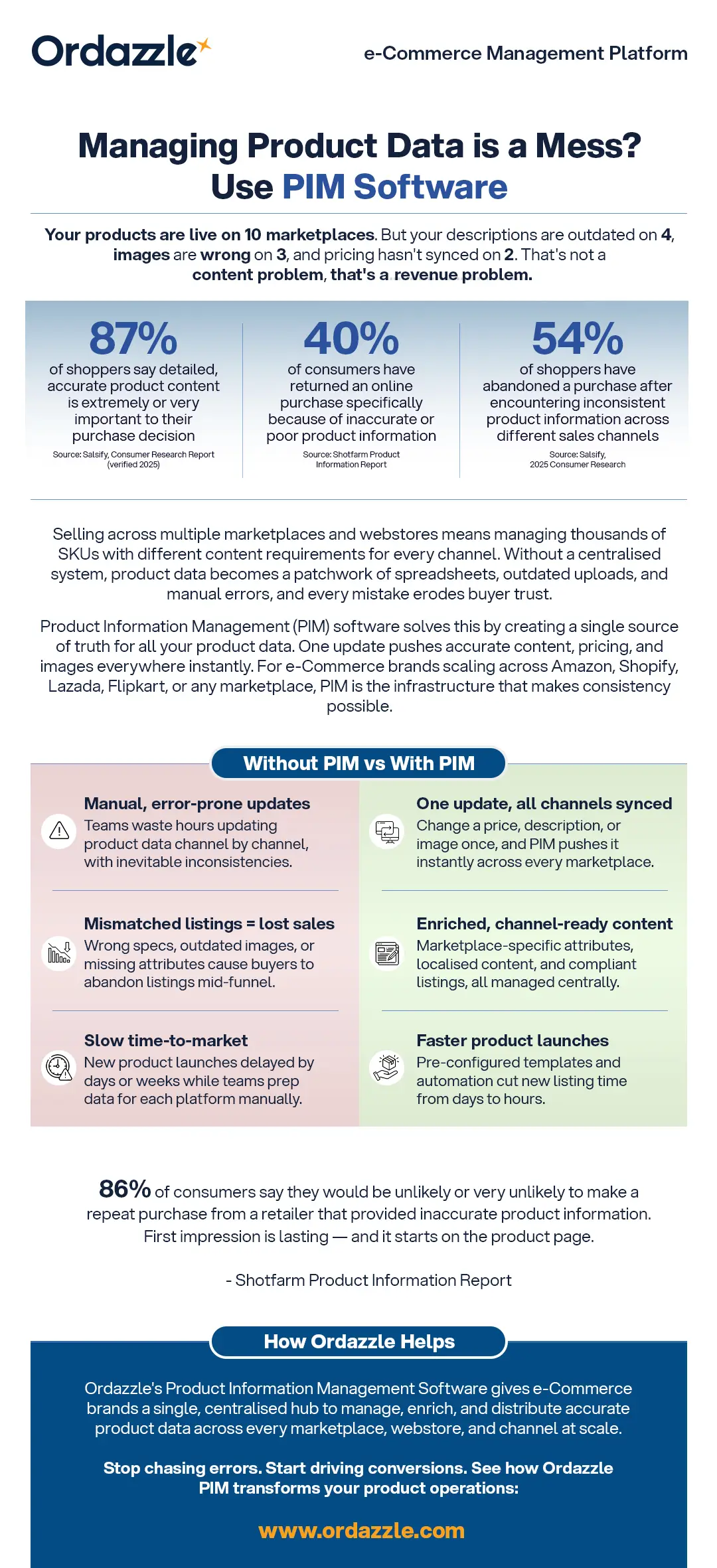
Poor product data is inconvenient and expensive. Studies consistently show that product content errors are one of the top reasons for cart abandonment and high return rates. When customers receive a product that doesn't match its listing, trust erodes fast.
Here's what unmanaged product information costs you:
- Inconsistent listings across channels, leading to brand confusion
- Manual data entry errors and time lost on corrections
- Delayed time-to-market when launching new products
- Poor SEO performance due to thin or duplicate content
- Lower conversion rates from incomplete product pages
With the right product information management software, all of this becomes manageable and scalable.
How a PIM System Works in e-Commerce
A PIM system sits at the centre of your e-Commerce stack, connecting upstream data sources (suppliers, ERP, DAM) with downstream distribution channels (marketplaces, your website, mobile apps, print catalogues). Here's how the workflow typically looks:
1. Data Ingestion: Product data flows in from multiple sources, supplier feeds, internal databases, or manual imports, into a single repository.
2. Data Enrichment: Teams add, edit, and enhance product information: descriptions, SEO metadata, images, translations, and specifications.
3. Data Validation: The PIM software checks for completeness and accuracy against predefined quality rules.
4. Distribution: Clean, enriched data is published to all relevant channels in the required format for each platform.
5. Ongoing Sync: Updates made centrally push automatically to all channels, ensuring consistency at all times.
This is what makes PIM in e-Commerce so powerful. It eliminates the manual effort of maintaining separate data sets per channel.
Key Features to Look for in E-Commerce PIM Software
Not all product management software is built equal. When evaluating solutions, prioritise these capabilities:
- Centralised repository: One place to manage all product data, regardless of category or channel.
- Multi-language and multi-region support: Critical for brands expanding into new geographies.
- Channel-specific formatting: The ability to adapt product data to each marketplace's requirements without duplicating effort.
- Workflow automation: Built-in approval flows, notifications, and task assignments for large content teams.
- Data quality scoring: Automatic completeness and accuracy checks to catch errors before they go live.
- Integration capabilities: Seamless connections with ERPs, DAMs, e-Commerce platforms, and logistics tools.
- Bulk editing and import: Ability to update thousands of SKUs simultaneously.
Does PIM Software Increase Sales? Here's What the Data Says
The connection between product data quality and sales performance is well-documented. Brands that invest in robust PIM software report:
- Faster time-to-market for new product launches
- Reduced return rates due to accurate product descriptions
- Higher conversion rates from richer, more complete product pages
- Improved organic search rankings from better structured content
When product information is consistent and high-quality across every channel, customers can make informed purchase decisions and that directly drives revenue.
Do I Really Need a PIM System?
A common question, and the answer depends on the scale of your operations. If you're managing fewer than 100 SKUs on a single channel with a small team, a spreadsheet might suffice for now. But if any of the following apply to you, a PIM system is not optional:
- You sell across multiple marketplaces or geographies
- Your product catalogue changes frequently (new launches, updates, seasonality)
- Your team spends significant time on manual data entry and corrections
- You've experienced errors or inconsistencies in live listings
- You're planning to expand your catalogue or enter new markets
For growing e-Commerce brands, the right product management software is an investment that pays for itself quickly: in time saved, errors avoided, and revenue protected.
PIM Software and Multi-Language, Multi-Region Support
Expanding into new markets means adapting your product information for local audiences. PIM software with built-in localisation capabilities allows you to:
- Manage translated content for each region within a single system
- Apply region-specific pricing, compliance data, and labelling
- Control which content variants are published to which channels
For brands operating across Southeast Asia, the Middle East, or South Asia, this functionality isn't a luxury, it's a necessity. Ordazzle's PIM in e-Commerce solution is designed specifically with multi-region scaling in mind.
How to Choose the Best E-Commerce PIM Software
When shortlisting the best PIM for e-Commerce, consider these factors:
- Scalability: Can it handle your growth plans - more SKUs, more channels, more geographies?
- Ease of use: Can non-technical teams work with it comfortably?
- Integration depth: Does it connect natively with your existing tools?
- Support and onboarding: Does the vendor offer dedicated implementation support?
- Pricing model: Is it transparent and aligned with your business model?
Ordazzle's best PIM for e-Commerce is purpose-built for high-growth brands operating across complex, multi-channel environments.
Ordazzle’s PIM for e-Commerce
Managing product information at scale doesn't have to be a constant battle.
With Ordazzle's product information management software, you get a centralised, intelligent system built for the demands of modern multi-channel commerce.
Ready to see it in action? Request a demo today and discover how Ordazzle can simplify your product data operations from day one
Frequently Asked Questions
How does PIM software increase sales?
By ensuring product information is accurate, complete, and optimised across every channel, PIM software reduces friction in the buyer journey, improves search visibility, and lowers return rates, all of which directly contribute to higher sales.
How does a PIM system work in e-Commerce?
A PIM system centralises all product data, allows teams to enrich and validate it, and then automatically distributes it in the correct format to every connected sales channel.
Do I really need a PIM system?
If you manage a growing catalogue across multiple channels or regions, yes. Manual data management at scale leads to errors, delays, and revenue loss. A PIM system solves this structurally.
Does PIM support multi-language and multi-region product data?
Yes. Robust product information management software includes localisation features that allow you to manage translated content, region-specific attributes, and channel-appropriate formatting from a single platform.
What's the difference between a PIM and an ERP?
An ERP manages business operations (finance, inventory, procurement), while a PIM system specialises in managing and distributing product content. They're complementary systems, the best setups integrate both.
How long does it take to implement PIM software?
Implementation timelines vary based on catalogue size and integration complexity. Ordazzle's PIM software is designed for rapid deployment with dedicated onboarding support.