How a Warehouse Management System Improves e-Commerce Warehouse Management Efficiency

Fast-growing e-Commerce brands often struggle with warehouse inefficiencies as order volumes increase. Manual inventory tracking, disconnected warehouse systems, and fulfilment delays create operational bottlenecks.
A modern warehouse management system (WMS) helps automate inventory tracking, optimise order picking, and streamline fulfilment operations. For digital retail brands in India and Southeast Asia, adopting intelligent WMS warehouse management software is becoming essential for scaling operations efficiently.
What Is a Warehouse Management System?
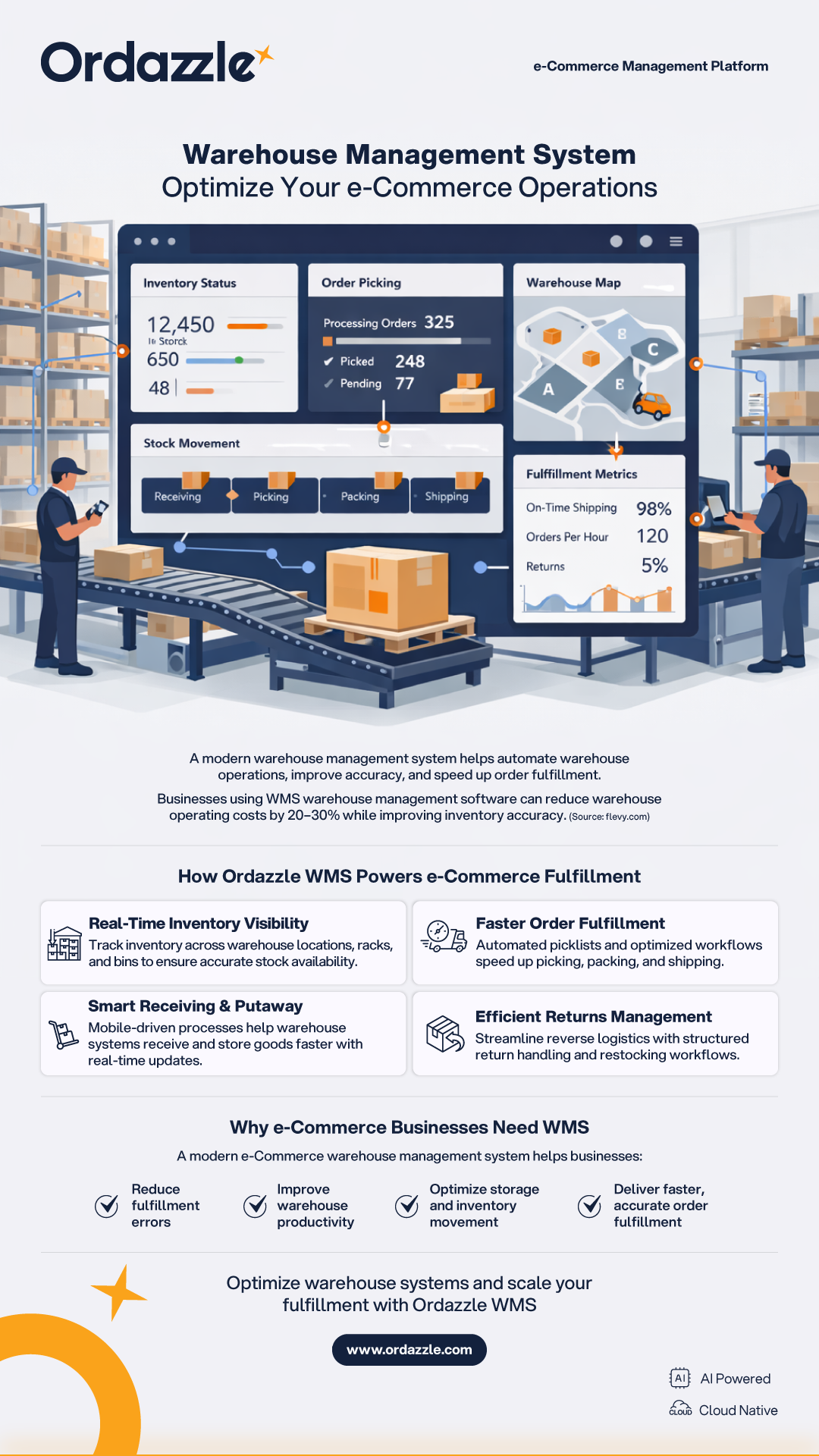
A warehouse management system is software that manages and optimises warehouse operations, including inventory tracking, order picking, packing, shipping, and stock movement within a warehouse.
In an e-Commerce environment, a wms warehouse management platform typically handles:
- Real-time inventory visibility
- Order picking and packing workflows
- Warehouse bin and location management
- Inbound and outbound stock tracking
- Shipping and fulfilment coordination
Unlike basic inventory tools, modern wms software integrates directly with e-Commerce platforms, marketplaces, and order management systems to automate fulfilment operations.
Why Do Fast-Growing e-Commerce Brands Struggle With Warehouse Systems Efficiency?
Warehouse inefficiencies typically emerge when order volumes grow faster than operational systems. Many brands begin with manual processes such as spreadsheets, basic inventory tools, or disconnected warehouse systems.
As order volumes increase, this approach becomes unsustainable. Common operational issues include:
- Slow order picking and packing
- Inventory inaccuracies
- Overselling across marketplaces
- Delayed fulfilment during peak periods
- Limited visibility across warehouses
“Warehouse operations are the backbone of e-Commerce fulfilment. When inventory visibility and order processing are disconnected, operational inefficiencies quickly multiply.”
How Does WMS Software Help Reduce Order Processing Time?
A modern wms warehouse management software reduces order processing time by automating the workflows involved in picking, packing, and shipping.
Instead of relying on manual coordination, WMS platforms guide warehouse teams through optimised workflows.
This includes:
- Intelligent Order Picking
WMS software determines the most efficient picking routes within a warehouse, reducing travel time for warehouse staff.
- Automated Packing Workflows
Packing stations receive accurate order information automatically, reducing manual verification.
- Real-Time Inventory Updates
Inventory levels update instantly after every order, preventing stock discrepancies.
- Shipping Integration
WMS systems connect with courier services to generate labels and shipment tracking automatically.
Together, these capabilities significantly reduce fulfilment cycle times.
What Operational Problems Does e-Commerce Warehouse Management Solve?
Effective e-Commerce warehouse management solves several operational challenges that digital retail brands face as they scale.
- Inventory Visibility Gaps
Without a WMS, brands often struggle to maintain accurate inventory data across warehouses and marketplaces.
- Order Fulfilment Delays
Manual order processing leads to slower fulfilment times, especially during sales events.
- Warehouse Space Utilisation
WMS platforms optimise storage locations to maximise warehouse capacity.
- Human Error in Picking and Packing
Barcode scanning and automated workflows reduce manual mistakes.
These improvements enable brands to fulfil orders faster while maintaining operational accuracy.
Operational Scenario
Scenario: A D2C Brand Scaling Warehouse Operations
A beauty brand initially manages 200 orders per day from a single warehouse. Orders are processed manually, inventory is tracked in spreadsheets, and warehouse staff pick items based on printed order lists.
As the brand expands to marketplaces and order volume reaches 2,000 daily orders, the warehouse begins experiencing problems:
- Incorrect items shipped to customers
- Delayed dispatch times
- Inventory mismatches across sales channels
- Increased customer complaints
After implementing a warehouse management system, the brand introduced barcode scanning, real-time inventory updates, and automated picking routes.
Within weeks, fulfilment speed improves, and operational errors decline significantly.
The 4 Pillars of Efficient WMS Software Operations
Scalable warehouse operations rely on several core capabilities.
1. Real-Time Inventory Visibility
Accurate stock levels across all warehouse locations.
2. Optimised Picking and Packing Workflows
Automated routing improves order processing speed.
3. Fulfilment Integration
Warehouse systems connect with shipping carriers and order management platforms.
4. Operational Intelligence
Data insights help operations teams monitor warehouse performance.
These four pillars are the foundation of the best warehouse management system solutions used by high-growth digital retail brands.
Signs Your Warehouse Operations Need a WMS
Many fast-growing brands delay WMS implementation until operational problems become severe.
If you recognise these symptoms, it may be time to adopt warehouse management software small business solutions.
- Warehouse teams rely on spreadsheets for inventory tracking
- Order picking takes longer as SKU counts increase
- Inventory discrepancies occur frequently
- Marketplace stock levels do not match warehouse inventory
Warehouse staff struggle to locate products quickly
Fulfilment delays occur during peak sales periods
“Operational complexity in e-Commerce often begins inside the warehouse. Without intelligent systems, fulfilment processes struggle to scale with demand.”
How Modern Warehouse Systems Support e-Commerce Growth
Modern warehouse systems are designed specifically for the complexity of multi-channel e-Commerce. Unlike traditional warehouse software, these systems integrate with the broader commerce technology stack.
This includes:
- e-Commerce storefronts
- Marketplace platforms
- Order Management Systems (OMS)
- Product Information Management (PIM) tools
- Shipping and fulfilment partners
By connecting these systems, brands gain end-to-end visibility across orders, inventory, and fulfilment operations.
Platforms such as Ordazzle combine warehouse management with order orchestration, marketplace integrations, and operational intelligence.
This unified approach allows brands to manage inventory, orders, and fulfilment workflows from a single operational environment.
Why Warehouse Management Matters for Fast-Growing Digital Retail Brands
The warehouse is often the most operationally intensive part of an e-Commerce business. As brands expand product catalogues and sales channels, warehouse complexity grows quickly. In markets such as India and Southeast Asia, many digital-first brands sell across multiple marketplaces simultaneously.
Without an integrated wms warehouse management platform, operations teams face:
- Fragmented inventory data
- Slow fulfilment operations
- Increased operational costs
- Limited scalability
According to McKinsey, companies implementing advanced warehouse automation can improve productivity by 25–40%.
For digital retail brands operating in high-growth markets, warehouse technology is becoming a critical growth enabler.
Warehouse inefficiencies are a major bottleneck for growing e-Commerce brands. A warehouse management system helps automate inventory tracking, picking workflows, and fulfilment processes.
Real-time inventory visibility reduces stock discrepancies across marketplaces. Intelligent wms warehouse management software enables faster order processing and improved operational accuracy. Integrated platforms that combine WMS software, order management, and marketplace connectivity provide the strongest operational advantage.
Final Thoughts
As digital retail continues to grow across India and Southeast Asia, warehouse efficiency is becoming a defining factor in customer experience and operational scalability.
Brands that rely on manual processes or disconnected warehouse systems often struggle with fulfilment delays, inventory inaccuracies, and operational inefficiencies.
Implementing the best warehouse management system allows e-Commerce companies to automate warehouse workflows, improve inventory accuracy, and fulfil orders faster.
Modern commerce operations platforms that combine WMS capabilities with order management, inventory orchestration, and operational intelligence, such as those offered by Ordazzle, help brands scale their fulfilment infrastructure with confidence.
See how Ordazzle helps e-Commerce brands streamline warehouse operations, inventory visibility, and fulfilment orchestration.
Let’s Talk with our experts to explore how intelligent warehouse management can support your growth.
Common Questions e-Commerce Leaders Ask
Why choose our Warehouse Management System over others?
A modern best warehouse management system should integrate seamlessly with order management platforms, marketplaces, and shipping providers. Systems that combine warehouse management with broader e-Commerce operations intelligence provide greater operational visibility than standalone WMS tools.
How does WMS software help reduce order processing time?
WMS software automates order picking, packing, and shipping workflows. By guiding warehouse teams through optimised picking routes and providing real-time order data, WMS platforms significantly reduce fulfilment cycle times.
Can your WMS scale as my business grows?
Yes. Modern wms warehouse management software is designed to support increasing order volumes, larger product catalogues, and multiple warehouses. Cloud-based systems allow brands to expand operations without major infrastructure changes.
How does your WMS improve operational efficiency?
A warehouse management system improves efficiency by automating inventory tracking, reducing manual errors, optimising warehouse layouts, and providing real-time operational insights.