The Complete Guide to Order Management Systems (OMS) for e-Commerce
e-Commerce has entered a new era of operational complexity. Brands today sell across their own websites, major marketplaces, social commerce channels and physical outlets simultaneously, often serving customers across multiple geographies in different languages and currencies. Every one of those touchpoints generates orders, each with its own fulfilment logic, delivery expectation and inventory implication.
For much of the past decade, businesses ensured order management through a combination of spreadsheets, manual coordination and channel-specific tools. That approach has reached its limit. As order volumes grow and customer expectations continue to rise, particularly around speed, accuracy and visibility, the absence of structured order management solutions or infrastructure is no longer a minor inefficiency. It is a direct constraint on growth.
This is where the order management system (OMS) becomes foundational. An OMS is not simply a tool for processing orders. It is the operational backbone that connects every channel, every fulfilment node and every customer interaction into a coherent, scalable commerce engine.
Key Insight: 73% of online shoppers expect real-time order tracking, and 68% say they will not return to a brand after a single poor delivery experience. For growing e-Commerce businesses, e-Commerce order management software is no longer optional; it is a commercial imperative.
In this guide, we provide a complete framework for understanding what an OMS is, how it works, what to look for, and when to invest.
Key Takeaways
- An order management system (OMS) automates the end-to-end order lifecycle, from capture to fulfilment and returns, across every sales channel.
- Without one, growing e-Commerce brands face overselling, delayed fulfilment, and marketplace penalties at scale.
- A strong OMS delivers real-time inventory sync, smart routing, and ecommerce order automation in one platform.
- The right solution scales with your business, and Ordazzle is built specifically for multi-channel commerce in APAC.
What is an Order Management System (OMS)?
An order management system (OMS) is a centralised software platform that manages the complete lifecycle of a customer order, from the moment a purchase is made through to fulfilment, delivery and returns. It connects sales channels, inventory data, payment systems, logistics partners and customer communications into a single, automated workflow.
In practical terms, an e-Commerce order management system answers a fundamental operational question: once an order is placed, what happens next, and who (or what) is responsible for making sure it is fulfilled correctly, quickly and cost-effectively?
How an OMS differs from an ERP, a WMS and an Inventory Management System:
| System | Primary Function | Scope |
|---|---|---|
| ERP (Enterprise Resource Planning) | Financial and business-wide data management | Finance, HR, procurement, supply chain |
| WMS (Warehouse Management System) | Physical warehouse operations | Picking, packing, bin management, storage |
| IMS (Inventory Management System) | Stock tracking, replenishment, and availability management | Stock levels, reorder points, multi-location inventory visibility |
| OMS (Order Management System) | End-to-end order lifecycle management | Order capture, routing, fulfilment, returns, tracking |
While an ERP governs the financial fabric of a business, a WMS manages physical warehouse operations, and an IMS tracks stock levels and availability, an online order management system sits specifically at the intersection of commerce and Order fulfilment system. It orchestrates the order journey across all of these systems in real time.
For e-Commerce businesses, all four may be relevant, but the OMS is the layer that ensures orders actually flow correctly from purchase to delivery.
Why Order Management Matters Today
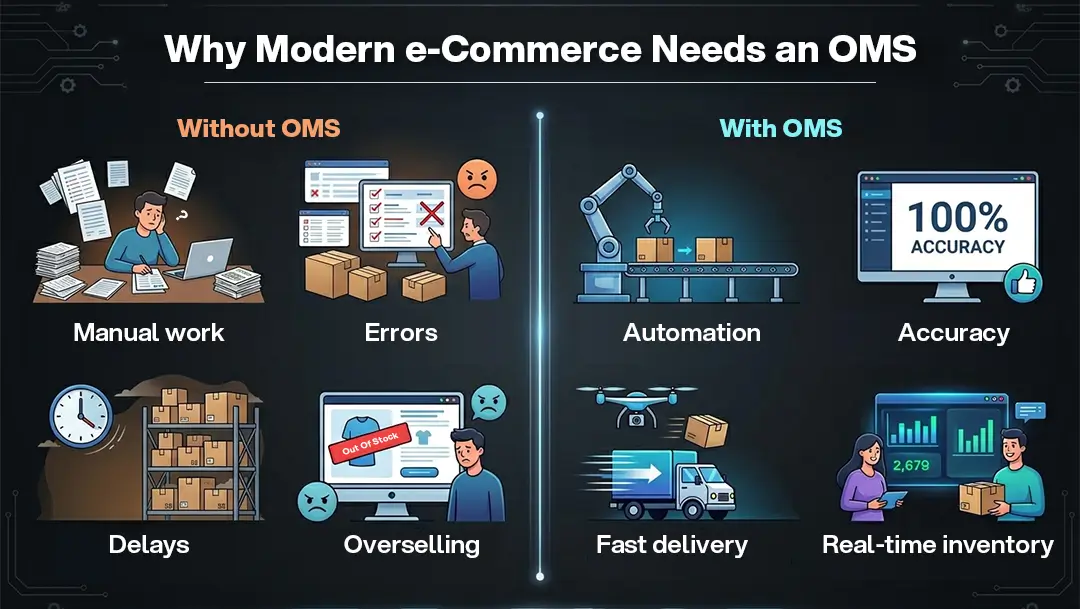
The case for structured e-Commerce order management has never been stronger or more urgent. Several converging trends have made manual or fragmented order handling a significant operational liability for brands of every size.
- Accelerating Order Volumes
Global e-Commerce order volumes continue to grow at double-digit rates year-on-year. Brands that once processed hundreds of orders per day now routinely manage thousands, spanning multiple platforms and fulfilment nodes. Without order management software for e-Commerce, scaling order volumes creates proportional increases in errors, delays, and operational overhead. - Marketplace Complexity
Most growing e-Commerce brands sell across three or more channels simultaneously, including their own webstore, Amazon, Flipkart, Shopee, and others. Each marketplace has its own SLA requirements, cancellation policies and fulfilment rules. Marketplace order management software consolidates this complexity into a single, manageable workflow. - Real-Time Inventory Demands
Customers expect accurate stock information at the point of purchase. A single oversell event, where inventory shown as available is not actually in stock, can trigger a cascade of cancellations, customer complaints and marketplace penalties. e-Commerce order management software with real-time inventory sync prevents this by maintaining a live, accurate stock position across every sales channel. - Rising Returns and Reverse Logistics
Return rates in e-Commerce remain high, averaging 20–30% in fashion categories. Managing returns efficiently, updating inventory accurately and processing refunds promptly are all functions that an e-Commerce order management solution handles natively, reducing the manual burden on operations teams. - Omni-channel Customer Expectations
Modern consumers expect consistent service across channels, such as same pricing, same promotions, same delivery commitments, regardless of where they shop. Meeting this expectation requires a centralised order management solution that enforces consistency across every touchpoint in real time.
Ordazzle Insight: The cost of operating without a structured order management system e-Commerce is not just operational. It is commercial. Missed SLAs, oversells and delayed fulfilment directly impact repeat purchase rates, marketplace rankings and customer lifetime value.
How Order Management Works: The End-to-End Process Flow
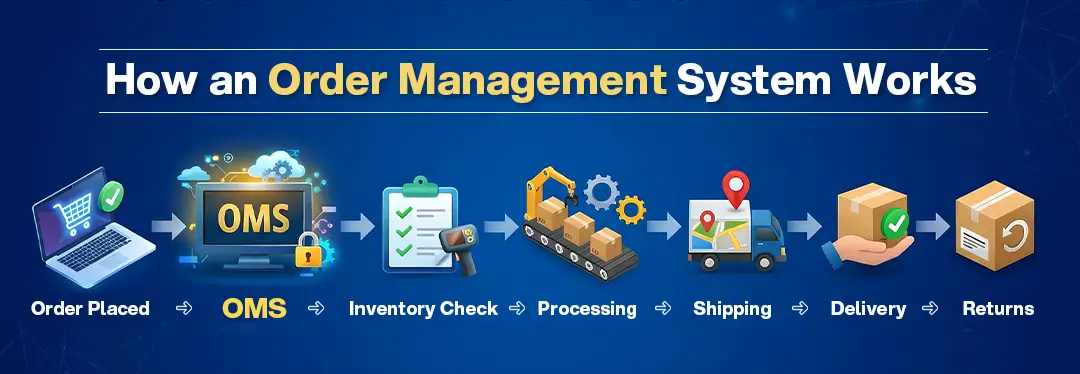
Understanding what order management does in practice requires following an order through its complete lifecycle. A modern e-Commerce order management system manages every step of this journey in a continuous, automated flow:
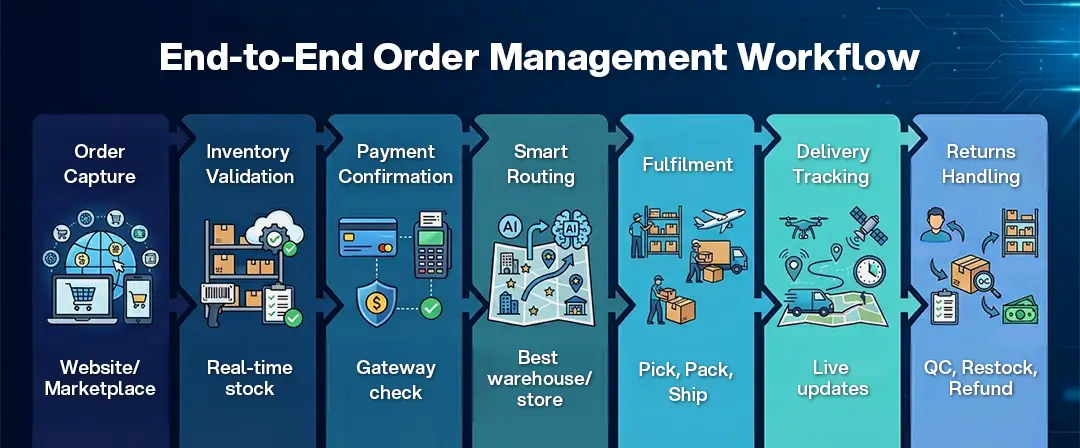
At each stage, the order management software for e-Commerce communicates in real time with connected systems, such as inventory databases, payment gateways, logistics partners and customer notification services, ensuring that every stakeholder has accurate, current information. The result is a closed-loop process that eliminates the manual handoffs and reconciliation overhead that characterize fragmented operations.
Core Features of an Effective e-Commerce Order Management Software
Not all order management software platforms deliver the same capabilities. The most effective e-Commerce order management software combines the following core features into a unified, configurable platform:
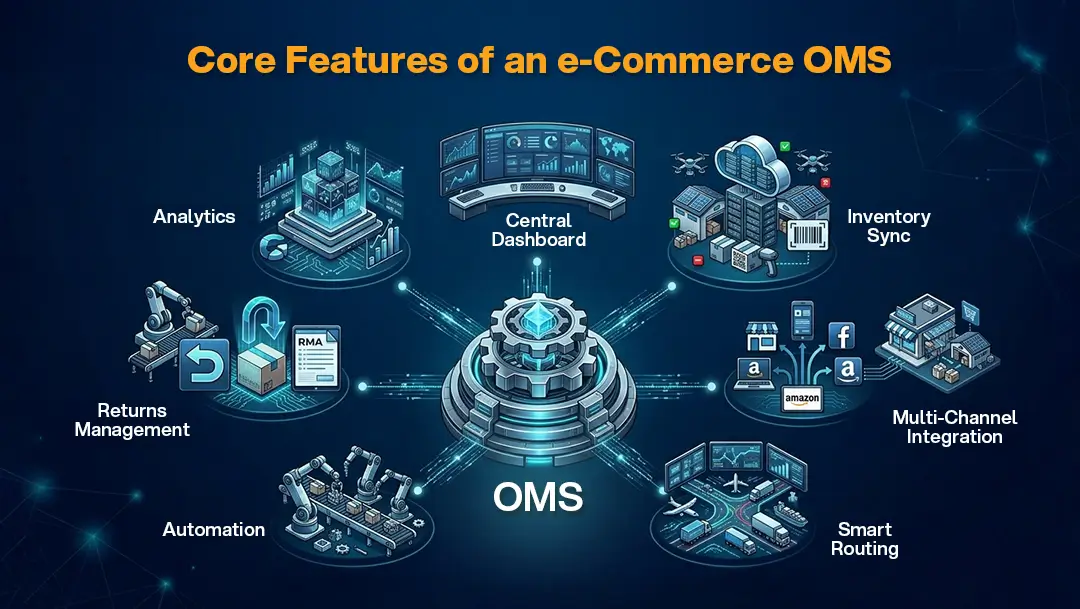
1. Centralised Order Dashboard
A single command centre providing live visibility across all orders, channels and fulfilment nodes. Operations teams should be able to view, filter, prioritise and act on orders from any channel without switching between systems.
2. Real-Time Inventory Synchronisation
Automatic, continuous inventory updates across every sales channel and warehouse node. This prevents overselling, reduces safety stock requirements, and enables confident fulfilment decisions. It is the operational core of effective e-Commerce order management.
3. Multi-Channel Order Integration
Native connectors to leading marketplaces (Amazon, Flipkart, Shopee, Lazada), webstore platforms (Shopify, Magento), and social commerce channels. A robust marketplace order management capability is now table stakes for any growing e-Commerce brand.
4. Smart Order Routing
Intelligent rules that automatically assign each order to the optimal fulfilment node, based on inventory availability, distance, delivery SLA, cost and business priority rules. Effective e-Commerce order fulfillment software makes smart routing automated and auditable.
5. Automated Workflow Management
Configurable rules for order acceptance, exception handling, hold logic, and escalation pathways. e-Commerce order automation eliminates manual decision-making from routine order flows, freeing operations teams to focus on exceptions and strategy.
6. Returns and Cancellation Management
End-to-end reverse logistics management, including automated returns authorisation, quality check workflows, inventory restocking and refund processing. A mature e-Commerce order management solution makes returns as operationally efficient as forward fulfilment.
7. Reporting and Analytics
Real-time and historical reporting on order performance, fulfilment accuracy, SLA compliance, return rates, and channel-level profitability. Data-driven order management enables continuous operational improvement and informs commercial strategy.
Key Benefits of Using an e-Commerce Order Management Software
The measurable business impact of implementing a robust order management system software extends across operations, customer experience and commercial performance. Here are the five most significant benefits:
| Benefit | Business Impact |
|---|---|
| Reduced Errors & Exceptions | Automated validation and routing eliminate manual errors that cause mispicks, wrong shipments, and customer complaints. |
| Faster Order Fulfilment | Smart routing and automated workflows reduce the time between order placement and dispatch, improving delivery speed and SLA compliance. |
| Improved Inventory Accuracy | Real-time sync across all channels prevents overselling, reduces stockouts, and improves sell-through rates. |
| Enhanced Customer Experience | Accurate tracking updates, proactive exception handling, and seamless returns build trust and drive repeat purchases. |
| Scalable Growth Infrastructure | A cloud-native OMS scales with order volume and channel complexity without requiring proportional headcount growth. |
Also explore: Why Every e-Commerce Brand Needs a Powerful OMS
Challenges Businesses Face Without an OMS
The decision not to invest in structured e-Commerce order management software carries real and measurable operational costs. Businesses operating without an OMS consistently face the following challenges:
- Overselling and stockouts
Without real-time inventory sync, orders are accepted for items that are out of stock, generating cancellations, customer refunds, and marketplace penalties. - Manual processing errors
Every manual handoff between order management, warehouse, and logistics teams introduces risk of inaccuracy - wrong addresses, incorrect items, missed SLAs. - Delayed fulfilment
Without automated routing and exception handling, order queues back up, particularly during high-volume periods - peak season, flash sales or promotional events. - Poor cross-channel visibility
Separate tools for each sales channel make it impossible to get a unified view of order status, inventory position, or fulfilment performance across the business.
Unsustainable returns management
Manual returns processing is slow, error-prone, and expensive. Without automation, return rates compound operational costs rapidly.
Marketplace non-compliance
Missed SLAs on platforms like Amazon or Flipkart trigger account-level penalties, reduced visibility, and in severe cases, seller suspension.
The cumulative impact of these challenges grows non-linearly with scale. A business processing 100 orders per day with manual tools will not simply face ten times the problems at 1,000 orders per day — it will face an operational crisis. This is the inflection point at which order management software for e-Commerce becomes a strategic necessity, not a nice-to-have.
Types of Order Management Systems
The order management system landscape offers several architectural models, each suited to different business contexts. Understanding the distinctions helps businesses make a more informed investment decision.
| OMS Type | Best Suited For | Key Consideration |
|---|---|---|
| Standalone OMS | e-Commerce-first brands needing dedicated order management | Best-in-class order capability; requires integration with other systems |
| ERP-Integrated OMS | Businesses with existing ERP infrastructure | Tight financial and inventory integration; often less flexible for commerce needs |
| Cloud-Based OMS | Scaling businesses needing flexibility and speed-to-deploy | Lower upfront cost, rapid deployment, scales with growth |
| Marketplace-Focused OMS | Brands selling primarily through third-party marketplaces | Deep marketplace connectors; real-time SLA and compliance management |
| Enterprise Commerce OMS | Large-scale multi-channel, multi-geography operations | Maximum configurability; requires more implementation investment |
For most growing e-Commerce brands in 2026, the right choice is a cloud-based, multi-channel OMS that offers deep marketplace order management integration alongside robust e-Commerce order fulfilment capabilities. The era of on-premise, single-channel OMS deployments is rapidly giving way to flexible, API-first platforms built for the complexity of modern commerce.
Also Explore: How Multi-Channel OMS Drives Growth
Latest OMS Trends for 2026
The order management system landscape is evolving rapidly. Understanding where the market is heading helps businesses evaluate platforms not just for their current needs but for their future requirements.
- AI-Driven Order Routing and Anomaly Detection
Artificial intelligence is being embedded natively into order management software to enable predictive routing, real-time anomaly detection, and automated exception handling. AI-powered OMS platforms can identify potential fulfilment failures before they occur - flagging delayed shipments, payment anomalies or inventory shortfalls for proactive intervention. - Automation-First Order Workflows
Leading e-Commerce order processing software platforms are moving toward fully automated order flows where manual intervention is the exception rather than the rule. From order acceptance to label generation, e-Commerce order automation is compressing fulfilment cycles and reducing operational headcount requirements at scale. - Unified Commerce and Real-Time Visibility
The convergence of online and offline channels is driving demand for online order management system platforms that provide a truly unified commerce view, including one dashboard for every order, every channel, every fulfilment node, in real time. - Hyperlocal Fulfilment
As same-day and next-day delivery expectations become standard, order fulfilment for ecommerce is increasingly moving closer to the customer. OMS platforms are evolving to support store-as-warehouse models, dark stores, and micro-fulfilment centres — with intelligent routing to always select the optimal node for speed and cost. - Marketplace-First Commerce
Marketplaces continue to grow as the dominant channel for e-Commerce in many markets. Marketplace order management capabilities, including SLA enforcement, marketplace-specific fulfilment rules, and real-time inventory reservation, are increasingly treated as core OMS functionality rather than optional integrations.
Also Explore: AI-Powered Order Management
Ordazzle Insight: The OMS platforms that will define commerce in 2027 and beyond are being built today with AI, automation and unified control at their core. Businesses that invest in best e-Commerce order management software now will compound their operational advantage while those on traditional tools will face increasingly expensive catch-up costs.
How to Choose the Right OMS: A Decision Framework
Selecting the right order management solution is one of the most consequential technology decisions a growing e-Commerce business can make. The following framework provides a structured basis for evaluation.
| Evaluation Criterion | What to Assess |
|---|---|
| Multi-Channel Integration Depth | Native connectors to all relevant marketplaces and webstore platforms; real-time sync, not batch updates |
| Scalability Architecture | Cloud-native, API-first design that handles order volume spikes without performance degradation |
| Marketplace Compliance | Built-in SLA monitoring, penalty avoidance logic and marketplace-specific fulfilment rule management |
| Automation Depth | Configurability of routing rules, acceptance logic, and exception handling without requiring custom development |
| Reporting & Analytics | Real-time operational dashboards plus strategic analytics for channel, product and fulfilment performance |
| Implementation Ease | Pre-built connectors, onboarding support, and documented APIs that reduce time-to-live |
| Support Flexibility | Responsiveness and expertise of the vendor’s support team, particularly during peak trading periods |
| Total Cost of Ownership | Platform subscription plus implementation, integration, and ongoing support costs, not just the licence fee |
Beyond the functional checklist, evaluate whether the vendor has deep operational experience in your specific markets and channels. A best e-Commerce order management system for a brand primarily selling through Southeast Asian marketplaces will have very different integration requirements from one focused on direct-to-consumer in MENA. Ensure your shortlisted platform has proven, production-grade connectors, not theoretical integration capabilities.
Questions to Ask Before Buying an Order Management System for e-Commerce in 2026
With a wide range of order management software options available, from lightweight tools to enterprise-grade platforms, choosing the right one can feel overwhelming. The good news is that the decision becomes clearer once you stop evaluating features in isolation and start asking: does this platform actually fit how my business operates and where it is heading?
Here are the factors that matter most when evaluating the best e-Commerce order management software for your business.
1. Does it connect to every channel you sell on?
This is the most practical starting point. An e-Commerce order management system that does not have native, real-time connectors to your active marketplaces, whether that is Amazon, Flipkart, Noon, Shopee, or your own webstore, will create more manual work, not less.
Look for pre-built, production-grade integrations, not theoretical API compatibility. The quality of marketplace order management connectivity is often what separates platforms that work in demos from those that perform in production.
2. Will it scale with your growth, not just handle your current volume?
Many businesses choose an online order management system based on today’s order volumes and find themselves re-platforming within 18 months. A cloud-native, API-first architecture is not just a technical preference, it is a commercial safeguard. It means your platform can handle order volume spikes during peak sales periods, absorb new channel additions and expand into new markets without requiring re-engineering from the ground up.
3. How much can you automate without writing custom code?
The depth of e-Commerce order automation varies significantly between platforms. The best e-Commerce order processing software lets your operations team configure routing rules, acceptance logic, SLA enforcement and exception handling through a no-code interface, without depending on a development team for every change.
If configuring a new routing rule requires a developer sprint, the platform is adding operational drag, not removing it.
4. Does it give you real-time visibility or just end-of-day reports?
Effective order management is more than a batch process. It is a live tracking system. Your team needs to see order status, inventory position and fulfilment exceptions in real time, not the next morning.
Evaluate whether the platform’s reporting is genuinely live or whether it is pulling from periodic data syncs. During high-volume periods, the difference between real-time and near-real-time visibility can mean the difference between catching a problem early and issuing customer refunds.
5. How does it handle returns and exceptions not just forward fulfilment?
Most platforms market their forward fulfilment capabilities. Fewer invest equally in reverse logistics.
For e-Commerce businesses with return rates above 15%, the efficiency of order fulfilment for e-Commerce that includes automated returns processing - QC checks, inventory restocking, refund triggers - is just as commercially important as outbound speed. Make sure your chosen order management solution treats reverse logistics as a first-class feature.
6. What does the vendor bring beyond the software?
Implementation quality, onboarding support and ongoing expertise matter as much as the platform itself. A vendor with deep experience in your specific markets and channels, who understands marketplace SLA structures, regional logistics dynamics, and the commercial realities of multi-channel e-Commerce, will help you extract significantly more value from the order management software for e-Commerce investment than one offering generic onboarding.
The right e-Commerce order management solution is not simply the one with the longest feature list, it is the one built for how you actually sell, where you sell, and the scale you are working toward.
How Ordazzle Helps Businesses Scale Order Management
Ordazzle is an enterprise-grade e-Commerce order management platform engineered for the operational complexity of multi-channel commerce. Built specifically for brands that sell across multiple marketplaces, webstores, and geographies, Ordazzle delivers the automation, intelligence, and scalability that growing e-Commerce operations demand.
- Multi-Channel Order Consolidation
Ordazzle consolidates all orders from every selling platform - marketplaces, webstores, and social commerce - into a single, real-time dashboard. Operations teams gain full visibility across every channel without the need to manage multiple logins or reconcile fragmented reports. This unified view is the foundation of effective marketplace order management at scale. - Intelligent Order Receiving and Acceptance Rules
Ordazzle's e-Commerce order processing software enables businesses to define granular acceptance rules, by delivery mode, payment type, order value, postal code and fulfilment logic. Orders are automatically validated, accepted, held or flagged for exception handling based on these configurable rules, eliminating manual review of every incoming order. - Smart Order Routing for Maximum Fulfilment Efficiency
Ordazzle's smart routing engine evaluates real-time factors, such as inventory availability, warehouse proximity, SLA deadlines, carrier capacity, and cost parameters, to assign each order to the optimal fulfilment node. The result is faster order fulfilment for e-Commerce, lower shipping costs, and consistent SLA compliance across every channel. - End-to-End Returns and Reverse Logistics
Ordazzle automates the complete reverse logistics workflow, from return authorisation and quality inspection through to inventory restocking and refund processing. Detailed RTO and CIR reporting gives operations leaders the data to identify return root causes and implement structural improvements, reducing return rates over time. - AI-Powered Anomaly Detection
Ordazzle's embedded AI layer monitors complex order attributes across channels, payments, inventory, and logistics in real time, flagging anomalies before they become fulfilment failures. This proactive intelligence is particularly valuable during high-volume trading periods where manual oversight cannot scale. - Seamless API and Marketplace Integrations
Ordazzle's e-Commerce order management software platform connects natively to leading marketplaces across Asia-Pacific and MENA, including Amazon, Flipkart, Noon, Shopee, Lazada, and others, as well as major webstore and ERP platforms. Pre-built, production-grade connectors reduce integration complexity and accelerate time-to-live. - Flexible, Cloud-Native Architecture
Built cloud-native from the ground up, Ordazzle scales with business growth without requiring platform migration or significant reengineering. Whether processing thousands or millions of orders per month, the e-Commerce order fulfillment software infrastructure maintains performance, reliability, and security at every scale point.
When Should You Invest in an OMS?
Timing the investment in a structured order management solution is a strategic decision. The following triggers indicate that a business has reached the point where the cost of operating without a structured OMS exceeds the cost of implementing one.
| Trigger Signal | What It Means for Your OMS Strategy |
|---|---|
| Order volumes growing beyond manual capacity | If order management is consuming disproportionate team bandwidth, the ROI on an OMS is already positive. |
| Selling across 2+ marketplaces or channels | Multi-channel complexity without centralised management compounds errors and SLA breaches rapidly. |
| Recurring inventory mismatches or oversells | Real-time inventory sync is the core function of an OMS — these incidents indicate the need is urgent. |
| Increasing return rates without root cause visibility | Without returns analytics, return rates compound. An OMS provides the data to drive structural improvement. |
| Marketplace SLA penalties or account warnings | These are direct commercial signals that manual order management has reached its limit. |
| Scaling to new markets or channels | Expanding without centralised order infrastructure creates technical debt that becomes exponentially harder to unwind. |
The common thread across all these signals is that the cost of delay increases over time. Businesses that implement e-Commerce order management infrastructure before hitting an operational crisis build a more robust, scalable foundation, and do so at lower cost and risk than those forced into urgent remediation.
Frequently Asked Questions (FAQs)
What is the difference between an OMS and an ERP?
An ERP (Enterprise Resource Planning) system manages broad business functions including finance, HR, and procurement. An e-Commerce order management system is focused specifically on the order lifecycle — from purchase to fulfilment and returns. While both systems may manage inventory data, an OMS provides commerce-specific functionality (channel integration, smart routing, SLA management) that ERP platforms typically do not offer natively.
Is an OMS suitable for small e-Commerce businesses?
Cloud-based order management software for small business is available at a range of price points, making OMS accessible to businesses of all sizes. Smaller brands should consider investing in structured order management early, before order volumes create operational crises, as migrating from manual tools to an OMS during a period of rapid growth is significantly more disruptive than building on the right foundation from the outset.
How long does OMS implementation typically take?
Implementation timelines vary by platform complexity and integration requirements. A cloud-based e-Commerce order management system with pre-built marketplace connectors can typically be deployed within 4–8 weeks for standard configurations. More complex deployments involving custom integrations, multi-warehouse setups, or enterprise-scale data migration may require 2–4 months. Ordazzle's implementation methodology is designed to minimise time-to-live while ensuring configuration accuracy.
What marketplace integrations should an OMS support?
For e-Commerce brands in Asia-Pacific and MENA, essential marketplace order management integrations include Amazon, Flipkart, Noon, Shopee, Lazada, and regional platforms specific to target markets. The OMS should offer native, real-time connectors, not batch integrations, and should enforce marketplace-specific SLA and fulfilment rules automatically.
What is OMS in e-Commerce?
In e-Commerce, OMS refers to an Order Management System. It is a centralised platform that automates and manages the end-to-end order journey across all sales channels. It integrates with marketplaces, webstores, payment gateways, and logistics providers to ensure every order is fulfilled accurately, on time, and cost-effectively.
How does an OMS improve customer experience?
An order management solution improves customer experience by ensuring accurate stock availability at checkout, faster fulfilment and dispatch, real-time tracking updates, and seamless returns processing. Each of these touchpoints directly impacts customer satisfaction and repeat purchase intent, making the OMS a customer experience investment as much as an operational one.
Ready to Build Scalable Order Management for Your e-Commerce Business?
The e-Commerce operations landscape of 2026 rewards businesses that have invested in the right infrastructure, and increasingly penalises those that have not. The gap between brands running structured, automated order management software and those managing orders manually or through fragmented tools widens with every quarter of growth.
Ordazzle is purpose-built for exactly this challenge. With deep marketplace order management expertise, real-time automation, AI-powered intelligence, and flexible cloud architecture, Ordazzle provides the order management solution that growing e-Commerce brands need to scale confidently across channels, markets, and order volumes.